Department of Urology, Charité-Universitätsmedizin Berlin, Berlin, Germany.
Department of Medicine, Clinical Division of Oncology, Comprehensive Cancer Centre, Medical University of Vienna, Vienna, Austria.
Prostate Cancer Prostatic Dis. 2018 Nov;21(4):461-472. doi: 10.1038/s41391-018-0060-y. Epub 2018 Jul 9.
Patients with prostate cancer are at risk of impaired bone health. Prostate cancer has a propensity to metastasize to bone, after which patients are at risk of skeletal-related events (SREs). These complications are associated with increased mortality, substantial pain, and reduced quality of life. Patients are also at risk of bone loss due to androgen deprivation therapy (ADT), which can be compounded in elderly patients with reduced bone density. It is essential, therefore, that aspects of bone health and therapies able to prevent the occurrence of SREs are considered throughout the clinical course of prostate cancer.
We reviewed the literature regarding the molecular mechanisms underpinning bone lesion formation, the modes of action of therapies that prevent SREs, and the efficacy and safety of these therapies in patients with hormone-sensitive or castration-resistant prostate cancer (CRPC).
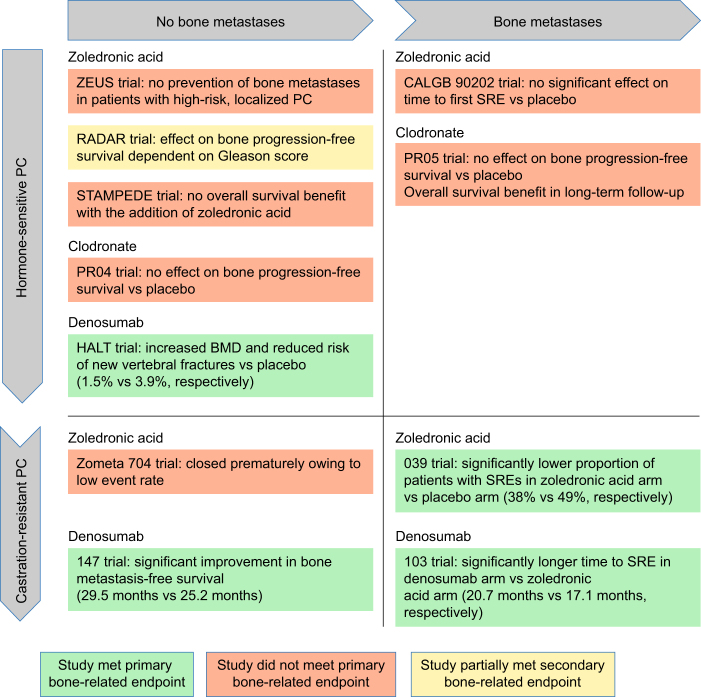
Therapies such as denosumab (a RANKL inhibitor) and zoledronic acid (a bisphosphonate) were indicated for prevention of SREs. Radium-223 dichloride also has proven efficacy in delaying symptomatic SREs, as well as in improving overall survival through effects on bone metastases. Before development of bone metastases, low-dose denosumab may also be used for treatment of ADT-associated bone loss. Denosumab may also have the potential to delay bone metastases development in patients with CRPC, although this is not currently an approved indication. The safety profile of therapies to prevent SREs should be considered. This review consolidates the available evidence on use of denosumab and bisphosphonates in prostate cancer, differentiated by hormone-sensitive and castration-resistant disease.
There is convincing evidence to support the use of denosumab and bisphosphonates to maintain bone health in patients with prostate cancer. Clinicians should be mindful of the adverse event risk profile of these therapies.
前列腺癌患者存在骨骼健康受损的风险。前列腺癌有向骨骼转移的倾向,之后患者有发生骨骼相关事件(SREs)的风险。这些并发症与死亡率增加、严重疼痛和生活质量降低有关。由于去势治疗(ADT),患者也有发生骨丢失的风险,而在骨密度降低的老年患者中,这种风险可能会增加。因此,在前列腺癌的整个临床过程中,必须考虑骨骼健康的各个方面以及能够预防 SREs 发生的治疗方法。
我们回顾了关于支持骨病变形成的分子机制、预防 SREs 的治疗方法的作用方式以及这些治疗方法在激素敏感或去势抵抗性前列腺癌(CRPC)患者中的疗效和安全性的文献。
例如地舒单抗(RANKL 抑制剂)和唑来膦酸(双膦酸盐)等治疗方法被用于预防 SREs。镭-223 二氯化物也已被证明可有效延迟有症状的 SREs,并通过对骨转移的影响改善总生存率。在发生骨转移之前,低剂量地舒单抗也可用于治疗 ADT 相关的骨丢失。地舒单抗也有可能延迟 CRPC 患者的骨转移发展,尽管这不是目前的批准适应症。预防 SREs 的治疗方法的安全性概况也应加以考虑。这篇综述综合了关于地舒单抗和双膦酸盐在前列腺癌中的应用的现有证据,根据激素敏感和去势抵抗性疾病进行了区分。
有令人信服的证据支持使用地舒单抗和双膦酸盐来维持前列腺癌患者的骨骼健康。临床医生应注意这些疗法的不良事件风险概况。