Department of Medical Imaging, Guangdong Second Provincial General Hospital, Guangzhou, People's Republic of China.
Department of Renal Transplantation, Guangdong Second Provincial General Hospital, Guangzhou, People's Republic of China.
Neuroimage Clin. 2018 Jun 5;19:775-781. doi: 10.1016/j.nicl.2018.06.003. eCollection 2018.
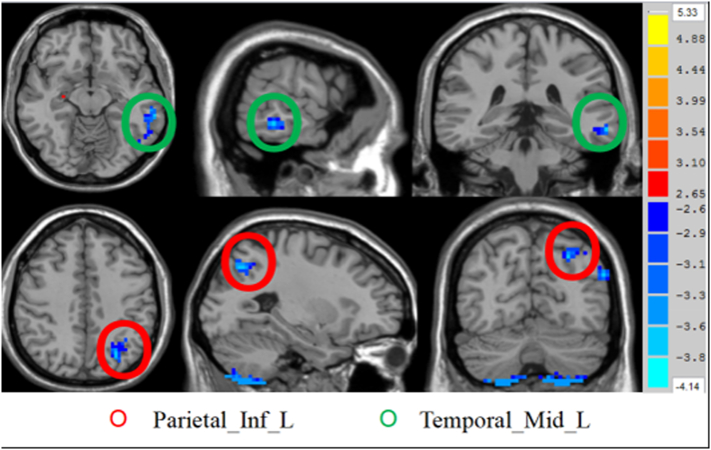
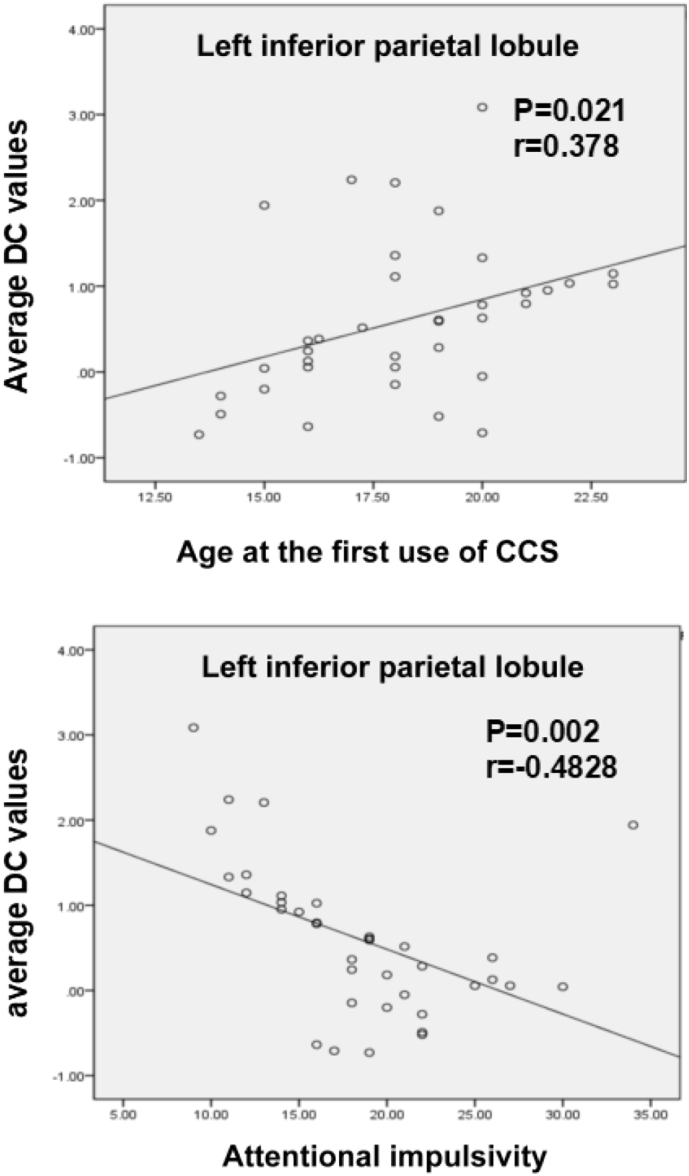
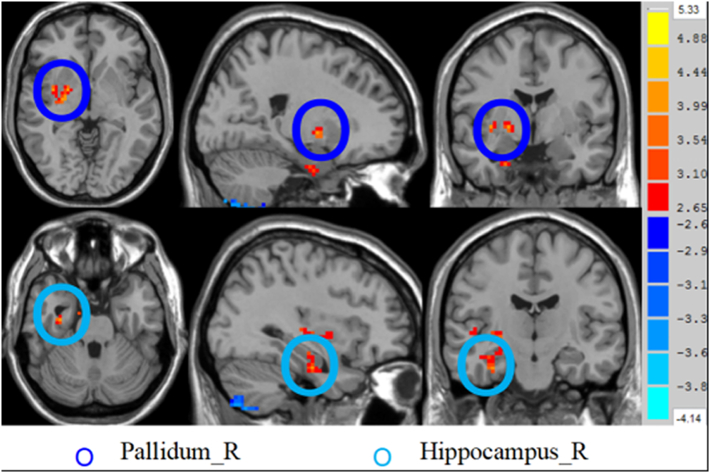
Codeine-containing cough syrups (CCS) have become one of the most popular drugs of abuse in young population worldwide. However, the neurobiological mechanisms underlying CCS-dependence are yet ill-defined. Therefore, understanding the brain abnormalities in chronic users of CCS is crucial for developing effective interventions. The present study depicted the intrinsic dysconnectivity pattern of whole-brain functional networks at the voxel level in chronic users of CCS. In addition, the degree centrality (DC) changes were correlated to the Barratt Impulsiveness Scale (BIS-11) total score, dose, duration of CCS use, and the age at first use of cough syrups. The current study included 38 chronic CCS users and 34 matched control subjects. All patients were evaluated using the BIS-11. Next, resting-state functional magnetic resonance imaging (rs-fMRI) datasets were acquired from these CCS users and controls. Whole-brain connectivity was analyzed using a graph theory approach: degree centrality (DC). CCS-dependent individuals exhibited low DC values in the left inferior parietal lobule and the left middle temporal gyrus, while high DC values were noted in the right pallidum and the right hippocampus ( < 0.01, AlphaSim corrected). Also, significant correlations were established between average DC value in the left inferior parietal lobule and attentional impulsivity scores and the age at first CCS use. The rs-fMRI study suggested that the abnormal intrinsic dysconnectivity pattern of whole-brain functional networks may provide an insight into the neural substrates of abnormalities in the cognitive control circuit, the reward circuit, and the learning and memory circuit in CCS-dependent individuals.
含可待因的咳嗽糖浆(CCS)已成为全球年轻人中最受欢迎的滥用药物之一。然而,CCS 依赖的神经生物学机制仍未得到明确界定。因此,了解 CCS 慢性使用者的大脑异常对于开发有效的干预措施至关重要。本研究在体素水平描绘了 CCS 慢性使用者全脑功能网络的内在连接异常模式。此外,还将大脑区域的度中心性(degree centrality,DC)变化与巴瑞特冲动量表(Barratt Impulsiveness Scale,BIS-11)总分、CCS 使用剂量、使用时间和首次使用咳嗽糖浆的年龄进行相关性分析。该研究纳入了 38 名 CCS 慢性使用者和 34 名匹配的对照受试者。所有患者均接受 BIS-11 评估。随后,从这些 CCS 使用者和对照组中获取静息态功能磁共振成像(resting-state functional magnetic resonance imaging,rs-fMRI)数据集。采用图论方法分析全脑连接:度中心性(degree centrality,DC)。CCS 依赖者的左侧顶下小叶和左侧颞中回的 DC 值较低,而右侧苍白球和右侧海马的 DC 值较高(<0.01,经 AlphaSim 校正)。此外,左顶下小叶的平均 DC 值与注意力冲动性评分和首次使用 CCS 的年龄之间存在显著相关性。rs-fMRI 研究表明,全脑功能网络的异常内在连接异常模式可能为理解认知控制回路、奖励回路和学习记忆回路异常提供神经基础。