Watanabe Koichiro, Ikuno Yasuaki, Kakeya Yumi, Kito Hirotaka, Matsubara Aoi, Kaneda Mizuki, Katsuyama Yu, Naka-Kaneda Hayato
Department of Anatomy, Shiga University of Medical Science, Seta Tsukinowa-cho, Otsu, Shiga 520-2192 Japan.
Inflamm Regen. 2018 Jun 6;38:9. doi: 10.1186/s41232-018-0066-9. eCollection 2018.
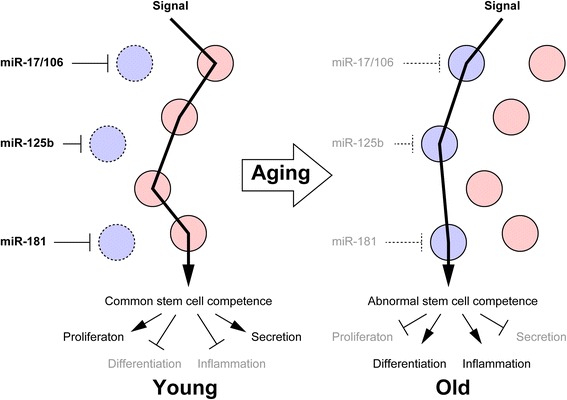
Restoration of tissue homeostasis by controlling stem cell aging is a promising therapeutic approach for geriatric disorders. The molecular mechanisms underlying age-related dysfunctions of specific types of adult tissue stem cells (TSCs) have been studied, and various microRNAs were recently reported to be involved. However, the central roles of microRNAs in stem cell aging remain unclear. Interest in this area was sparked by murine heterochronic parabiosis experiments, which demonstrated that systemic factors can restore the functions of TSCs. Age-related changes in secretion profiles, termed the senescence-associated secretory phenotype, have attracted attention, and several pro- and anti-aging factors have been identified. On the other hand, many microRNAs are linked with the age-dependent dysregulations of various physiological processes, including "stem cell aging." This review summarizes microRNAs that appear to play common roles in stem cell aging.
通过控制干细胞衰老来恢复组织稳态是治疗老年疾病的一种有前景的治疗方法。特定类型的成体组织干细胞(TSCs)与年龄相关功能障碍的分子机制已得到研究,最近有报道称多种微小RNA参与其中。然而,微小RNA在干细胞衰老中的核心作用仍不清楚。小鼠异时联体共生实验引发了对这一领域的兴趣,该实验表明全身因素可以恢复TSCs的功能。与衰老相关的分泌谱变化,即衰老相关分泌表型,已引起关注,并且已经鉴定出几种促衰老和抗衰老因子。另一方面,许多微小RNA与包括“干细胞衰老”在内的各种生理过程的年龄依赖性失调有关。本综述总结了似乎在干细胞衰老中起共同作用的微小RNA。