Somasekhar M B, Mertz J E
J Virol. 1985 Dec;56(3):1002-13. doi: 10.1128/JVI.56.3.1002-1013.1985.
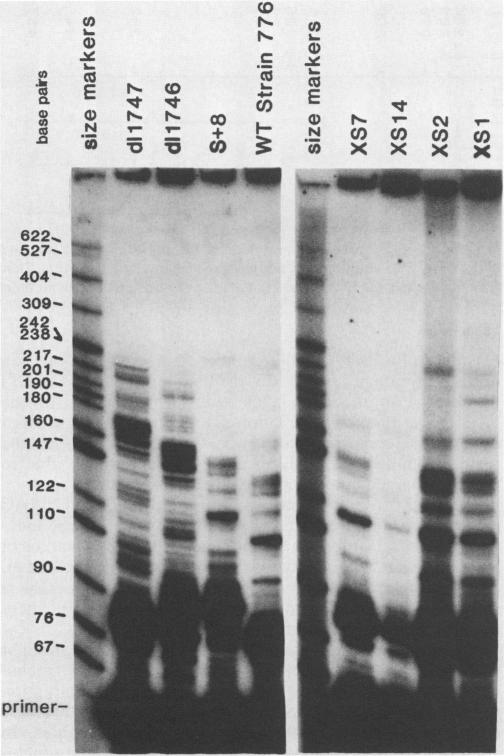
The 5' ends of the simian virus 40 (SV40) late RNAs are heterogeneous in location, spanning a 300-nucleotide region from residues 28 to 325. To examine whether upstream or downstream measuring functions analogous to the TATA box play roles in positioning the 5' ends of these RNAs, we determined by S1 and primer extension mapping the locations of the 5' ends of the late viral RNAs made in monkey cells infected with: (i) three wild-type strains of SV40 that contain tandem duplications of the enhancer region that are 64, 85, and 91, rather than 72, base pairs in length; (ii) four viable mutants that contain alterations in the 21-base-pair tandem repeats; and (iii) four viable mutants that possess small deletions or insertions at or near the major cap site at residue 325. Most of the 5' ends of the RNAs were identical in location to those seen with wild-type strain 776. The only exceptions were the absence of RNAs whose 5' ends mapped to within three bases upstream or downstream of a sequence alteration. In addition, the sequences within residues 251 to 277 that function as transcriptional initiation sites in wild-type strain 776 also did so in their second locations in the wild-type strains in which these sequences are duplicated. Differences were noted in the relative abundances of the numerous 5' ends of the late RNAs, even among the wild-type strains. These findings indicate that many (and likely all) of the approximately two dozen locations of 5' ends of SV40 late RNAs are each determined largely by sequences within their immediate vicinity. However, sequences somewhat removed from these transcriptional initiation sites may modulate the efficiencies with which they are utilized.
猿猴病毒40(SV40)晚期RNA的5′端在位置上具有异质性,跨越从第28位到第325位残基的300个核苷酸区域。为了研究类似于TATA盒的上游或下游测量功能是否在定位这些RNA的5′端中发挥作用,我们通过S1和引物延伸图谱法确定了在感染以下病毒的猴细胞中产生的晚期病毒RNA的5′端位置:(i)三种野生型SV40菌株,其增强子区域包含串联重复,长度分别为64、85和91个碱基对,而非72个碱基对;(ii)四种存活突变体,其21个碱基对的串联重复序列发生了改变;(iii)四种存活突变体,在第325位残基的主要帽位点或其附近有小的缺失或插入。这些RNA的大多数5′端在位置上与野生型776菌株的相同。唯一的例外是不存在5′端定位于序列改变上游或下游三个碱基范围内的RNA。此外,在野生型776菌株中作为转录起始位点的第251至277位残基内的序列,在这些序列被复制的野生型菌株的第二个位置也起到了同样的作用。即使在野生型菌株中,也注意到晚期RNA众多5′端的相对丰度存在差异。这些发现表明,SV40晚期RNA约二十几个5′端位置中的许多(可能全部)在很大程度上各自由其紧邻区域内的序列决定。然而,与这些转录起始位点有一定距离的序列可能会调节它们被利用的效率。