Department of Thoracic Surgery, The Third Affiliated Hospital of Kunming Medical University, Kunming, China.
Department of Palliative Medicine, The Third Affiliated Hospital of Kunming Medical University, Kunming, China.
PLoS One. 2018 Jul 11;13(7):e0200452. doi: 10.1371/journal.pone.0200452. eCollection 2018.
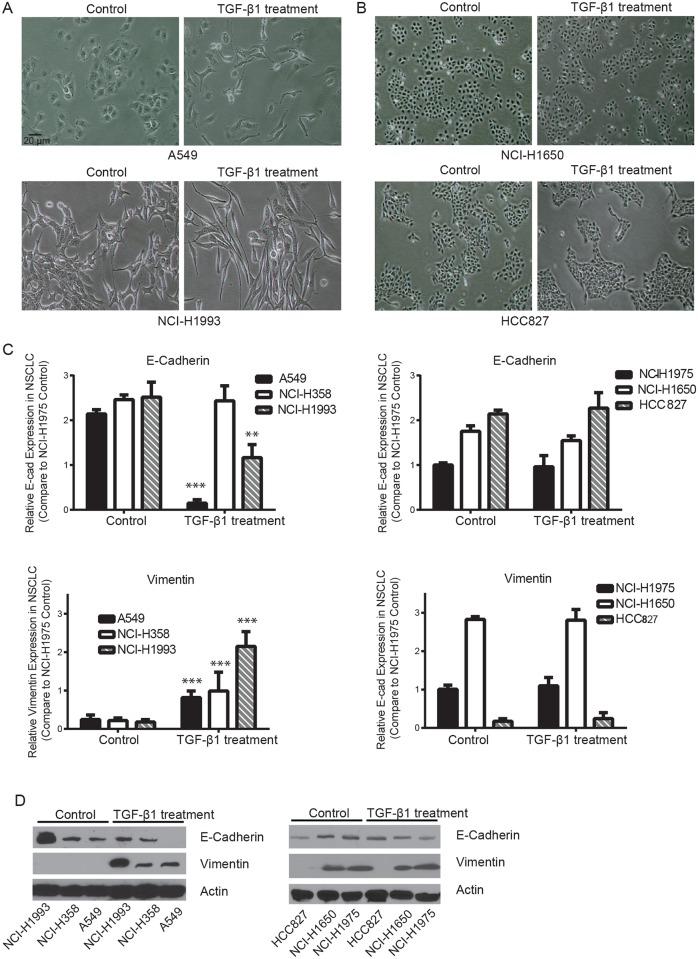
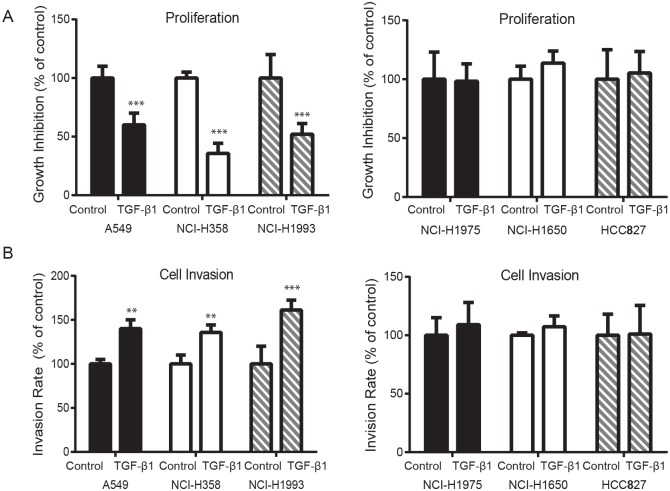
In the tumor progression, transforming growth factor β1 (TGFβ1) plays a critical role in tumorigenesis as well as metastasis. It is known that high plasma level of TGFβ1 in patients with advanced non-small cell lung cancer (NSCLC) is correlated with poor prognostics. In addition, the generation of cancer stem-like cells is associated with metastasis, drug resistance, and tumor recurrence, which also lead to poor outcomes in NSCLC patients. However, it remains unclear how TGFβ1 promotes NSCLC cells to acquire stem-like properties and accelerate tumor metastasis. In our study, we found that short term TGFβ1 treatment resulted in a significant epithelial-mesenchymal transition (EMT) morphological change in TGFβ1-sensitive NSCLC cells but not in insensitive cells. Western blotting confirmed increased Vimentin and reduced E-Cadherin protein expression after TGFβ1 treatment in A549, NCI-H1993, and NCI-H358 cells. TGFβ1 incubation dramatically decreased in vitro cell proliferation and increased cell invasion in TGFβ1-sensitive NSCLC cells but not in NCI-H1975, NCI-H1650, and HCC827 cells. Moreover, TGFβ1 was able to enhance the mRNA expression of Oct4, Nanog and Sox2 and drastically increased anchorage-independent colony formation in TGFβ1-sensitive NSCLC cells, suggesting the acquisition of cancer stem-like properties. Interestingly, we found that vascular endothelial growth factor receptor 3 (VEGFR3) mRNA expression was significantly elevated in TGFβ1-sensitive NSCLC cells compared to insensitive cells. And TGFβ1 was capable of inducing VEGF-C gene expression. Pharmacological blocking TGFβ type I receptor kinase (ALK5) significantly inhibited TGFβ1-induced VEGF-C expression. Silencing of ALK5 by siRNA also dramatically reduced TGFβ1-induced VEGF-C expression in TGFβ1-sensitive NSCLC cells. Therefore, TGFβ1 contributes for NSCLC metastasis through promoting EMT, generation of high invasive cancer cells with stem-like properties, and increasing VEGF-C expression. Blocking TGFβ pathway is a potential therapeutic target in human non-small cell lung cancer.
在肿瘤进展过程中,转化生长因子 β1(TGFβ1)在肿瘤发生和转移中起着关键作用。已知晚期非小细胞肺癌(NSCLC)患者的血浆 TGFβ1 水平升高与预后不良相关。此外,癌症干细胞样细胞的产生与转移、耐药和肿瘤复发相关,这也导致 NSCLC 患者的预后不良。然而,目前尚不清楚 TGFβ1 如何促进 NSCLC 细胞获得干细胞样特性并加速肿瘤转移。在我们的研究中,我们发现短期 TGFβ1 处理导致 TGFβ1 敏感的 NSCLC 细胞发生显著的上皮-间充质转化(EMT)形态变化,但在不敏感的细胞中则没有。Western blot 证实 TGFβ1 处理后 A549、NCI-H1993 和 NCI-H358 细胞中 Vimentin 增加,E-Cadherin 蛋白表达减少。TGFβ1 孵育可显著降低 TGFβ1 敏感的 NSCLC 细胞的体外细胞增殖,并增加细胞侵袭,但对 NCI-H1975、NCI-H1650 和 HCC827 细胞则没有。此外,TGFβ1 能够增强 Oct4、Nanog 和 Sox2 的 mRNA 表达,并在 TGFβ1 敏感的 NSCLC 细胞中大幅增加锚定非依赖性集落形成,提示获得癌症干细胞样特性。有趣的是,我们发现与不敏感细胞相比,TGFβ1 敏感的 NSCLC 细胞中血管内皮生长因子受体 3(VEGFR3)mRNA 表达显著升高。并且 TGFβ1 能够诱导 VEGF-C 基因表达。药理学阻断 TGFβ Ⅰ型受体激酶(ALK5)可显著抑制 TGFβ1 诱导的 VEGF-C 表达。siRNA 沉默 ALK5 也可显著降低 TGFβ1 敏感的 NSCLC 细胞中 TGFβ1 诱导的 VEGF-C 表达。因此,TGFβ1 通过促进 EMT、产生具有干细胞样特性的高侵袭性癌细胞以及增加 VEGF-C 表达来促进 NSCLC 转移。阻断 TGFβ 途径是人类非小细胞肺癌的一个潜在治疗靶点。