Liu Liu, Ruiz David A, Dahcheh Fatme, Bertrand Guy, Suter Riccardo, Tondreau Aaron M, Grützmacher Hansjörg
UCSD-CNRS Joint Research Chemistry Laboratory (UMI 3555) , Department of Chemistry and Biochemistry , University of California San Diego , La Jolla , CA 92093-0343 , USA . Email:
Key Laboratory for Chemical Biology of Fujian Province , College of Chemistry and Chemical Engineering , Department of Chemistry , Xiamen University , Xiamen , 361005 , China.
Chem Sci. 2016 Mar 1;7(3):2335-2341. doi: 10.1039/c5sc04504e. Epub 2016 Jan 4.
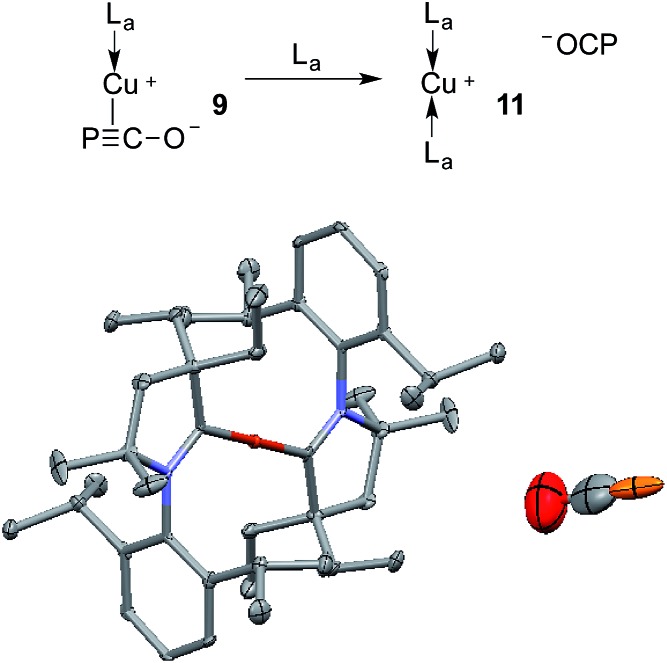
Sodium phosphaethynolate reacts with [MCl(PDI)] (M = Co, Ir; PDI = pyridinediimine) to give metallaphosphaketenes, which in the case of iridium rearranges into a dimetalladiphosphene, CO migration from phosphorus to the metal. Two different bonding modes of the PCO anion to CAAC-coinage metal complexes [CAAC: cyclic (alkyl)(amino)(carbene)] are reported, one featuring a strong Au-P bond and the other an η coordination to copper. The gold complex appears to be mostly unreactive whereas the copper complex readily reacts with various organic substrates. A completely free PCO anion was structurally characterized as the [Cu(L)] (OCP) salt. It results from the simple displacement of the PCO unit of the cationic (CAAC)Cu(PCO) complex by a second equivalent of CAAC.
磷乙炔酸钠与[MCl(PDI)](M = Co,Ir;PDI = 吡啶二亚胺)反应生成金属磷杂环丁二烯,在铱的情况下会重排为双金属二磷烯,同时发生CO从磷向金属的迁移。报道了PCO阴离子与CAAC-贵金属配合物[CAAC:环状(烷基)(氨基)(卡宾)]的两种不同键合模式,一种具有强Au-P键,另一种是与铜的η配位。金配合物似乎大多无反应性,而铜配合物则容易与各种有机底物反应。一个完全游离的PCO阴离子被结构表征为Cu(L)盐。它是由第二个当量的CAAC简单取代阳离子(CAAC)Cu(PCO)配合物中的PCO单元而产生的。