Yanagisawa Takufumi, Fukuma Ryohei, Seymour Ben, Hosomi Koichi, Kishima Haruhiko, Shimizu Takeshi, Yokoi Hiroshi, Hirata Masayuki, Yoshimine Toshiki, Kamitani Yukiyasu, Saitoh Youichi
Department of Neurosurgery, Osaka University Graduate School of Medicine.
Osaka University Institute for Advanced Co-Creation Studies.
Neurol Med Chir (Tokyo). 2018 Aug 15;58(8):327-333. doi: 10.2176/nmc.st.2018-0099. Epub 2018 Jul 12.
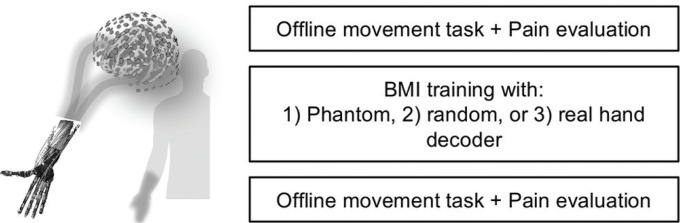
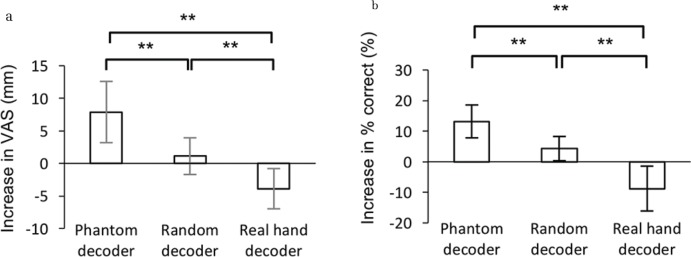
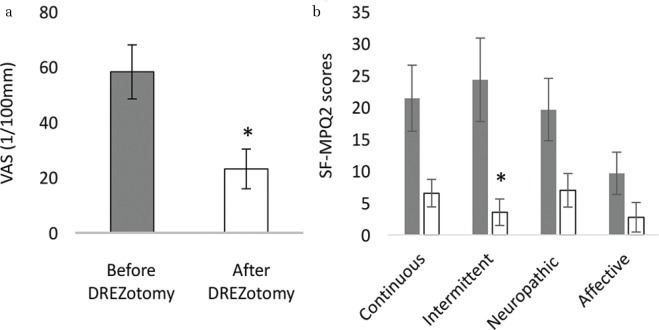
A brachial plexus root avulsion (BPRA) causes intractable pain in the insensible affected hands. Such pain is partly due to phantom limb pain, which is neuropathic pain occurring after the amputation of a limb and partial or complete deafferentation. Previous studies suggested that the pain was attributable to maladaptive plasticity of the sensorimotor cortex. However, there is little evidence to demonstrate the causal links between the pain and the cortical representation, and how much cortical factors affect the pain. Here, we applied lesioning of the dorsal root entry zone (DREZotomy) and training with a brain-machine interface (BMI) based on real-time magnetoencephalography signals to reconstruct affected hand movements with a robotic hand. The DREZotomy successfully reduced the shooting pain after BPRA, but a part of the pain remained. The BMI training successfully induced some plastic changes in the sensorimotor representation of the phantom hand movements and helped control the remaining pain. When the patient tried to control the robotic hand by moving their phantom hand through association with the representation of the intact hand, this especially decreased the pain while decreasing the classification accuracy of the phantom hand movements. These results strongly suggested that pain after the BPRA was partly attributable to cortical representation of phantom hand movements and that the BMI training controlled the pain by inducing appropriate cortical reorganization. For the treatment of chronic pain, we need to know how to modulate the cortical representation by novel methods.
臂丛神经根撕脱伤(BPRA)会导致失去感觉的患手出现顽固性疼痛。这种疼痛部分归因于幻肢痛,幻肢痛是肢体截肢及部分或完全传入神经阻滞之后发生的神经性疼痛。先前的研究表明,这种疼痛归因于感觉运动皮层的适应性不良可塑性。然而,几乎没有证据能证明疼痛与皮层表征之间的因果关系,以及皮层因素对疼痛的影响程度。在此,我们采用了背根入髓区切开术(DREZotomy),并基于实时脑磁图信号,通过脑机接口(BMI)进行训练,以利用机器人手重建患手的运动。DREZotomy成功减轻了BPRA后的刺痛,但仍有部分疼痛存在。BMI训练成功地在幻手运动的感觉运动表征中诱发了一些可塑性变化,并有助于控制剩余的疼痛。当患者试图通过与健手的表征相关联来移动幻手以控制机器人手时,这尤其能减轻疼痛,同时降低幻手运动的分类准确率。这些结果有力地表明,BPRA后的疼痛部分归因于幻手运动的皮层表征,且BMI训练通过诱发适当的皮层重组来控制疼痛。对于慢性疼痛的治疗,我们需要知道如何通过新方法调节皮层表征。