Shepherd Andrew J, Cloud Megan E, Cao Yu-Qing, Mohapatra Durga P
Washington University Pain Center, Washington University School of Medicine in St. Louis, St. Louis, MO, United States.
Department of Anesthesiology, Washington University School of Medicine in St. Louis, St. Louis, MO, United States.
Front Behav Neurosci. 2018 Jun 28;12:124. doi: 10.3389/fnbeh.2018.00124. eCollection 2018.
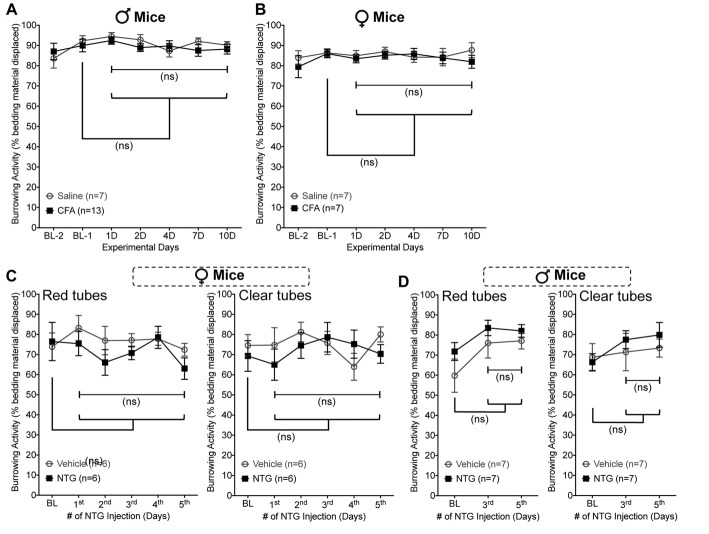
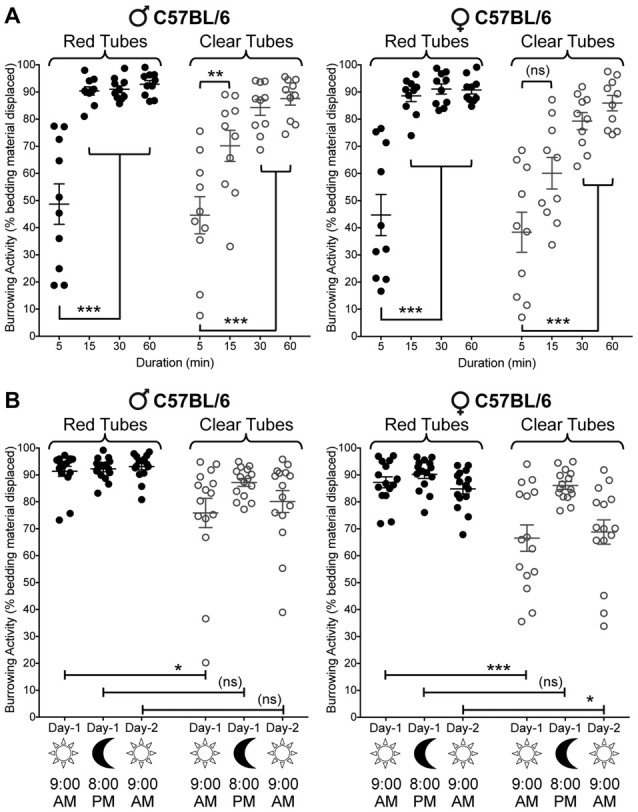
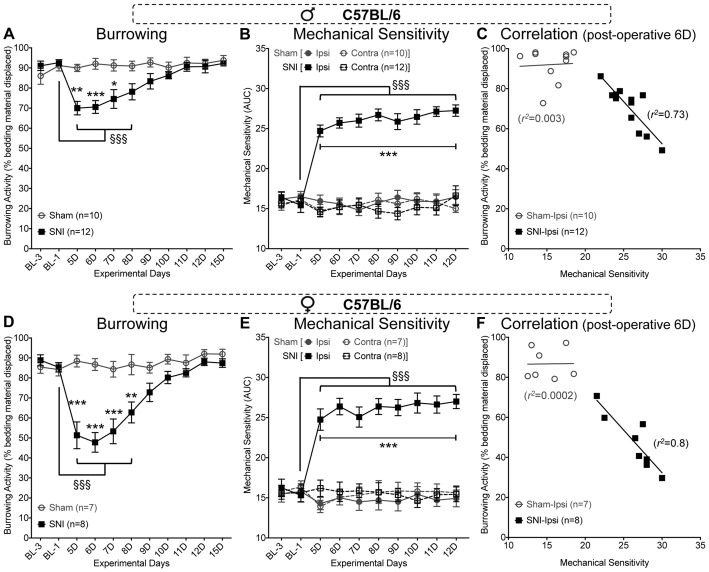
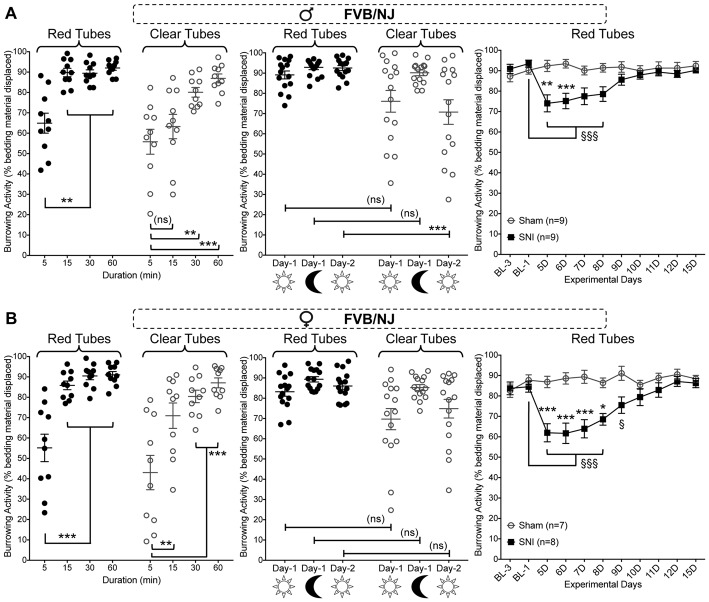
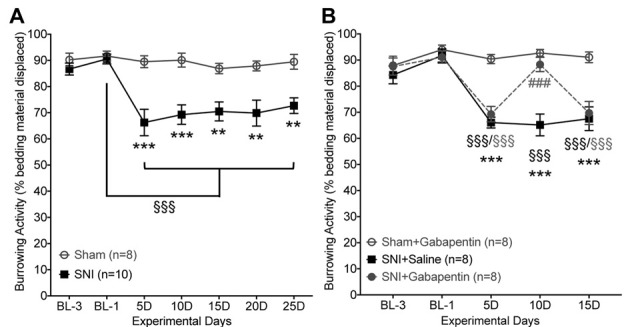
Burrowing, or the removal of material from an enclosed tube, is emerging as a prominent means of testing changes in a voluntary behavior in rodent models of various pain states. Here, we report no significant differences between male and female mice in terms of burrowing performance, in a substantially shorter time frame than previous reports. We found that the color of the burrow tube affects the variability of burrowing performance when tested in a lit room, suggesting that light aversion is at least a partial driver of this behavior. Spared nerve injury (SNI; as a model of neuropathy) impairs burrowing performance and correlates with enhanced mechanical sensitivity as assessed by von Frey filaments, as well as being pharmacologically reversed by an analgesic, gabapentin. Loss of the SNI-induced burrowing deficit was observed with daily testing post-surgery, but not when the testing interval was increased to 5 days, suggesting a confounding effect of daily repeat testing in this paradigm. Intraplantar complete Freund's adjuvant (as a model of inflammatory pain) and systemic nitroglycerin (as a model of migraine-like symptoms) administration did not induce any burrowing deficit, indicating that assessment of burrowing behavior may not be universally suitable for the detection of behavioral changes across all rodent pain models.
挖掘行为,即从封闭管道中移除材料,正成为在各种疼痛状态的啮齿动物模型中测试自愿行为变化的一种重要方法。在此,我们报告在比之前报告短得多的时间范围内,雄性和雌性小鼠在挖掘行为表现方面没有显著差异。我们发现,在有光照的房间进行测试时,挖掘管道的颜色会影响挖掘行为表现的变异性,这表明对光的厌恶至少是这种行为的部分驱动因素。保留神经损伤(SNI;作为神经病变模型)会损害挖掘行为表现,并且与通过von Frey细丝评估的机械敏感性增强相关,同时还可被镇痛药加巴喷丁药理逆转。术后每日测试可观察到SNI诱导的挖掘缺陷消失,但当测试间隔延长至5天时则未观察到,这表明在该范式中每日重复测试存在混杂效应。足底注射完全弗氏佐剂(作为炎性疼痛模型)和全身给予硝酸甘油(作为偏头痛样症状模型)并未诱导任何挖掘缺陷,这表明挖掘行为评估可能并非普遍适用于检测所有啮齿动物疼痛模型中的行为变化。