Centers for Disease Control and Prevention, 1600 Clifton Road NE, MS-E04, Atlanta, GA, 30333, USA.
The Aurum Institute, Johannesburg, Gauteng Province, South Africa.
BMC Public Health. 2018 Jul 13;18(1):868. doi: 10.1186/s12889-018-5729-6.
South Africa introduced medical male circumcision (MMC) to reduce HIV incidence. Mathematical modeling suggested that targeting MMC services to men aged 20-34 years could provide the most immediate impact on HIV incidence. However the majority of MMCs performed have been among males aged ≤25 years. We evaluated an intervention package to increase MMC uptake among men aged 25-49 years.
We conducted a pre-post study to compare the proportion of men (aged 25-49 years) presenting for MMC during the formative (Phase 1) and intervention (Phase 2) phases in Ekurhuleni, Johannesburg, South Africa. The intervention included infrastructure changes that separated adults from adolescents at the MMC site, an exclusive men's health club, adult-specific demand generation materials, and discussions with community members.
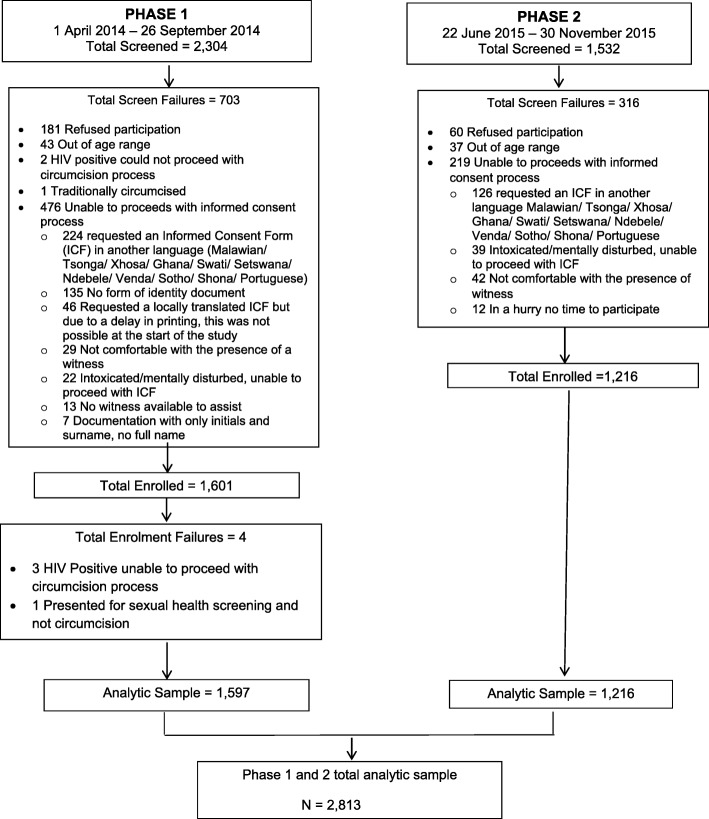
Overall 2817 enrolled in the study with 1601 from Phase 1 and 1216 in Phase 2. A higher proportion of participants aged 25-49 years accessed MMC in Phase 2 compared to Phase 1 (59.4% vs. 54.9%; Prevalence Ratio = 1.08; 95% Confidence Interval: 1.01-1.15; p = 0.019). Participants with multiple partners in the past 12 months in Phase 2 were more likely to access MMC services compared to participants in Phase 1 (unadjusted Odds Ratio, 1.37; 95% CI:1.17-1.61; p < 0.001). After adjusting for age, multiple partners remained a risk factor in Phase 2 (adjusted OR, 1.39; 95% CI: 1.18-1.63; p < 0.001).
The "Exclusive Intervention Strategy" was associated with a slight increase in the proportion of participants aged 25-49 years accessing MMC services, and an increase in those with HIV risk behaviors, during the intervention phase. These findings may provide important insights to overcoming barriers for accessing MMC services among men aged 25-49 years.
The study is registered at ClinicalTrials.gov , number NCT02352961 .
南非引入了男性包皮环切术(MMC)以降低 HIV 感染率。数学模型表明,将 MMC 服务针对 20-34 岁的男性,可以对 HIV 发病率产生最直接的影响。然而,大多数接受 MMC 的男性年龄都在 25 岁以下。我们评估了一项干预措施,以增加 25-49 岁男性接受 MMC 的比例。
我们进行了一项前后对照研究,比较了约翰内斯堡埃库鲁莱尼的男性(25-49 岁)在形成阶段(第 1 阶段)和干预阶段(第 2 阶段)接受 MMC 的比例。干预措施包括在 MMC 点将成年人与青少年分开的基础设施变化、专门的男性健康俱乐部、针对成年人的需求产生材料以及与社区成员的讨论。
共有 2817 名参与者入组,其中 1601 名来自第 1 阶段,1216 名来自第 2 阶段。与第 1 阶段相比,第 2 阶段有更多的 25-49 岁的参与者接受了 MMC(59.4%比 54.9%;患病率比,1.08;95%置信区间:1.01-1.15;p=0.019)。与第 1 阶段相比,在过去 12 个月中有多个性伴侣的参与者在第 2 阶段更有可能接受 MMC 服务(未调整的优势比,1.37;95%置信区间:1.17-1.61;p<0.001)。在调整了年龄后,在第 2 阶段,多个性伴侣仍然是一个危险因素(调整后的优势比,1.39;95%置信区间:1.18-1.63;p<0.001)。
“排他性干预策略”与第 2 阶段接受 MMC 服务的 25-49 岁参与者比例略有增加以及 HIV 风险行为增加相关。这些发现可能为克服 25-49 岁男性接受 MMC 服务的障碍提供重要见解。
该研究在 ClinicalTrials.gov 注册,编号为 NCT02352961。