Xu Jinjing, Wang Yali, Shi Jing, Liu Juan, Li Qingguo, Chen Longzhou
Galactophore Department, Jiangsu Huai'an Maternity and Children Hospital, Huai'an, Jiangsu 223001, P.R. China.
Oncol Lett. 2018 Aug;16(2):2063-2070. doi: 10.3892/ol.2018.8946. Epub 2018 Jun 11.
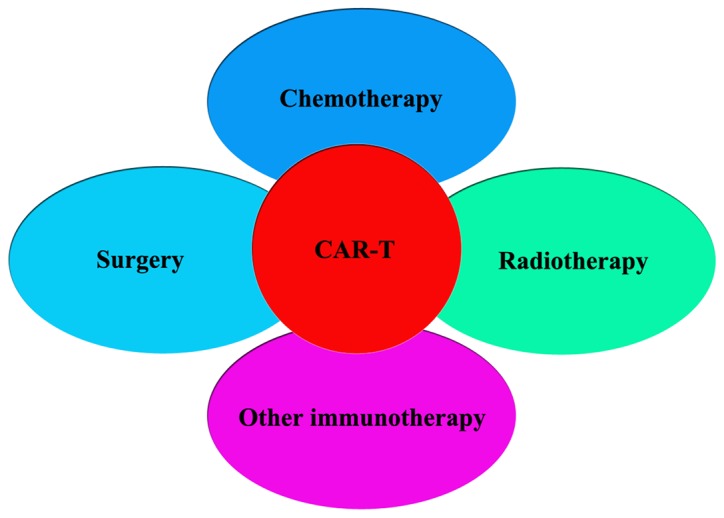
Chimeric antigen receptor (CAR) T-cell therapies have been demonstrated to have durable and potentially curative therapeutic efficacies in patients with hematological malignancies. Currently, multiple clinical trials in CAR-T cell therapy have been evaluated for the treatment of patients with solid malignancies, but have had less marked therapeutic effects when the agents are used as monotherapies. When summarizing relevant studies, the present study found that combination therapy strategies for solid tumors based on CAR-T cell therapies might be more effective. This review will focus on various aspects of treating solid tumors with CAR-T cell therapy: i) The therapeutic efficacy of CAR-T cell monotherapy, ii) the feasibility of the CAR-T cell therapy in conjunction with chemotherapy, iii) the feasibility of CAR-T cell therapy with radiotherapy, iv) the feasibility of CAR-T cell therapy with chemoradiotherapy, and v) the feasibility of the combination of CAR-T cell therapy with other strategies.
嵌合抗原受体(CAR)T细胞疗法已被证明在血液系统恶性肿瘤患者中具有持久且可能治愈的治疗效果。目前,多项CAR-T细胞疗法的临床试验已针对实体恶性肿瘤患者的治疗进行了评估,但当这些药物作为单一疗法使用时,治疗效果不太显著。在总结相关研究时,本研究发现基于CAR-T细胞疗法的实体瘤联合治疗策略可能更有效。本综述将聚焦于CAR-T细胞疗法治疗实体瘤的各个方面:i)CAR-T细胞单一疗法的治疗效果,ii)CAR-T细胞疗法联合化疗的可行性,iii)CAR-T细胞疗法联合放疗的可行性,iv)CAR-T细胞疗法联合放化疗的可行性,以及v)CAR-T细胞疗法与其他策略联合的可行性。