Liu Xiangjun, Zhang Chengfeng, Wang Cunhua, Sun Jianwei, Wang Deliang, Zhao Yansheng, Xu Xiaohui
Department of Orthopedics, The People's Hospital of Qingdao West Coast New Area, Qingdao, Shandong 266400, P.R. China.
Oncol Lett. 2018 Aug;16(2):2229-2236. doi: 10.3892/ol.2018.8939. Epub 2018 Jun 11.
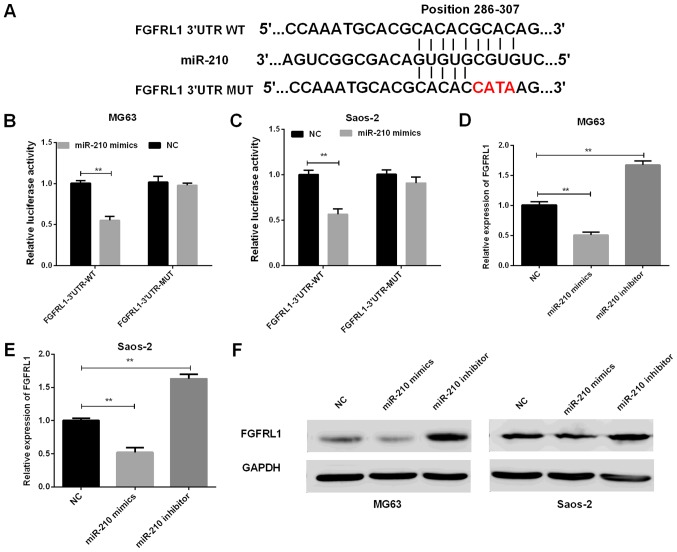
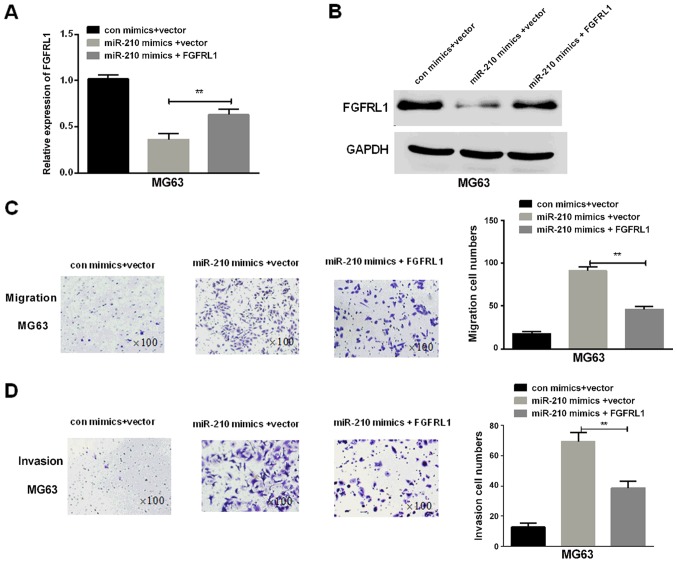
Osteosarcoma is a common bone tumor and a frequently occuring cancer-associated threat to children. Notably, the prognosis of osteosarcoma is very poor when it is diagnosed with metastasis. A growing number of studies have indicated that various microRNAs (miRs) serve important regulatory roles in the pathogeny of different types of cancer. However, the functions of miR-210 in osteosarcoma need to be elucidated comprehensively. The aim of the present study was to investigate the potential roles of miR-210 in osteosarcoma by targeting fibroblast growth factor receptor-like 1 (FGFRL1). Reverse transcription-quantitative polymerase chain reaction results revealed that the expression of miR-210 was highly elevated while FGFRL1 expression was reduced inversely in osteosarcoma tissues compared with matched normal tissues. The results of Transwell assays showed that miR-210 promoted osteosarcoma cell migration and invasion. Furthermore, the luciferase reporter assay results suggested that miR-210 could directly bind to FGFRL1 in osteosarcoma cells. In addition, the present findings demonstrated that miR-210 could negatively regulate FGFRL1 expression by targeting the 3'untranslated region. In conclusion, the findings of the present study suggested that miR-210 exerted tumor carcinogenic functions in osteosarcoma by targeting FGFRL1. The findings of this study demonstrated that FGFRL1 was a direct target of miR-210 in osteosarcoma involved in the promoting functions mediated by miR-210 in the invasion and migration of osteosarcoma, suggesting that miR-210/FGFRL1 may be promising for discovering diagnostic and prognostic biomarkers for the therapies of osteosarcoma.
骨肉瘤是一种常见的骨肿瘤,也是儿童时期常见的与癌症相关的威胁。值得注意的是,骨肉瘤一旦被诊断为发生转移,其预后非常差。越来越多的研究表明,各种微小RNA(miR)在不同类型癌症的发病机制中发挥着重要的调节作用。然而,miR-210在骨肉瘤中的功能仍需全面阐明。本研究的目的是通过靶向成纤维细胞生长因子受体样1(FGFRL1)来研究miR-210在骨肉瘤中的潜在作用。逆转录-定量聚合酶链反应结果显示,与配对的正常组织相比,骨肉瘤组织中miR-210的表达显著升高,而FGFRL1的表达则相反降低。Transwell实验结果表明,miR-210促进骨肉瘤细胞的迁移和侵袭。此外,荧光素酶报告基因实验结果表明,miR-210可以直接与骨肉瘤细胞中的FGFRL1结合。此外,本研究结果表明,miR-210可以通过靶向3'非翻译区负向调节FGFRL1的表达。总之,本研究结果表明,miR-210通过靶向FGFRL1在骨肉瘤中发挥肿瘤致癌作用。本研究结果表明,FGFRL1是miR-210在骨肉瘤中的直接靶点,参与了miR-210介导的骨肉瘤侵袭和迁移的促进作用,提示miR-210/FGFRL1可能有望成为骨肉瘤治疗的诊断和预后生物标志物。