Bakirtzis Christos, Ioannidis Panagiotis, Messinis Lambros, Nasios Grigorios, Konstantinopoulou Elina, Papathanasopoulos Panagiotis, Grigoriadis Nikolaos
The Multiple Sclerosis Center, 2nd Department of Neurology, AHEPA University Hospital, Aristotle University of Thessaloniki, Thessaloniki, Greece.
Department of Neurology, Neuropsychology Section, University of Patras Medical School, Patras, Greece.
Open Neurol J. 2018 May 31;12:31-40. doi: 10.2174/1874205X01812010031. eCollection 2018.
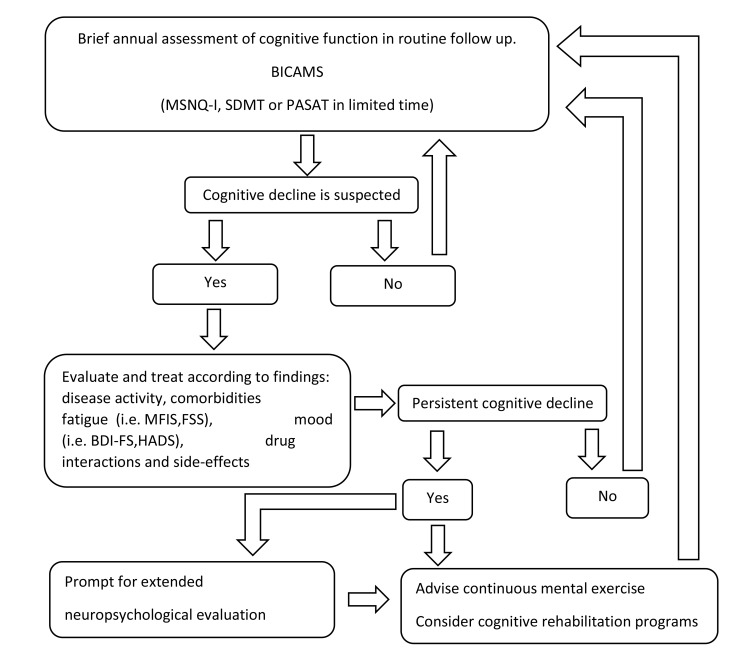
About half of patients with multiple sclerosis exhibit cognitive impairment which negatively affects their quality of life. The assessment of cognitive function in routine clinical practice is still undervalued, although various tools have been proposed for this reason. In this article, we describe the potential benefits of implementing cognitive assessment tools in routine follow -ups of MS patients. Early detection of changes in cognitive performance may provide evidence of disease activity, could unmask depression or medication side-effects and provide suitable candidates for cognitive rehabilitation. Since apathy and cognitive deficiencies are common presenting symptoms in Progressive Multifocal Leukoencephalopathy, we discuss the utility of frequent monitoring of mental status in multiple sclerosis patients at increased risk. In addition, we propose a relevant algorithm aiming to incorporate a systematic evaluation of cognitive function in every day clinical practice in multiple sclerosis.
约一半的多发性硬化症患者存在认知障碍,这对他们的生活质量产生负面影响。尽管为此已经提出了各种工具,但在常规临床实践中对认知功能的评估仍未得到重视。在本文中,我们描述了在多发性硬化症患者的常规随访中实施认知评估工具的潜在益处。早期发现认知表现的变化可能为疾病活动提供证据,可能揭示抑郁症或药物副作用,并为认知康复提供合适的人选。由于冷漠和认知缺陷是进行性多灶性白质脑病常见的症状表现,我们讨论了对风险增加的多发性硬化症患者频繁监测精神状态的效用。此外,我们提出了一种相关算法,旨在将认知功能的系统评估纳入多发性硬化症的日常临床实践中。