Uri Inbal, Grozinsky-Glasberg Simona
Neuroendocrine Tumor Unit, Endocrinology and Metabolism Department, Division of Medicine, Hadassah-Hebrew University Medical Center, P.O.B. 12000, 91120 Jerusalem, Israel.
Clin Diabetes Endocrinol. 2018 Jul 11;4:16. doi: 10.1186/s40842-018-0066-3. eCollection 2018.
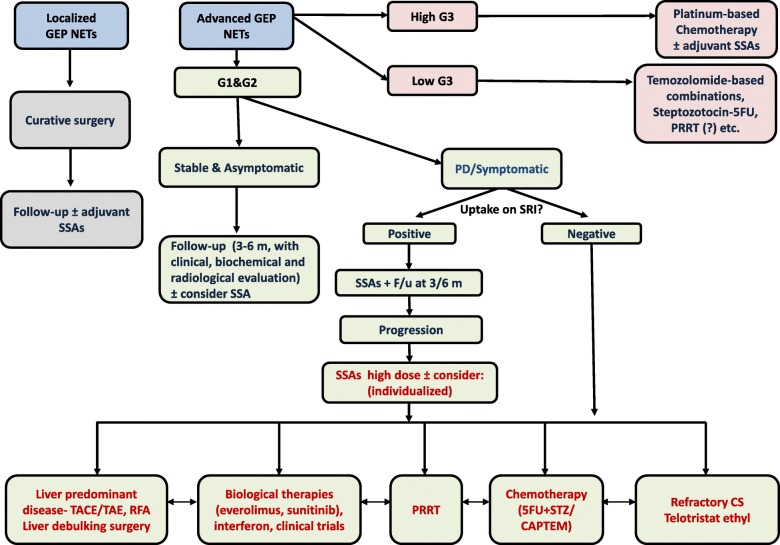
Neuroendocrine tumors (NETs) are rare neoplasms, with an estimated annual incidence of ~ 6.9/100,000. NETs arise throughout the body from cells of the diffuse endocrine system. More than half originate from endocrine cells of the gastrointestinal tract and the pancreas, thus being referred to as gastroenteropancreatic NETs (GEP NETs). The only treatment that offers a cure is surgery, however most patients are diagnosed with metastatic disease, and curative surgery is usually not an option.Since the majority of patients are not candidate for curative surgery, they can be offered long-term systemic treatment, for both symptomatic relief and tumor growth suppression. Evidence based treatment options include somatostatin analogues, everolimus (an mTOR inhibitor), sunitinib (a tyrosine kinase inhibitor), peptide receptor radionuclide therapy (PRRT), chemotherapy, etc., alone or combined with cytoreductive procedures (surgery or liver directed procedures). However, there is an increasing need for novel therapies. Other treatment options being investigated are immunotherapy and epigenetic assessment that may lead to more personalized interventions. Following first line therapy with somatostatin analogues, there is no clear information to date indicating a preferred treatment sequence, and therefore the treatment approach should be individualized based on each NET patient characteristics.
NET patients are increasingly diagnosed throughout the world, usually with metastatic disease and requiring systemic therapy. We believe that each patient should be therefore thoroughly evaluated and individually discussed by a multidisciplinary and dedicated NET-expert team, updated with all treatment options including ongoing clinical trials, and before selecting the proper treatment sequence.
神经内分泌肿瘤(NETs)是罕见肿瘤,估计年发病率约为6.9/10万。NETs起源于全身弥漫性内分泌系统的细胞。超过半数起源于胃肠道和胰腺的内分泌细胞,因此被称为胃肠胰神经内分泌肿瘤(GEP NETs)。唯一能治愈的治疗方法是手术,但大多数患者确诊时已发生转移,根治性手术通常不是选择。由于大多数患者不适合进行根治性手术,可为他们提供长期的全身治疗,以缓解症状并抑制肿瘤生长。循证治疗方案包括生长抑素类似物、依维莫司(一种mTOR抑制剂)、舒尼替尼(一种酪氨酸激酶抑制剂)、肽受体放射性核素治疗(PRRT)、化疗等,单独使用或与减瘤手术(手术或肝脏定向手术)联合使用。然而,对新型疗法的需求日益增加。正在研究的其他治疗选择包括免疫疗法和表观遗传评估,这可能会带来更个性化的干预措施。在使用生长抑素类似物进行一线治疗后,迄今尚无明确信息表明哪种治疗顺序更佳,因此治疗方法应根据每位NET患者的特征进行个体化选择。
全球范围内,NET患者的诊断越来越多,通常已发生转移且需要全身治疗。因此,我们认为在选择合适的治疗顺序之前,应由多学科且专业的NET专家团队对每位患者进行全面评估并单独讨论,同时让他们了解包括正在进行的临床试验在内的所有治疗选择。