Jankovic Joseph, Truong Daniel, Patel Atul T, Brashear Allison, Evatt Marian, Rubio Roman G, Oh Chad K, Snyder Daniel, Shears Gill, Comella Cynthia
Parkinson's Disease Center and Movement Disorders Clinic Department of Neurology, Baylor College of Medicine Houston TX.
The Parkinson's and Movement Disorder Institute Fountain Valley CA.
Mov Disord Clin Pract. 2018 Apr 26;5(3):273-282. doi: 10.1002/mdc3.12613. eCollection 2018 May-Jun.
Injectable daxibotulinumtoxinA (an investigational botulinum toxin, RT002) may offer a more prolonged duration of response-and therefore less frequent dosing-than onabotulinumtoxinA.
To perform a phase 2, open-label, dose-escalation study to assess the efficacy and safety of daxibotulinumtoxinA in cervical dystonia.
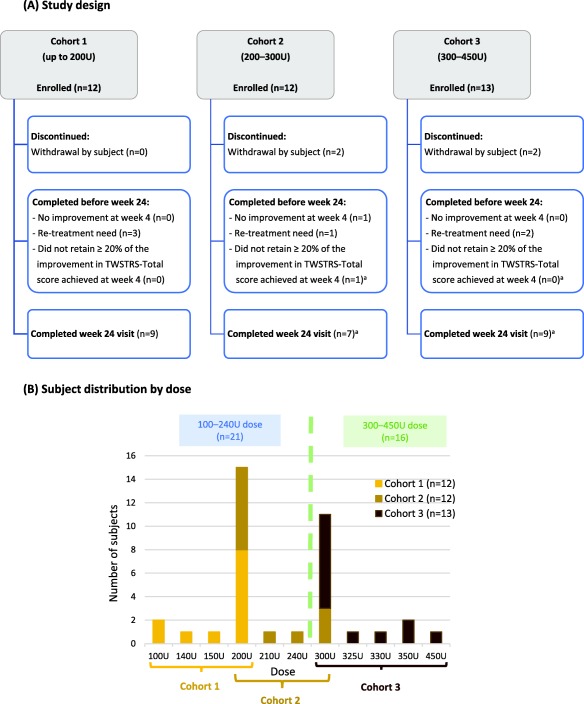
Subjects with moderate-to-severe isolated cervical dystonia were enrolled in sequential cohorts to receive a single open-label, intramuscular dose of injectable daxibotulinumtoxinA of up to 200 U ( 12), 200-300 U ( 12), or 300-450 U ( 13; https://clinicaltrials.gov identifier NCT02706795).
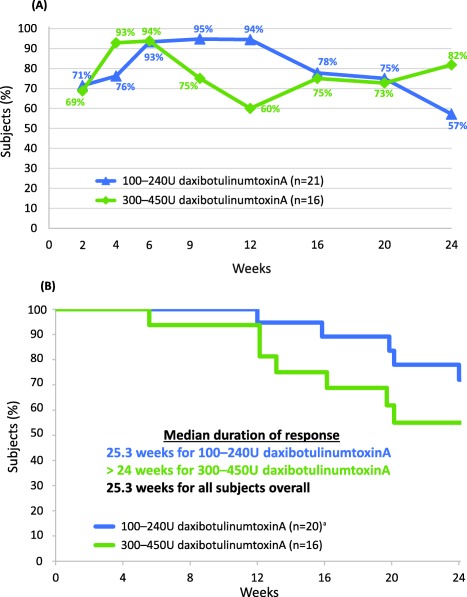
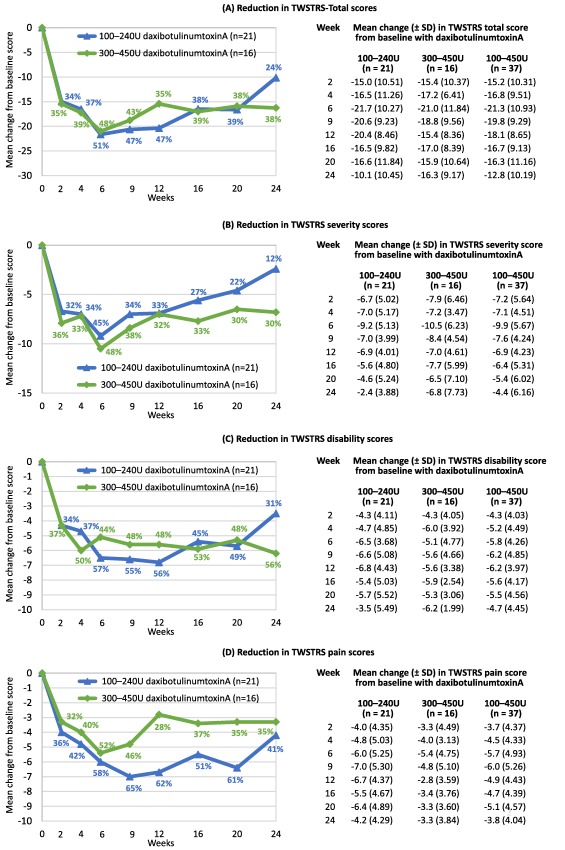
Overall, 33/37 enrollees completed the trial. DaxibotulinumtoxinA was associated with mean reductions in Toronto Western Spasmodic Torticollis Rating Scale (TWSTRS)-Total score of 16.8 (38%) at week 4, 21.3 (50%) at week 6, and 12.8 (30%) at week 24. The proportion of subjects who were responders (achieved ≥ 20% reduction in TWSTRS-Total score) was 94% at week 6 and 68% at week 24. The median duration of response (time until > 20% of the improvement in TWSTRS-Total score achieved at week 4 was no longer retained or re-treatment was needed) was 25.3 weeks (95% CI, 20.14-26.14 weeks). There were no serious adverse events and there was no apparent dose-related increase in the incidence of adverse events. The most common treatment-related adverse events were dysphagia (14%) and injection site erythema (8%).
Preliminary assessments suggest that injectable daxibotulinumtoxinA at doses up to 450 U is well tolerated and may offer prolonged efficacy in the treatment of cervical dystonia. Further studies involving larger numbers of patients are now warranted.
注射用达昔布妥毒素A(一种研究性肉毒毒素,RT002)可能比A型肉毒毒素产生更长的反应持续时间,因此给药频率更低。
进行一项2期开放标签剂量递增研究,以评估达昔布妥毒素A治疗颈部肌张力障碍的疗效和安全性。
中度至重度孤立性颈部肌张力障碍患者按顺序入组,接受单次开放标签肌肉注射剂量的注射用达昔布妥毒素A,剂量最高可达200 U(12例)、200 - 300 U(12例)或300 - 450 U(13例;https://clinicaltrials.gov标识符NCT02706795)。
总体而言,37名受试者中有33名完成了试验。达昔布妥毒素A在第4周时使多伦多西部痉挛性斜颈评定量表(TWSTRS)总分平均降低16.8(38%),第6周时降低21.3(50%),第24周时降低12.8(30%)。在第6周时,反应者(TWSTRS总分降低≥20%)的比例为94%,第24周时为68%。反应的中位持续时间(直到不再保持第4周时TWSTRS总分改善>20%或需要再次治疗的时间)为25.3周(95%CI,20.14 - 26.14周)。没有严重不良事件,不良事件的发生率也没有明显的剂量相关性增加。最常见的治疗相关不良事件是吞咽困难(14%)和注射部位红斑(8%)。
初步评估表明,剂量高达450 U的注射用达昔布妥毒素A耐受性良好,可能在治疗颈部肌张力障碍方面提供持久疗效。现在需要开展涉及更多患者的进一步研究。