Gerensea Hadgu, Kebede Awoke, Baraki Zeray, Berihu Hagos, Zeru Teklay, Birhane Eskedar, G/Her Dawit, Hintsa Solomun, Siyum Hailay, Kahsay Gizenesh, Gidey Gebreamlake, Teklay Girmay, Mulatu Gebremeskel
School of Nursing, College of Health Science, Aksum University, Aksum, Ethiopia.
School of Public Health, College of Health Science, Aksum University, Aksum, Ethiopia.
BMC Res Notes. 2018 Jul 16;11(1):476. doi: 10.1186/s13104-018-3588-y.
In an effort to reduce infant mortality and morbidity, the World Health Organization and other technical partners developed the Integrated Management of Newborn and Childhood Illness (IMNCI). This study focuses on assessment of consistency and completeness of integrated management of neonatal and child hood illness in primary health care units.
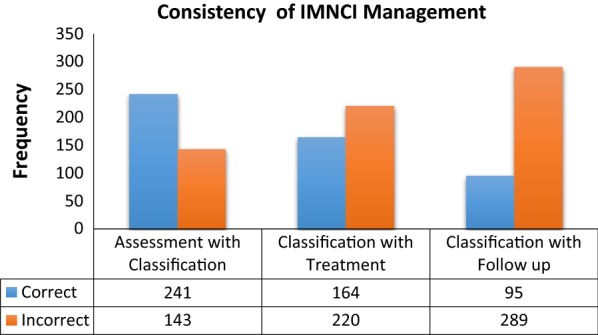
A total of 384 cases were taken from 3562 cases both from young infant registration (under-2 month old) and child registration (2 months-5 year old). Out of 384 cases, 241 (62.8%) cases were correctly classified and 143 (37.2%) were incorrect classifications. Similarly 164 (42.7%) cases were treated correctly where as 220 (57.3%) treated incorrectly. Only 95 (24.7%) cases have given appropriate appointments where as 289 (75.3%) cases were appointed incorrectly. The overall consistency of IMNCI management is poor. Unless continuous follow up of and training was given, children are not treated as expected. More over using electronic method of IMNCI may alleviate the problem.
为降低婴儿死亡率和发病率,世界卫生组织及其他技术合作伙伴制定了《新生儿和儿童疾病综合管理》(IMNCI)。本研究着重评估初级卫生保健单位中新生儿和儿童疾病综合管理的一致性和完整性。
从3562例婴儿登记(2个月以下)和儿童登记(2个月至5岁)病例中抽取了384例。在384例病例中,241例(62.8%)分类正确,143例(37.2%)分类错误。同样,164例(42.7%)治疗正确,220例(57.3%)治疗错误。只有95例(24.7%)预约适当,289例(75.3%)预约错误。IMNCI管理的总体一致性较差。除非持续进行随访和培训,否则儿童无法得到预期的治疗。此外,采用IMNCI的电子方法可能会缓解这一问题。