Department of Chemistry and Biochemistry, University of Notre Dame, Notre Dame, IN, USA.
Freimann Life Sciences Center and Department of Biological Sciences, University of Notre Dame, Notre Dame, IN, USA.
Eur J Pharmacol. 2018 Sep 5;834:77-83. doi: 10.1016/j.ejphar.2018.07.014. Epub 2018 Jul 19.
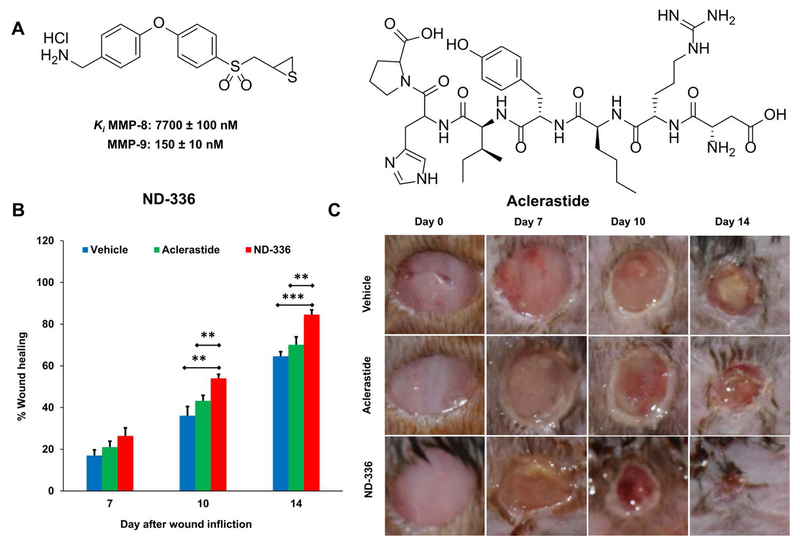
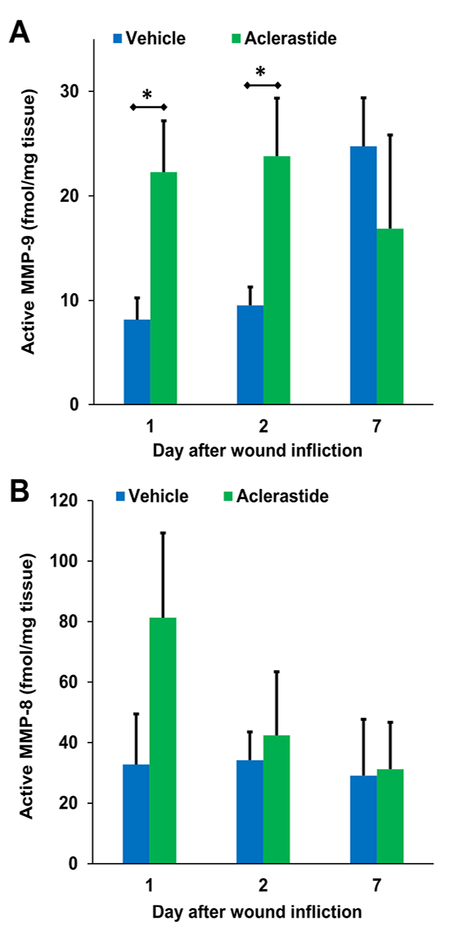
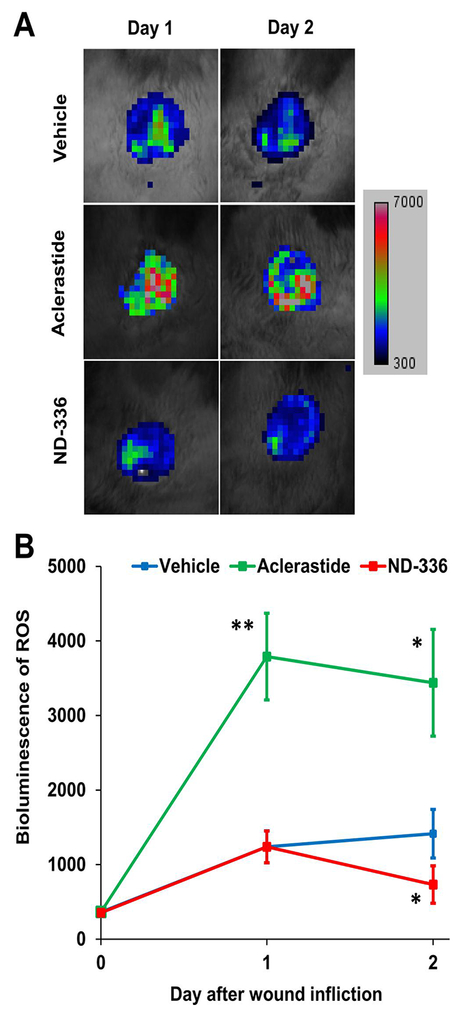
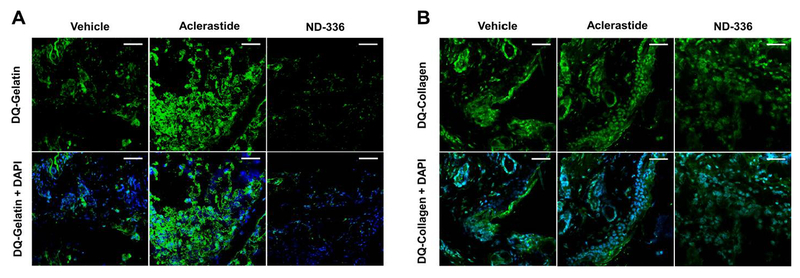
Chronic wounds are a complication of diabetes. Treatment for diabetic foot ulcers is complex with little clinical recourse, resulting in 108,000 lower-limb amputations annually in the United States alone. Matrix metalloproteinases (MMPs) play important roles in the pathology and in the repair of chronic wounds. We previously identified active MMP-8 and MMP-9 in wounds of diabetic mice and determined that MMP-8 accelerates wound repair, while MMP-9 is the culprit for the diabetic wound being refractory to healing. Aclerastide, a peptide analog of angiotensin II, recently failed in phase III clinical trials for treatment of diabetic foot ulcers. We demonstrate herein that treatment of wounds of diabetic mice with aclerastide results in elevated levels of reactive oxygen species and of active MMP-9, which is likely an important contributor to the failure of aclerastide in clinical trials.
慢性伤口是糖尿病的一种并发症。糖尿病足溃疡的治疗很复杂,临床方法有限,仅在美国每年就有 108,000 例下肢截肢。基质金属蛋白酶 (MMPs) 在慢性伤口的病理和修复中发挥重要作用。我们之前在糖尿病小鼠的伤口中发现了活性 MMP-8 和 MMP-9,并确定 MMP-8 可加速伤口愈合,而 MMP-9 是导致糖尿病伤口难以愈合的罪魁祸首。Aclerastide 是血管紧张素 II 的肽类似物,最近在治疗糖尿病足溃疡的 III 期临床试验中失败。我们在此证明,用 aclerastide 治疗糖尿病小鼠的伤口会导致活性 MMP-9 和活性氧的水平升高,这可能是 aclerastide 在临床试验中失败的一个重要原因。