Department of Laboratory Medicine & Pathobiology, University of Toronto, Toronto, ON, Canada.
Fred A. Litwin Centre for Cancer Genetics, Lunenfeld-Tanenbaum Research Institute, Sinai Health System, 600 University Avenue, Toronto, ON, M5G 1X5, Canada.
BMC Cancer. 2018 Jul 20;18(1):750. doi: 10.1186/s12885-018-4653-6.
We previously observed that T-bet+ tumor-infiltrating T lymphocytes (T-bet+ TILs) in primary breast tumors were associated with adverse clinicopathological features, yet favorable clinical outcome. We identified BRD4 (Bromodomain-Containing Protein 4), a member of the Bromodomain and Extra Terminal domain (BET) family, as a gene that distinguished T-bet+/high and T-bet-/low tumors. In clinical studies, BET inhibitors have been shown to suppress inflammation in various cancers, suggesting a potential link between BRD4 and immune infiltration in cancer. Hence, we examined the BRD4 expression and clinicopathological features of breast cancer.
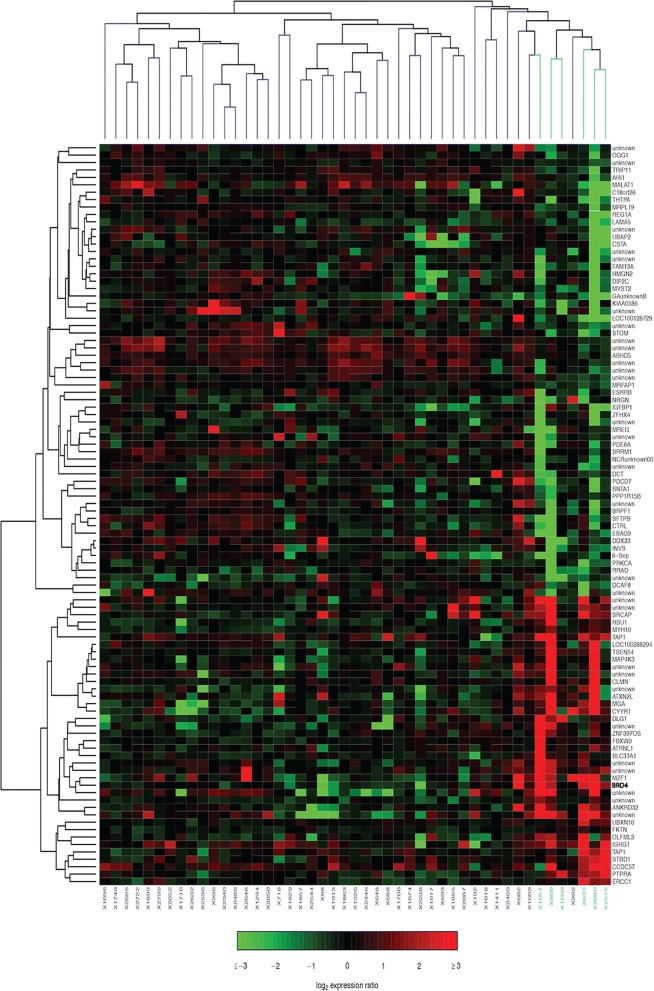
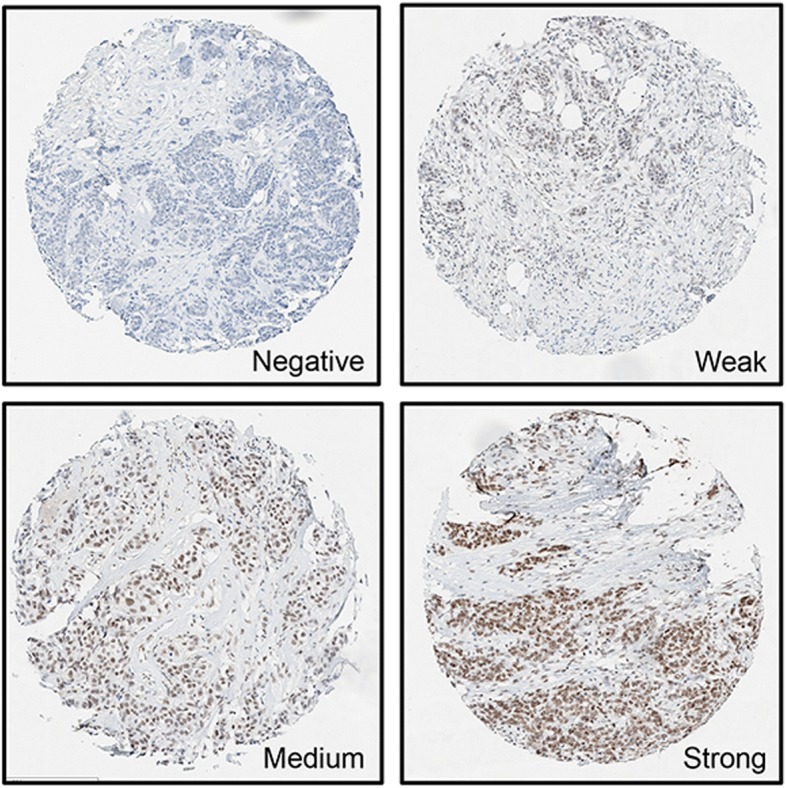
The cohort consisted of a prospectively ascertained consecutive series of women with axillary node-negative breast cancer with long follow-up. Gene expression microarray data were used to detect mRNAs differentially expressed between T-bet+/high (n = 6) and T-bet-/low (n = 41) tumors. Tissue microarrays (TMAs) constructed from tumors of 612 women were used to quantify expression of BRD4 by immunohistochemistry, which was analyzed for its association with T-bet+ TILs, Jagged1, clinicopathological features, and disease-free survival.
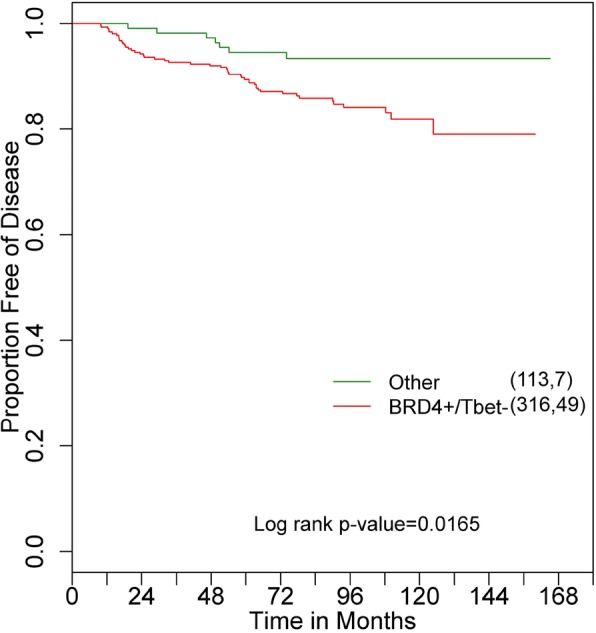
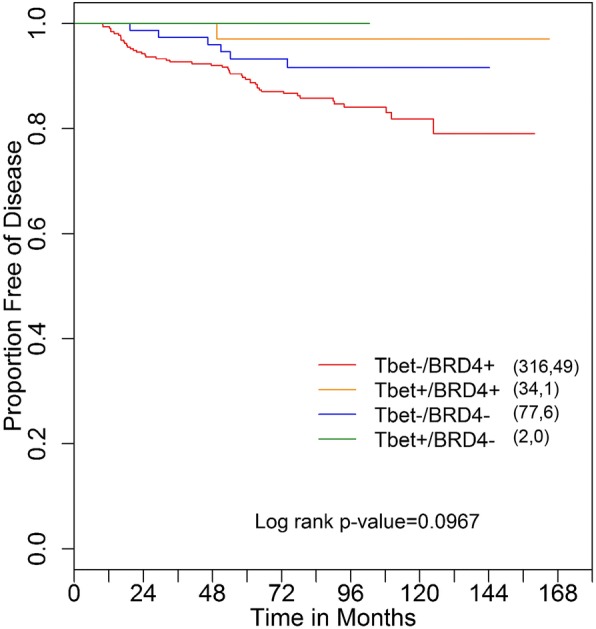
Microarray analysis indicated that BRD4 mRNA expression was up to 44-fold higher in T-bet+/high tumors compared to T-bet-/low tumors (p = 5.38E-05). Immunohistochemical expression of BRD4 in cancer cells was also shown to be associated with T-bet+ TILs (p = 0.0415) as well as with Jagged1 mRNA and protein expression (p = 0.0171, 0.0010 respectively). BRD4 expression correlated with larger tumor size (p = 0.0049), pre-menopausal status (p = 0.0018), and high Ki-67 proliferative index (p = 0.0009). Women with high tumoral BRD4 expression in the absence of T-bet+ TILs exhibited a significantly poorer outcome (log rank test p = 0.0165) relative to other subgroups.
The association of BRD4 expression with T-bet+ TILs, and T-bet+ TIL-dependent disease-free survival suggests a potential link between BRD4-mediated tumor development and tumor immune surveillance, possibly through BRD4's regulation of Jagged1 signaling pathways. Further understanding BRD4's role in different immune contexts may help to identify an appropriate subset of breast cancer patients who may benefit from BET inhibitors without the risk of diminishing the anti-tumoral immune activity.
我们之前观察到,原发性乳腺癌肿瘤浸润性 T 淋巴细胞(T-bet+TILs)中的 T-bet+与不良的临床病理特征相关,但临床结局良好。我们鉴定了 BRD4(Bromodomain-Containing Protein 4),Bromodomain 和 Extra Terminal 结构域(BET)家族的成员,作为区分 T-bet+/高和 T-bet-/低肿瘤的基因。在临床研究中,BET 抑制剂已被证明可抑制各种癌症中的炎症,这表明 BRD4 与癌症中的免疫浸润之间存在潜在联系。因此,我们检查了 BRD4 在乳腺癌中的表达和临床病理特征。
该队列由一组连续前瞻性确定的腋窝淋巴结阴性乳腺癌女性组成,随访时间较长。使用基因表达微阵列数据检测 T-bet+/高(n=6)和 T-bet-/低(n=41)肿瘤之间差异表达的 mRNAs。使用从 612 名女性肿瘤构建的组织微阵列(TMA)通过免疫组织化学定量 BRD4 的表达,分析其与 T-bet+TILs、Jagged1、临床病理特征和无病生存的关系。
微阵列分析表明,与 T-bet-/低肿瘤相比,T-bet+/高肿瘤中 BRD4mRNA 的表达高达 44 倍(p=5.38E-05)。癌细胞中 BRD4 的免疫组织化学表达也与 T-bet+TILs 相关(p=0.0415),以及 Jagged1mRNA 和蛋白表达相关(p=0.0171,0.0010)。BRD4 的表达与肿瘤较大(p=0.0049)、绝经前状态(p=0.0018)和高 Ki-67 增殖指数(p=0.0009)相关。在缺乏 T-bet+TILs 的情况下,高肿瘤 BRD4 表达的女性与其他亚组相比,结局明显较差(对数秩检验 p=0.0165)。
BRD4 表达与 T-bet+TILs 的关联以及 T-bet+TIL 依赖性无病生存表明,BRD4 介导的肿瘤发生与肿瘤免疫监视之间可能存在潜在联系,可能是通过 BRD4 对 Jagged1 信号通路的调节。进一步了解 BRD4 在不同免疫环境中的作用可能有助于确定合适的乳腺癌患者亚组,他们可能受益于 BET 抑制剂而不会有降低抗肿瘤免疫活性的风险。