MacDonald David Robert Walker, Rehman Haroon, Carnegie Carol Ann, Tomas-Hernandez Jordi, Johnstone Alan John
Aberdeen Royal Infirmary, Foresterhill, Aberdeen, AB25 2ZN, UK.
Vall d'Hebron Hospital, Barcelona, Spain.
Eur J Trauma Emerg Surg. 2020 Feb;46(1):93-98. doi: 10.1007/s00068-018-0986-8. Epub 2018 Jul 20.
We present the Aberdeen Weight-Bearing Test (Knee), an objective test specific for anterior knee discomfort assessed via load bearing. We assess its validity by performing it on normal subjects with no knee symptoms and subjects who had undergone anterograde tibial nailing.
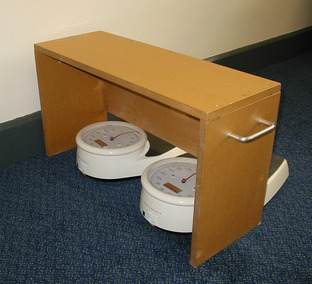
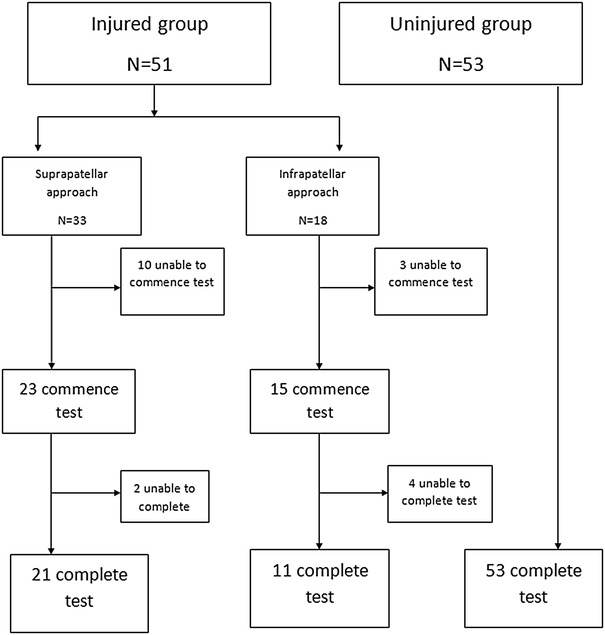
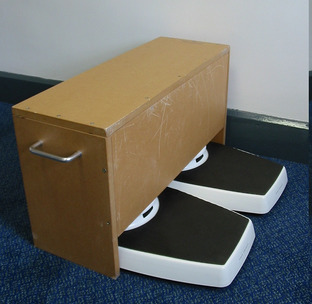
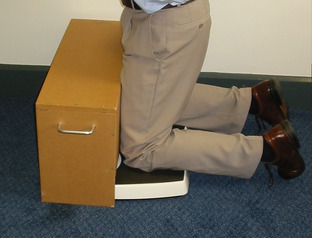
Two scales are placed parallel on the floor with the dials concealed from the subject. The subject then kneels with one knee on each scale. The weight through each knee is recorded at 0, 15, 30, 45, and 60 s. The proportion of total body weight on each leg at each timepoint is calculated, and a ratio calculated from the values. A value of 1 equates to equal weight on each leg. The test was performed on 53 normal subjects and 38 subjects who had undergone tibial nailing.
In the normal group, no significant difference in mean ratio of weight distribution (left:right) was seen at any timepoint (mean ratio range = 0.98-0.99, p value range = 0.18-0.64). In the tibial nail group, a difference was observed in mean ratio of weight distribution (injured:uninjured) favouring the uninjured leg, reaching significance at 0, 15, 30, and 45 s (mean ratio range = 0.88-0.94, p value range = 0.01-0.02). At 60 s, the mean ratio was 0.93 (p = 0.09).
The Aberdeen Weight-Bearing Test (Knee) is an objective, easily reproducible, specific test for anterior knee discomfort. It produces different results in individuals who have undergone anterograde tibial nailing compared to individuals with no knee symptoms.
我们介绍阿伯丁负重试验(膝关节),这是一种通过负重评估前膝部不适的客观测试。我们通过对无膝关节症状的正常受试者和接受顺行性胫骨髓内钉固定术的受试者进行该测试来评估其有效性。
将两个秤平行放置在地板上,秤盘对受试者隐藏。受试者然后单膝跪在每个秤上。在0、15、30、45和60秒时记录通过每个膝关节的重量。计算每个时间点每条腿上的体重占总体重的比例,并根据这些值计算出一个比率。值为1表示每条腿上的重量相等。对53名正常受试者和38名接受胫骨髓内钉固定术的受试者进行了该测试。
在正常组中,在任何时间点体重分布的平均比率(左:右)均无显著差异(平均比率范围 = 0.98 - 0.99,p值范围 = 0.18 - 0.64)。在胫骨髓内钉组中,观察到体重分布的平均比率(受伤:未受伤)有利于未受伤的腿,在0、15、30和45秒时达到显著水平(平均比率范围 = 0.88 - 0.94,p值范围 = 0.01 - 0.02)。在60秒时,平均比率为0.93(p = 0.09)。
阿伯丁负重试验(膝关节)是一种针对前膝部不适的客观、易于重复且特异性的测试。与无膝关节症状的个体相比,接受顺行性胫骨髓内钉固定术的个体该测试产生不同结果。