Department of Nuclear Medicine, University of Würzburg, Würzburg, Germany.
The Russell H. Morgan Department of Radiology and Radiological Science, Division of Nuclear Medicine and Molecular Imaging, Johns Hopkins University School of Medicine, Baltimore, MD, United States.
Sci Rep. 2018 Jul 24;8(1):11120. doi: 10.1038/s41598-018-29509-0.
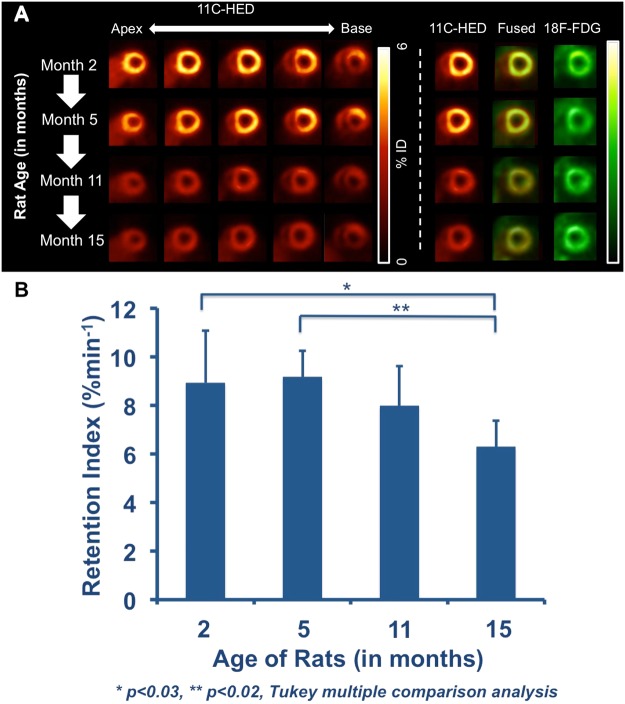
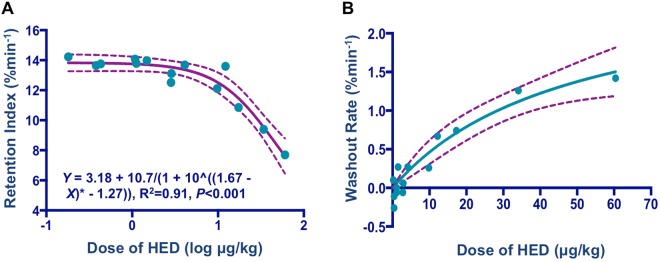
We aimed to explore the impact of ageing on 11C-hydroxyephedrine (11C-HED) uptake in the healthy rat heart in a longitudinal setting. To investigate a potential cold mass effect, the influence of specific activity on cardiac 11C-HED uptake was evaluated: 11C-HED was synthesized by N-methylation of (-)-metaraminol as the free base (radiochemical purity >95%) and a wide range of specific activities (0.2-141.9 GBq/μmol) were prepared. C-HED (48.7 ± 9.7MBq, ranged 0.2-60.4 μg/kg cold mass) was injected in healthy Wistar Rats. Dynamic 23-frame PET images were obtained over 30 min. Time activity curves were generated for the blood input function and myocardial tissue. Cardiac 11C-HED retention index (%/min) was calculated as myocardial tissue activity at 20-30 min divided by the integral of the blood activity curves. Additionally, the impact of ageing on myocardial 11C-HED uptake was investigated longitudinally by PET studies at different ages of healthy Wistar Rats. A dose-dependent reduction of cardiac 11C-HED uptake was observed: The estimated retention index as a marker of norepinephrine function decreased at a lower specific activity (higher amount of cold mass). This observed high affinity of 11C-HED to the neural norepinephrine transporter triggered a subsequent study: In a longitudinal setting, the 11C-HED retention index decreased with increasing age. An age-related decline of cardiac sympathetic innervation could be demonstrated. The herein observed cold mass effect might increase in succeeding scans and therefore, 11C-HED microPET studies should be planned with extreme caution if one single radiosynthesis is scheduled for multiple animals.
我们旨在探索在纵向设置中年龄对健康大鼠心脏中 11C-羟基麻黄碱(11C-HED)摄取的影响。为了研究潜在的冷质量效应,评估了比活度对心脏 11C-HED 摄取的影响:通过(-)-间羟胺的 N-甲基化将 11C-HED 作为游离碱合成(放射化学纯度>95%),并制备了广泛的比活度(0.2-141.9GBq/μmol)。在健康的 Wistar 大鼠中注射 11C-HED(48.7±9.7MBq,范围 0.2-60.4μg/kg 冷质量)。获得 30 分钟的动态 23 帧 PET 图像。为血液输入函数和心肌组织生成时间活性曲线。计算心肌 11C-HED 保留指数(%/min)作为 20-30 分钟时心肌组织活性除以血液活性曲线的积分。此外,通过不同年龄健康 Wistar 大鼠的 PET 研究,纵向研究年龄对心肌 11C-HED 摄取的影响。观察到心脏 11C-HED 摄取呈剂量依赖性降低:作为去甲肾上腺素功能的标志物,估计的保留指数在比活度较低(冷质量较大)时降低。11C-HED 对神经去甲肾上腺素转运体的这种高亲和力引发了随后的研究:在纵向设置中,11C-HED 保留指数随年龄的增加而降低。可以证明心脏交感神经支配的年龄相关性下降。如果计划对多个动物进行单次放射合成,在此观察到的冷质量效应可能会在随后的扫描中增加,因此应非常谨慎地计划 11C-HED microPET 研究。