Olsen Margaret A, Stwalley Dustin, Demont Clarisse, Dubberke Erik R
Department of Medicine, Washington University School of Medicine, St. Louis, Missouri.
Department of Surgery, Washington University School of Medicine, St. Louis, Missouri.
Open Forum Infect Dis. 2018 Jul 19;5(7):ofy160. doi: 10.1093/ofid/ofy160. eCollection 2018 Jul.
Numerous studies have found increased risk of infection (CDI) with increasing age. We hypothesized that increased CDI risk in an elderly population is due to poorer overall health status with older age.
A total of 174 903 persons aged 66 years and older coded for CDI in 2011 were identified using Medicare claims data. The comparison population consisted of 1 453 867 uninfected persons. Potential risk factors for CDI were identified in the prior 12 months and organized into categories, including infections, acute noninfectious conditions, chronic comorbidities, frailty indicators, and health care utilization. Multivariable logistic regression models with CDI as the dependent variable were used to determine the categories with the biggest impact on model performance.
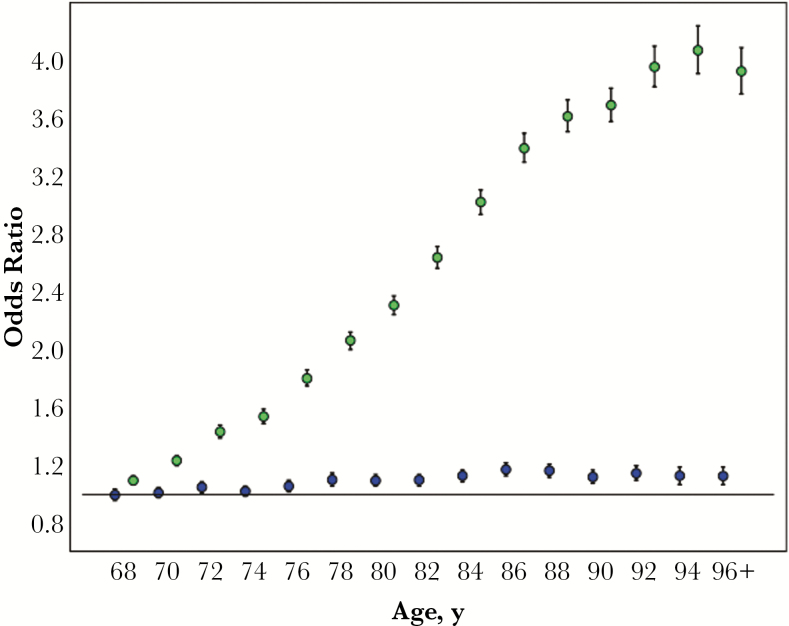
Increasing age was associated with progressively increasing risk of CDI in univariate analysis, with 5-fold increased risk of CDI in 94-95-year-old persons compared with those aged 66-67 years. Independent risk factors for CDI with the highest effect sizes included septicemia (odds ratio [OR], 4.1), emergency hospitalization(s) (OR, 3.9), short-term skilled nursing facility stay(s) (OR, 2.7), diverticulitis (OR, 2.2), and pneumonia (OR, 2.1). Exclusion of age from the full model had no impact on model performance. Exclusion of acute noninfectious conditions followed by frailty indicators resulted in lower c-statistics and poor model fit. Further exclusion of health care utilization variables resulted in a large drop in the c-statistic.
Age did not improve CDI risk prediction after controlling for a wide variety of infections, other acute conditions, frailty indicators, and prior health care utilization.
大量研究发现,随着年龄增长,感染(艰难梭菌感染,CDI)风险增加。我们推测老年人群中CDI风险增加是由于随着年龄增长整体健康状况较差所致。
利用医疗保险理赔数据,识别出2011年编码为CDI的174903名66岁及以上的人群。对照人群包括1453867名未感染人群。在之前的12个月中确定CDI的潜在风险因素,并将其分为几类,包括感染、急性非感染性疾病、慢性合并症、虚弱指标和医疗保健利用情况。以CDI作为因变量的多变量逻辑回归模型用于确定对模型性能影响最大的类别。
在单变量分析中,年龄增长与CDI风险逐渐增加相关,94 - 95岁人群的CDI风险比66 - 67岁人群高5倍。效应量最高的CDI独立风险因素包括败血症(比值比[OR],4.1)、急诊住院(OR,3.9)、短期入住专业护理机构(OR,2.7)、憩室炎(OR,2.2)和肺炎(OR,2.1)。在完整模型中排除年龄对模型性能没有影响。排除急性非感染性疾病,随后排除虚弱指标,导致c统计量降低和模型拟合不佳。进一步排除医疗保健利用变量导致c统计量大幅下降。
在控制了各种感染、其他急性疾病、虚弱指标和先前的医疗保健利用情况后,年龄并不能改善CDI风险预测。