Department of Earth and Environmental Sciences, Ludwig-Maximilians University of Munich, Theresienstrasse 41, Munich, 80333, Germany.
Department of Psychiatry, Psychosomatics and Psychotherapy, Center of Mental Health, University Hospital Würzburg, Würzburg, 97080, Germany.
Sci Rep. 2018 Jul 27;8(1):11363. doi: 10.1038/s41598-018-29766-z.
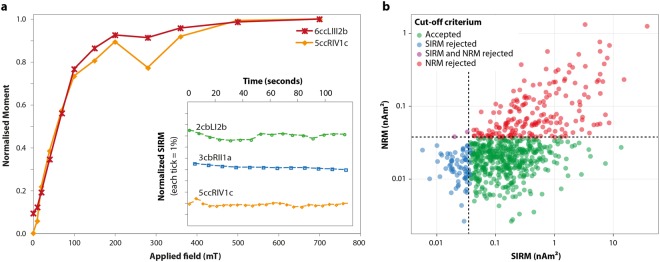
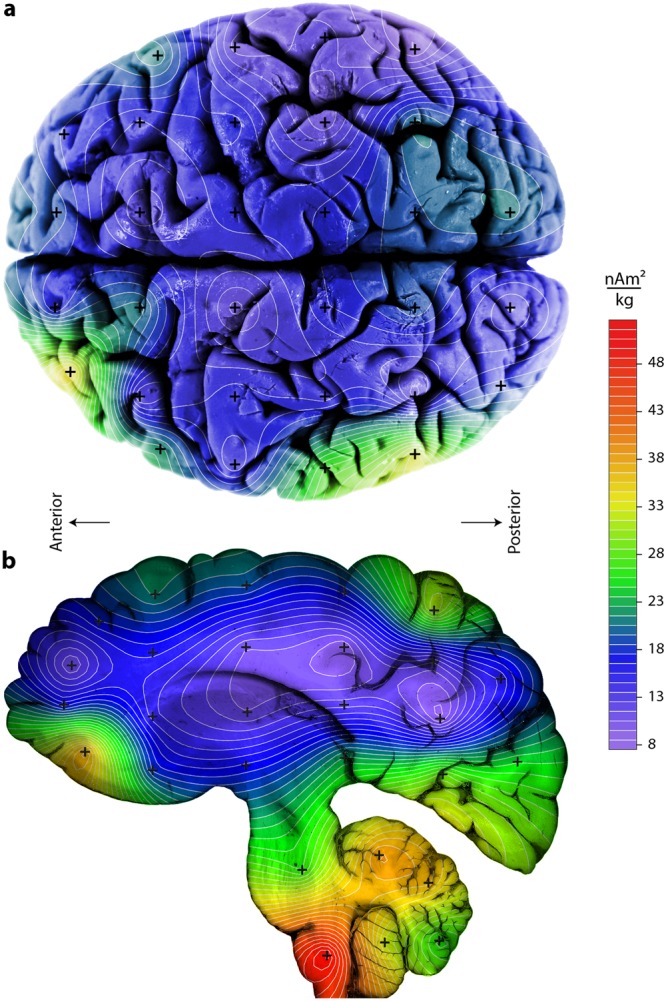
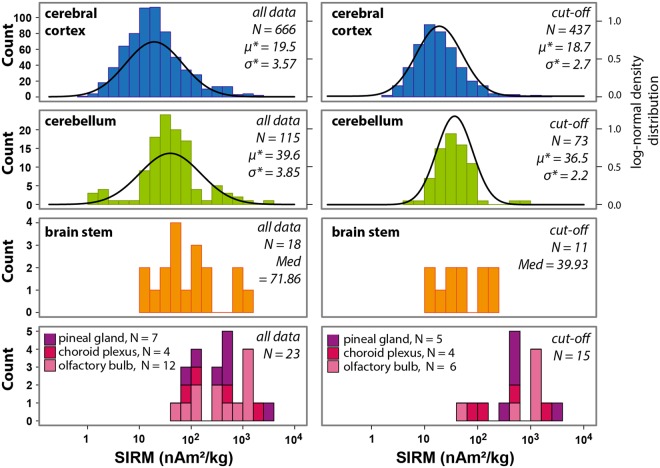
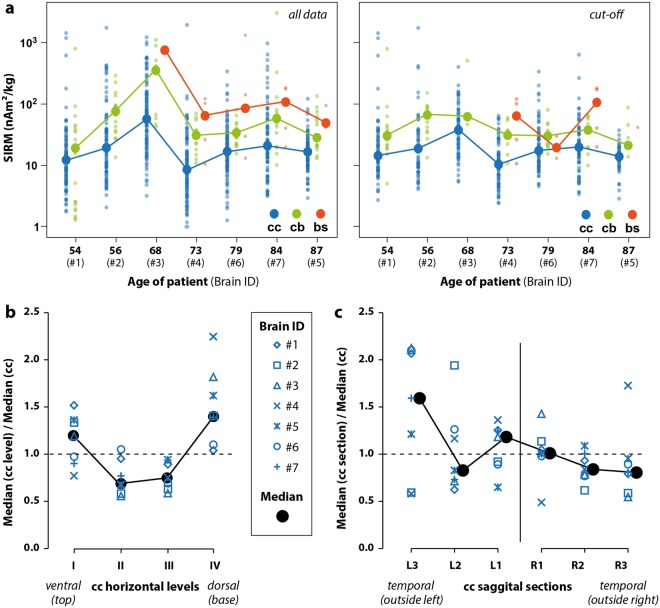
That the human brain contains magnetite is well established; however, its spatial distribution in the brain has remained unknown. We present room temperature, remanent magnetization measurements on 822 specimens from seven dissected whole human brains in order to systematically map concentrations of magnetic remanence carriers. Median saturation remanent magnetizations from the cerebellum were approximately twice as high as those from the cerebral cortex in all seven cases (statistically significantly distinct, p = 0.016). Brain stems were over two times higher in magnetization on average than the cerebral cortex. The ventral (lowermost) horizontal layer of the cerebral cortex was consistently more magnetic than the average cerebral cortex in each of the seven studied cases. Although exceptions existed, the reproducible magnetization patterns lead us to conclude that magnetite is preferentially partitioned in the human brain, specifically in the cerebellum and brain stem.
人脑含有磁铁矿这一点已得到充分证实;然而,其在大脑中的空间分布仍不清楚。我们对来自七个全脑解剖的 822 个样本进行了室温、剩余磁化强度测量,以便系统地绘制磁性剩余载体的浓度图。在所有七种情况下,来自小脑的饱和剩余磁化强度中位数大约是大脑皮层的两倍(统计学上显著不同,p=0.016)。脑干的磁化强度平均比大脑皮层高两倍以上。大脑皮层的下部(最底层)水平层在七个研究病例中的每个病例中都比大脑皮层的平均磁化强度更高。尽管存在例外情况,但可重复的磁化模式使我们得出结论,磁铁矿在人脑内是优先分配的,特别是在小脑和脑干内。