van der Aart Jasper, Golla Sandeep S V, van der Pluijm Marieke, Schwarte Lothar A, Schuit Robert C, Klein Pieter J, Metaxas Athanasios, Windhorst Albert D, Boellaard Ronald, Lammertsma Adriaan A, van Berckel Bart N M
Department of Radiology & Nuclear Medicine, VU University Medical Center, De Boelelaan 1117, 1081 HV, Amsterdam, The Netherlands.
Centre for Human Drug Research, Leiden, The Netherlands.
EJNMMI Res. 2018 Jul 27;8(1):69. doi: 10.1186/s13550-018-0424-2.
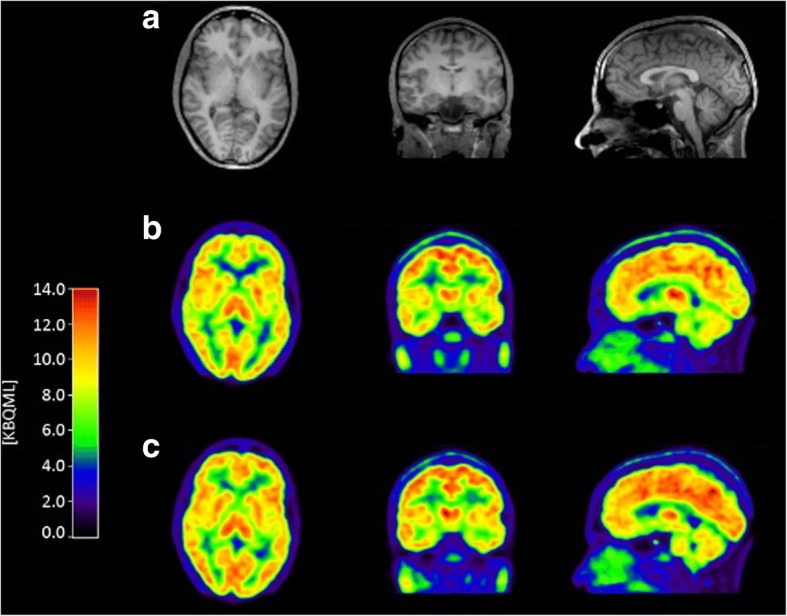
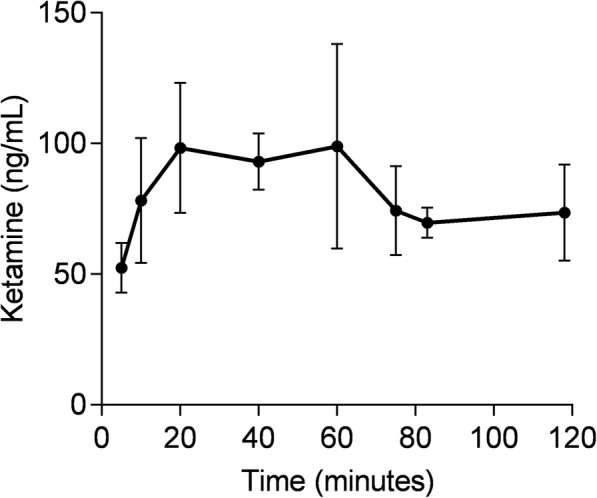
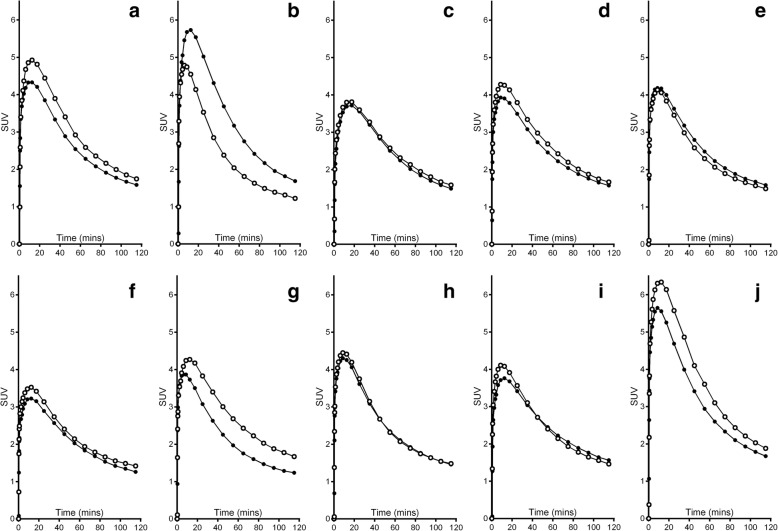
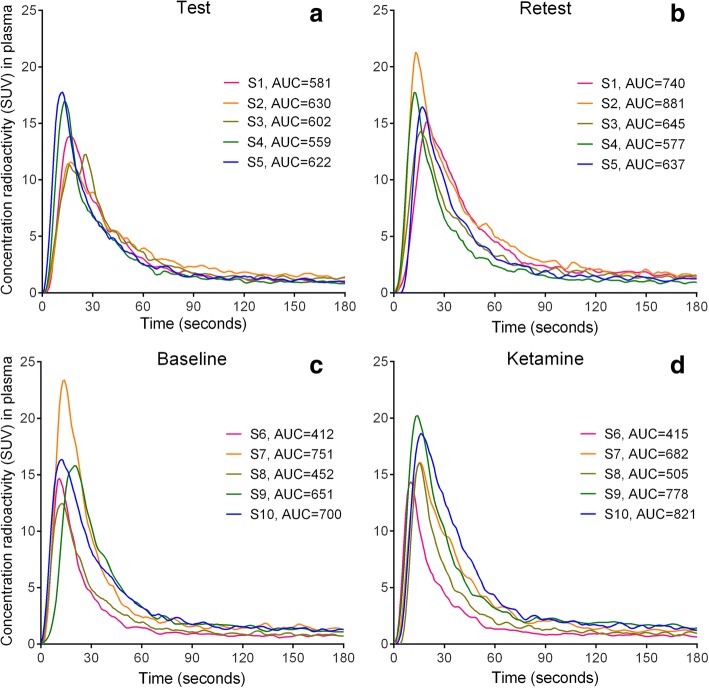
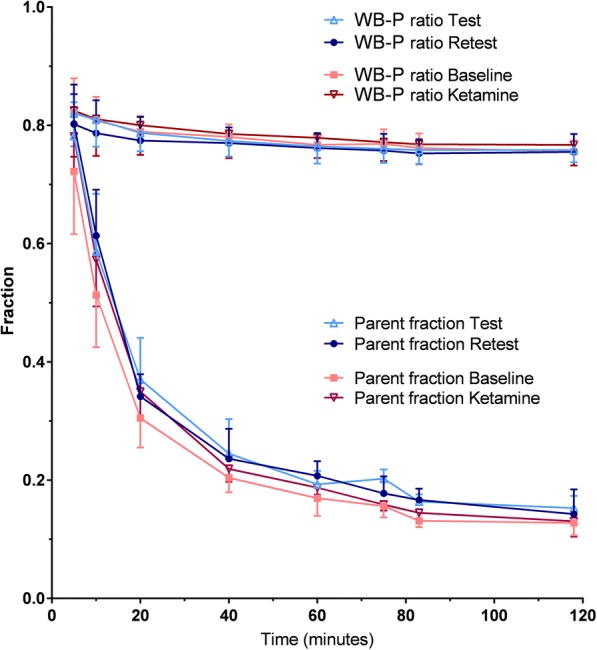
Efforts to develop suitable positron emission tomography (PET) tracers for the ion channel site of human N-methyl-D-aspartate (NMDA) receptors have had limited success. [F]PK-209 is a GMOM derivative that binds to the intrachannel phencyclidine site with high affinity and selectivity. Primate PET studies have shown that the volume of distribution in the brain was reduced by administration of the NMDA receptor antagonist MK-801, consistent with substantial specific binding. The purpose of the present study was to evaluate [F]PK-209 in 10 healthy humans by assessing test-retest reproducibility and binding specificity following intravenous S-ketamine administration (0.5 mg ∙ kg). Five healthy subjects underwent a test-retest protocol, and five others a baseline-ketamine protocol. In all cases dynamic, 120-min PET scans were acquired together with metabolite-corrected arterial plasma input functions. Additional input functions were tested based on within-subject and population-average parent fractions.
Best fits of the brain time-activity curves were obtained using an irreversible two-tissue compartment model with additional blood volume parameter. Mean test-retest variability of the net rate of influx K varied between 7 and 24% depending on the input function. There were no consistent changes in [F]PK-209 PET parameters following ketamine administration, which may be a consequence of the complex endogenous ligand processes that affect channel gating.
The molecular interaction between [F]PK-209 and the binding site within the NMDA receptor ion channel is insufficiently reproducible and specific to be a reliable imaging agent for its quantification.
EudraCT 2014-001735-36. Registered 28 April 2014.
开发适用于人类N-甲基-D-天冬氨酸(NMDA)受体离子通道位点的正电子发射断层扫描(PET)示踪剂的努力成效有限。[F]PK-209是一种GMOM衍生物,它以高亲和力和选择性与通道内苯环己哌啶位点结合。灵长类动物PET研究表明,给予NMDA受体拮抗剂MK-801后,脑内分布容积减小,这与大量特异性结合一致。本研究的目的是通过评估静脉注射S-氯胺酮(0.5mg∙kg)后的重测再现性和结合特异性,在10名健康人体内评估[F]PK-209。5名健康受试者接受重测方案,另外5名接受基线-氯胺酮方案。在所有情况下,均采集了120分钟的动态PET扫描以及代谢物校正的动脉血浆输入函数。基于受试者内和群体平均母体分数测试了额外的输入函数。
使用具有额外血容量参数的不可逆双组织隔室模型获得了脑时间-活度曲线的最佳拟合。根据输入函数,流入速率常数K的平均重测变异性在7%至24%之间。氯胺酮给药后,[F]PK-209 PET参数没有一致的变化,这可能是影响通道门控的复杂内源性配体过程的结果。
[F]PK-209与NMDA受体离子通道内结合位点之间的分子相互作用的再现性和特异性不足,无法作为可靠的成像剂进行定量。
EudraCT 2014-001735-36。2014年4月28日注册。