Shi Huiying, Zhang Qin, Han Chaoqun, Zhen Ding, Lin Rong
Department of Gastroenterology, Union Hospital, Tongji Medical College, Huazhong University of Science and Technology, Wuhan 430022, China.
Department of Pathology, Union Hospital, Tongji Medical College, Huazhong University of Science and Technology, Wuhan 430022, China.
BMC Endocr Disord. 2018 Jul 28;18(1):51. doi: 10.1186/s12902-018-0274-y.
The Ki-67 index in gastroenteropancreatic neuroendocrine neoplasms (GEP-NENs) may change throughout the disease course. However, the definitive effect of Ki-67 variability on GEP-NENs remains unknown. The aims of this study were to evaluate changes in Ki-67 levels throughout the disease course and investigate the role of Ki-67 index variability in GEP-NENs.
Specimens with multiple pathologies were evaluated from 30 patients who were selected from 514 patients with GEP-NENs, being treated at Wuhan Union Hospital from July 2009 to February 2018. The Ki-67 index was evaluated among multiple specimens over the disease course. Univariable and multivariable Cox proportional hazards regression analyses were performed to assess the prognostic significance of various clinical and histopathologic features.
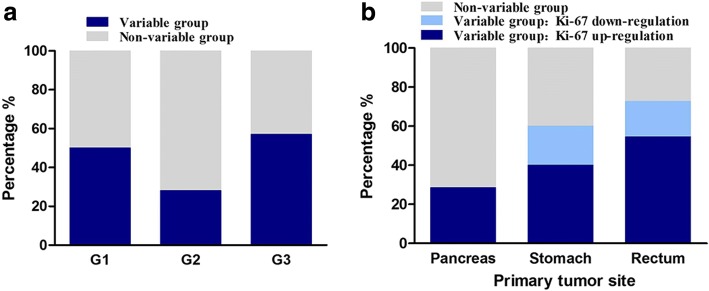
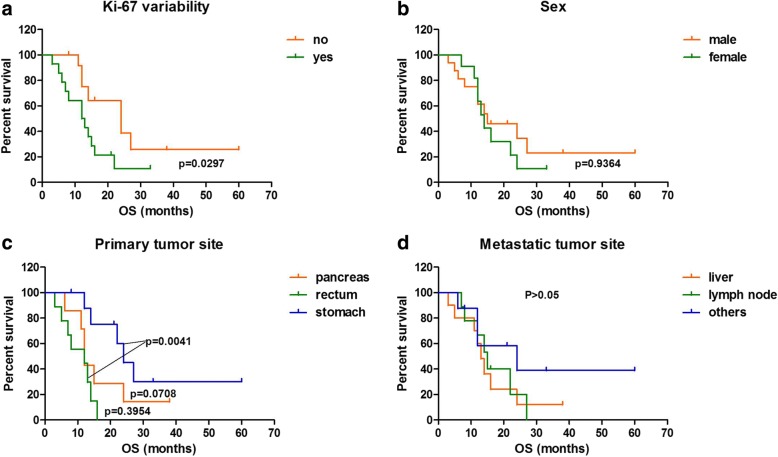
Among the 514 patients with GEP-NENs, metastases were seen in 182 (35.41%). Among the 30 patients from whom specimens with multiple pathologies were obtained, 24 were both primary and metastatic specimens and six were specimens collected over the course of the disease. Changes in Ki-67 levels were detected in 53.3% of the patients, of whom 40% had up-regulated Ki-67 levels, and 13.3% had down-regulated Ki-67 levels. Kaplan-Meier survival analysis showed that the group with Ki-67 variability had a shorter overall survival (p = 0.0297). The Cox regression analysis indicated that Ki-67 variability (p = 0.038) was the only independent prognostic factor for overall survival.
Our data suggest that patients with GEP-NENs and Ki-67 variability had a poorer prognosis. The re-assessment of Ki-67 at sites of metastasis or during the disease course might play a role in predicting the prognosis of patients with GEP-NENs. This finding could have implications for how GEP-NENs are monitored and treated.
胃肠胰神经内分泌肿瘤(GEP-NENs)中的Ki-67指数可能在疾病过程中发生变化。然而,Ki-67变异性对GEP-NENs的确切影响仍不清楚。本研究的目的是评估疾病过程中Ki-67水平的变化,并探讨Ki-67指数变异性在GEP-NENs中的作用。
从2009年7月至2018年2月在武汉协和医院接受治疗的514例GEP-NENs患者中选取30例患者,对其具有多种病理情况的标本进行评估。在疾病过程中对多个标本的Ki-67指数进行评估。进行单变量和多变量Cox比例风险回归分析,以评估各种临床和组织病理学特征的预后意义。
在514例GEP-NENs患者中,182例(35.41%)出现转移。在获得具有多种病理情况标本的30例患者中,24例为原发和转移标本,6例为疾病过程中采集的标本。53.3%的患者检测到Ki-67水平变化,其中40%的患者Ki-67水平上调,13.3%的患者Ki-67水平下调。Kaplan-Meier生存分析显示,Ki-67具有变异性的组总生存期较短(p = 0.0297)。Cox回归分析表明,Ki-67变异性(p = 0.038)是总生存期的唯一独立预后因素。
我们的数据表明,具有Ki-67变异性的GEP-NENs患者预后较差。在转移部位或疾病过程中重新评估Ki-67可能对预测GEP-NENs患者的预后起作用。这一发现可能对GEP-NENs的监测和治疗方式产生影响。