Department of Pharmacology and Toxicology and Higuchi Bioscience Center, University of Kansas, Lawrence, KS, 66047, USA.
State Key Laboratory of Oral Diseases, National Clinical Research Center for Oral Diseases, West China Hospital of Stomatology, Sichuan University, 610041, Cheng Du, China.
Nat Commun. 2018 Jul 30;9(1):2968. doi: 10.1038/s41467-018-04389-0.
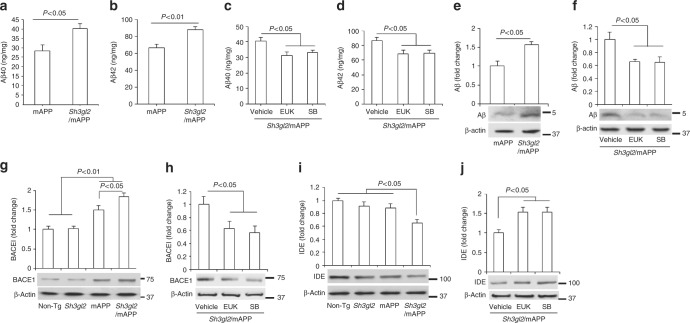
Endophilin A1 (EP) is a protein enriched in synaptic terminals that has been linked to Alzheimer's disease (AD). Previous in vitro studies have shown that EP can bind to a variety of proteins, which elicit changes in synaptic transmission of neurotransmitters and spine formation. Additionally, we previously showed that EP protein levels are elevated in AD patients and AD transgenic animal models. Here, we establish the in vivo consequences of upregulation of EP expression in amyloid-β peptide (Aβ)-rich environments, leading to changes in both long-term potentiation and learning and memory of transgenic animals. Specifically, increasing EP augmented cerebral Aβ accumulation. EP-mediated signal transduction via reactive oxygen species (ROS)/p38 mitogen-activated protein (MAP) kinase contributes to Aβ-induced mitochondrial dysfunction, synaptic injury, and cognitive decline, which could be rescued by blocking either ROS or p38 MAP kinase activity.
内收蛋白 A1(EP)是一种在突触末端富集的蛋白质,与阿尔茨海默病(AD)有关。以前的体外研究表明,EP 可以与多种蛋白质结合,这些蛋白质会引起神经递质突触传递和脊柱形成的变化。此外,我们之前还表明,AD 患者和 AD 转基因动物模型中的 EP 蛋白水平升高。在这里,我们在富含淀粉样β肽(Aβ)的环境中建立了 EP 表达上调的体内后果,导致转基因动物的长时程增强和学习记忆发生变化。具体而言,增加 EP 会增加大脑中的 Aβ 积累。EP 通过活性氧(ROS)/丝裂原活化蛋白激酶(MAP)激酶介导的信号转导导致 Aβ 诱导的线粒体功能障碍、突触损伤和认知能力下降,这可以通过阻断 ROS 或 p38 MAP 激酶活性来挽救。