CAS Key Laboratory of Pathogenic Microbiology and Immunology, Institute of Microbiology, Chinese Academy of Sciences (CAS), Beijing, People's Republic of China.
Cancer Institute and Hospital, Chinese Academy of Medical Sciences, Beijing, People's Republic of China.
Mol Cancer. 2018 Aug 2;17(1):113. doi: 10.1186/s12943-018-0862-5.
HER2 gene amplification generates an enormous number of HER2 transcripts, but the global effects on endogenous miRNA targets including HER family members in breast cancer are unexplored.
We generated a HER2-3'UTR expressing vector to test the tumor-promoting properties in HER2 low expressing T47D and MCF7 cells. Through microarray analysis and real-time PCR analysis we identified genes that were regulated by HER2-3'UTR. Positive and negative manipulation of miRNA expression, response element mutational studies and transcript reporter assays were performed to explore the mechanism of competitive sequestration of miR125a/miRNA125b by HER2 3'UTR. To investigate if trastuzumab-induced upregulation of HER3 is also mediated through miRNA de-repression, we used the CRISPR/cas9 to mutate the endogenous HER2 mRNA in HER2 over-expressing Au565 cells. Finally, we looked at cohorts of breast cancer samples of our own and the TCGA to show if HER2 and HER3 mRNAs correlate with each other.
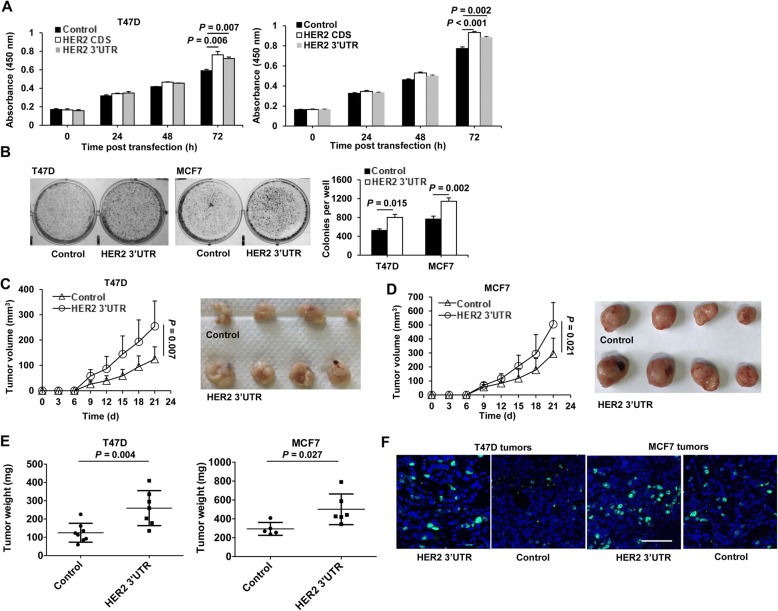
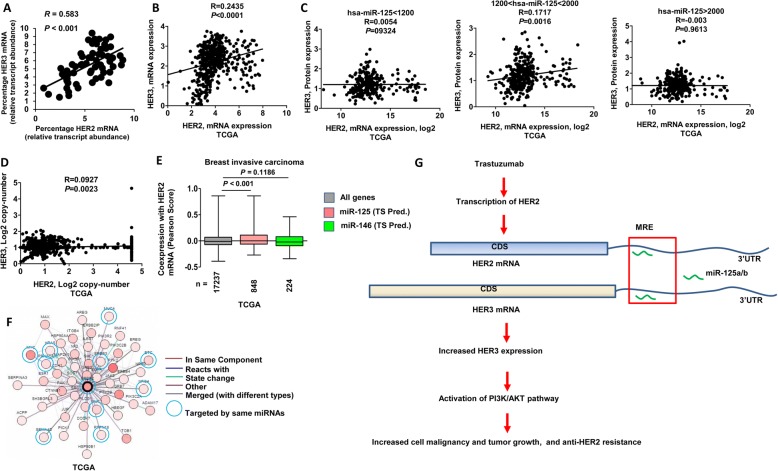
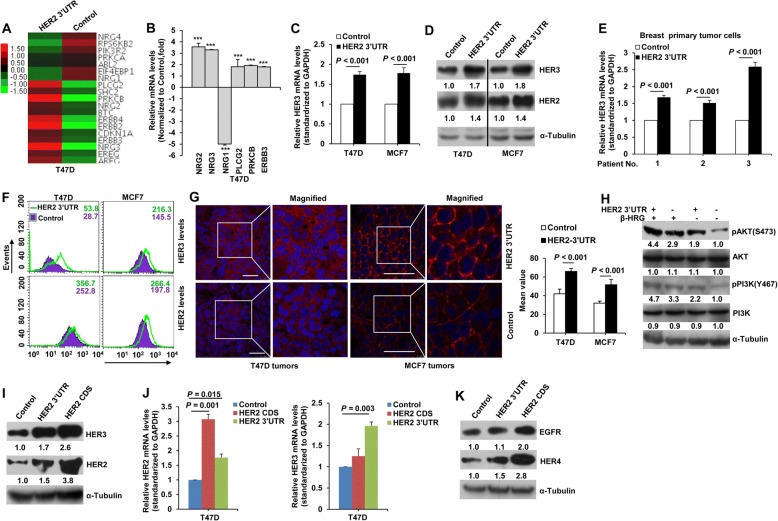
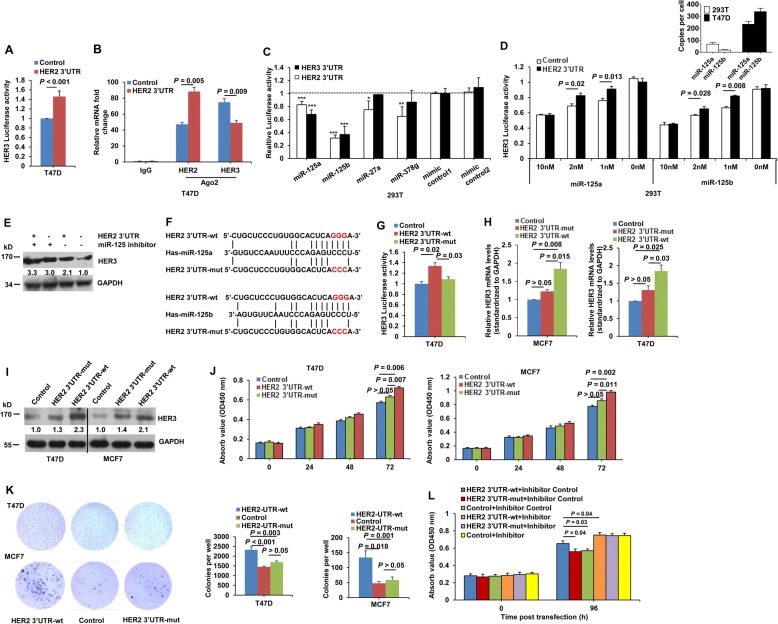
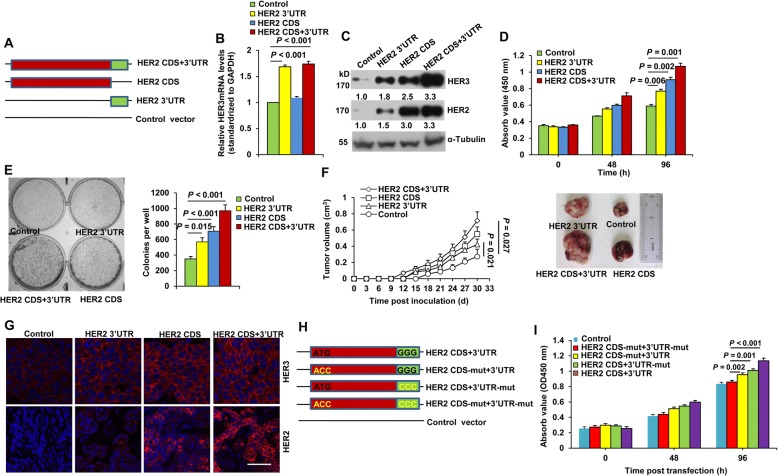
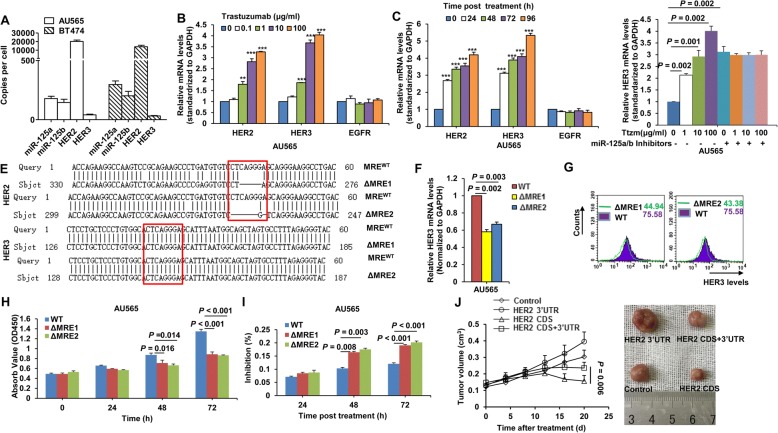
The HER2 3'UTR pronouncedly promoted cell proliferation, colony formation, and breast tumor growth. High-throughput sequencing revealed a significant increase in HER3 mRNA and protein levels by the HER2 3'untranslated region (3'UTR). The HER2 3'UTR harboring a shared miR-125a/b response element induced miR-125a/b sequestration and thus resulted in HER3 mRNA derepression. Trastuzumab treatment upregulated HER3 via elevated HER2 mRNA expression, leading to trastuzumab resistance. Depletion of miR-125a/b enhanced the antitumor activity of trastuzumab. Microarray data from HER2-overexpressing primary breast cancer showed significant elevation of mRNAs for predicted miR-125a/b targets compared to non-targets.
These results suggest that HER2 3'UTR-mediated HER3 upregulation is involved in breast cell transformation, increased tumor growth, and resistance to anti-HER2 therapy. The combinatorial targeting of HER3 mRNA or miR-125a/b may offer an effective tool for breast cancer therapy.
HER2 基因扩增产生了大量的 HER2 转录本,但在乳腺癌中,HER 家族成员等内源性 miRNA 靶标的全局影响仍未被探索。
我们构建了一个表达 HER2-3'UTR 的载体,以测试其在 HER2 低表达的 T47D 和 MCF7 细胞中的促肿瘤特性。通过微阵列分析和实时 PCR 分析,我们鉴定出受 HER2-3'UTR 调控的基因。通过 miRNA 表达的正、负调控,响应元件突变研究和转录报告基因分析,探索了 HER2 3'UTR 通过竞争性结合 miR125a/miRNA125b 来抑制 miRNA 表达的机制。为了研究曲妥珠单抗诱导的 HER3 上调是否也是通过 miRNA 去抑制介导的,我们使用 CRISPR/cas9 突变 HER2 过表达的 Au565 细胞中的内源性 HER2 mRNA。最后,我们观察了自己和 TCGA 的乳腺癌样本队列,以显示 HER2 和 HER3 mRNA 是否相互关联。
HER2 3'UTR 显著促进细胞增殖、集落形成和乳腺癌生长。高通量测序显示,HER2 非翻译区(3'UTR)显著增加了 HER3 mRNA 和蛋白水平。含有共享 miR-125a/b 反应元件的 HER2 3'UTR 诱导 miR-125a/b 结合,从而导致 HER3 mRNA 去抑制。曲妥珠单抗治疗通过上调 HER2 mRNA 表达而上调 HER3,导致曲妥珠单抗耐药。miR-125a/b 的耗竭增强了曲妥珠单抗的抗肿瘤活性。HER2 过表达的原发性乳腺癌的微阵列数据显示,与非靶标相比,预测的 miR-125a/b 靶标的 mRNA 显著升高。
这些结果表明,HER2 3'UTR 介导的 HER3 上调参与了乳腺癌细胞转化、肿瘤生长增加和抗 HER2 治疗耐药。HER3 mRNA 或 miR-125a/b 的联合靶向可能为乳腺癌治疗提供有效的工具。