From the Department of Therapeutic Discovery and
Department of Cardiometabolic Disorders, Amgen Discovery Research, Amgen Inc., South San Francisco, California 94080.
J Biol Chem. 2018 Sep 21;293(38):14678-14688. doi: 10.1074/jbc.RA118.004343. Epub 2018 Aug 1.
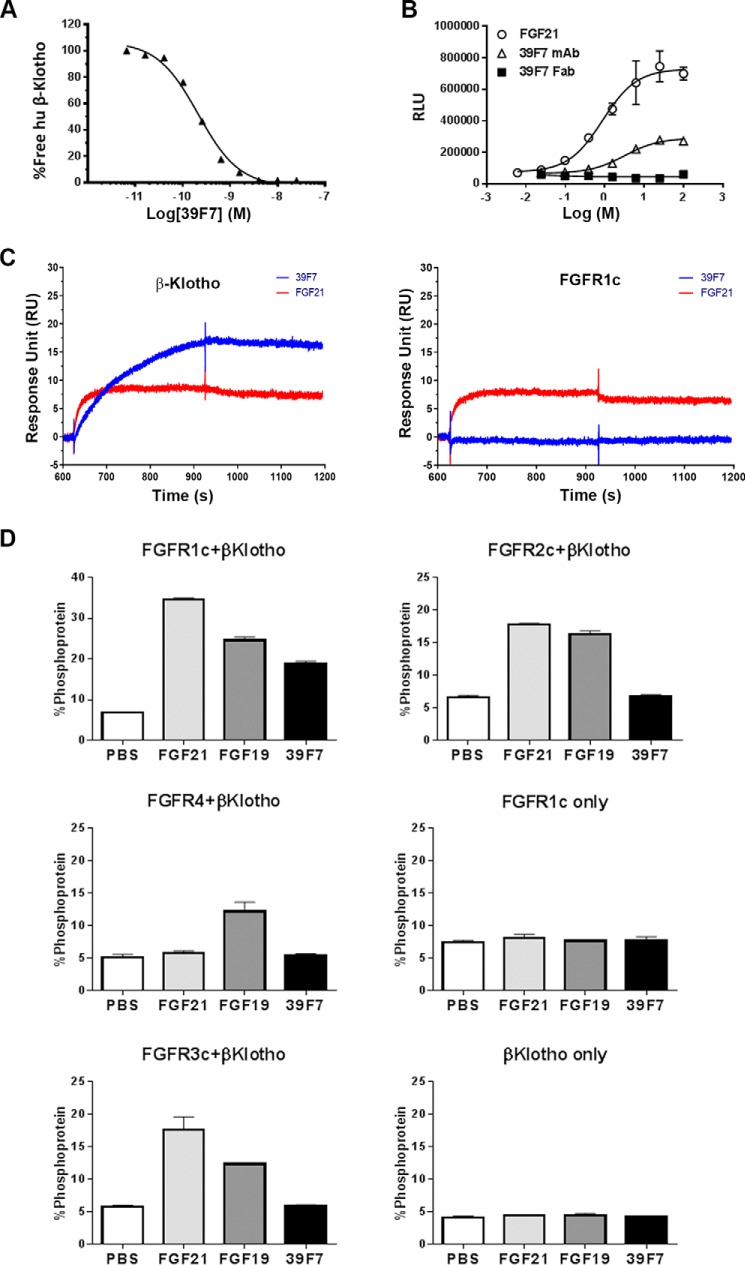
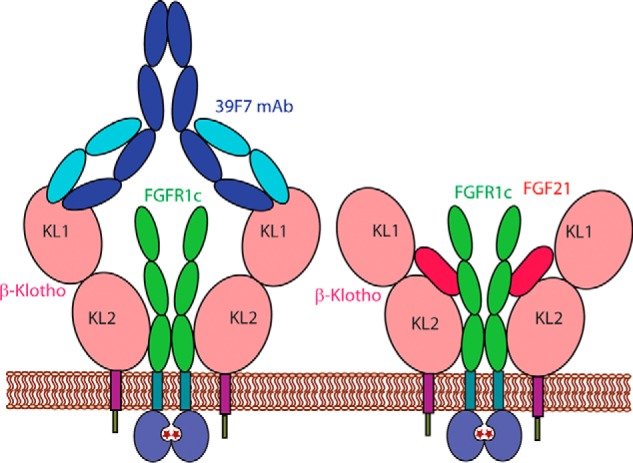
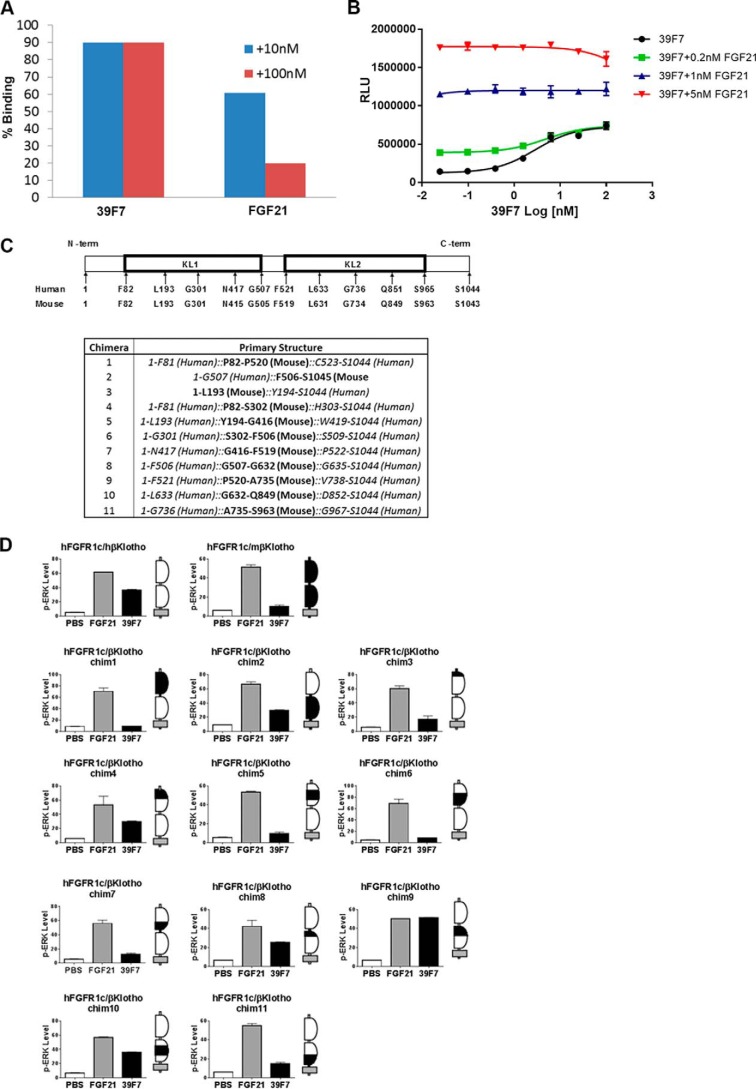
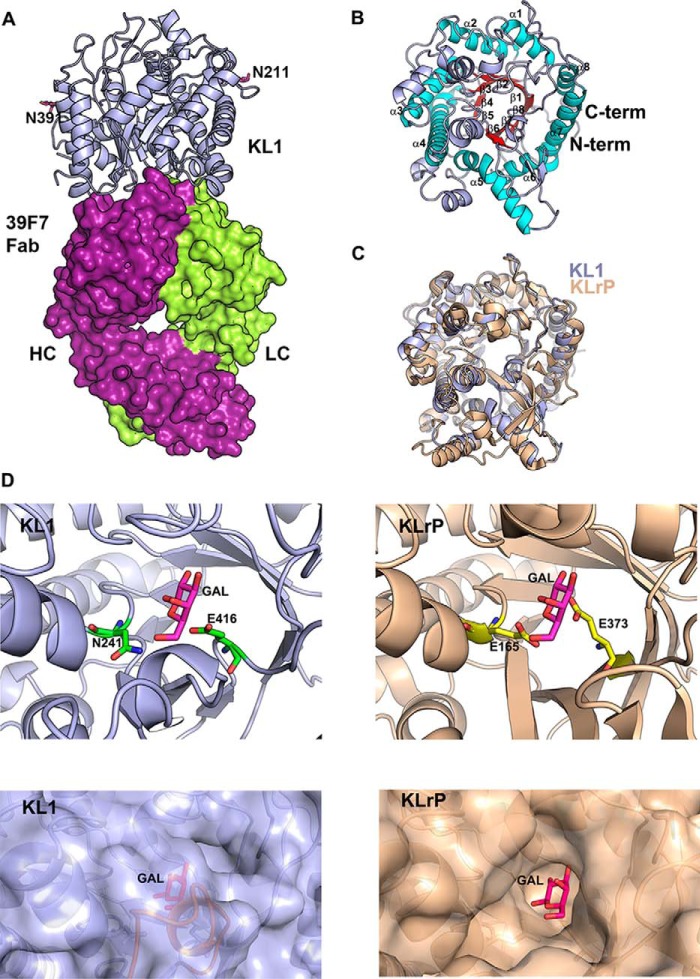
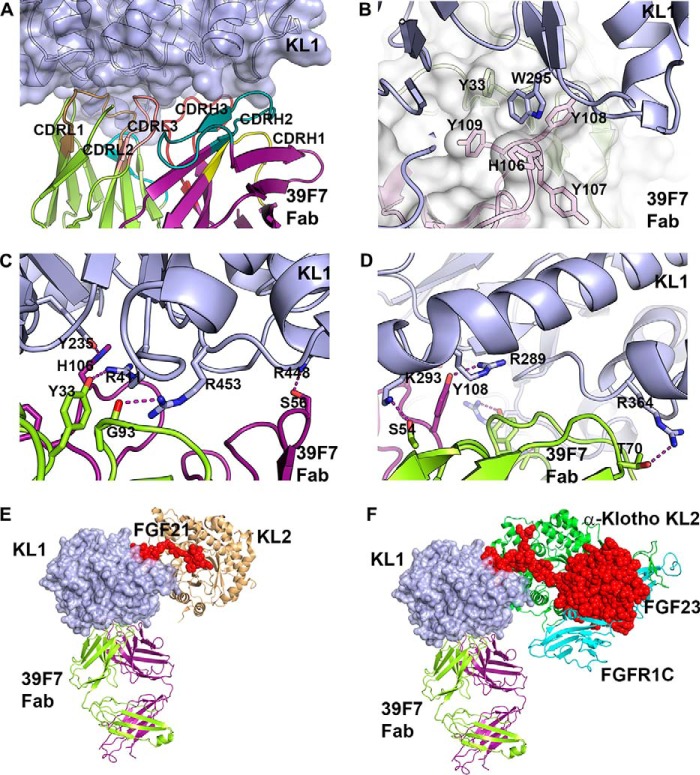
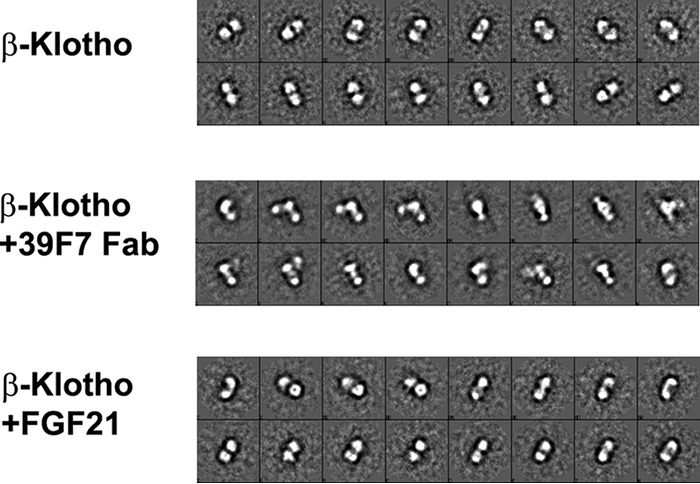
Fibroblast growth factor 21 (FGF21), an endocrine hormone in the FGF family, plays a critical role in regulating metabolic homeostasis and has emerged as a therapeutic target for metabolic diseases, including Type 2 diabetes mellitus. FGF21 functions through a receptor complex that consists of an FGF receptor (FGFR) and a co-receptor β-Klotho. Here, we identify and biochemically and structurally characterize 39F7, a high-affinity agonistic monoclonal antibody (mAb) against β-Klotho that mimics FGF21 function. The co-crystal structure of β-Klotho KL1 domain in complex with 39F7 Fab revealed that the recognition of 39F7 is centered on Trp-295 of β-Klotho in a FGF21 noncompetitive manner. KL1 adopts a (β/α) TIM barrel fold which resembles that of β-glycosylceramidase, but lacks molecular features for enzymatic activity, suggesting that KL1 functions as a scaffold protein instead. characterization demonstrated that, although 39F7 does not compete with FGF21, it is specific for β-Klotho/FGFR1c activation. Furthermore, the agonistic activity of 39F7 required the full IgG molecule to be bivalent, suggesting that 39F7 functions by promoting receptor/co-receptor dimerization. Supported by negative stain EM analysis of full-length β-Klotho, we propose a molecular model wherein the agonistic antibody 39F7 acts in a β-Klotho- and FGFR1c-dependent manner, mimicking FGF21 activity. More importantly, 39F7 offers promising therapeutic potential in the axis of FGF21 signaling as an antibody therapy alternative to FGF21 analogs for treatment of metabolic diseases.
成纤维细胞生长因子 21(FGF21)是 FGF 家族中的一种内分泌激素,在调节代谢稳态中起着关键作用,已成为包括 2 型糖尿病在内的代谢性疾病的治疗靶点。FGF21 通过由成纤维细胞生长因子受体(FGFR)和共同受体β-Klotho 组成的受体复合物发挥作用。在这里,我们鉴定并通过生物化学和结构表征了 39F7,这是一种针对β-Klotho 的高亲和力激动性单克隆抗体(mAb),可模拟 FGF21 的功能。β-Klotho KL1 结构域与 39F7 Fab 的复合物的共晶结构显示,39F7 的识别以非竞争性方式集中在β-Klotho 的色氨酸 295 上。KL1 采用(β/α)TIM 桶折叠,类似于β-糖苷神经酰胺酶,但缺乏酶活性的分子特征,表明 KL1 作为支架蛋白发挥作用。 表征表明,尽管 39F7 与 FGF21 不竞争,但它是β-Klotho/FGFR1c 激活的特异性。此外,39F7 的激动活性需要完整的 IgG 分子是二价的,这表明 39F7 通过促进受体/共同受体二聚化起作用。基于全长β-Klotho 的负染 EM 分析的支持,我们提出了一个分子模型,其中激动性抗体 39F7 以β-Klotho 和 FGFR1c 依赖的方式起作用,模拟 FGF21 的活性。更重要的是,39F7 作为 FGF21 信号轴的抗体治疗替代物,为治疗代谢性疾病提供了有前途的治疗潜力,可替代 FGF21 类似物。