Department of Physiology, Medical University, Innsbruck, Innsbruck, Austria.
J Cell Physiol. 2018 Dec;233(12):9045-9051. doi: 10.1002/jcp.26767. Epub 2018 Aug 2.
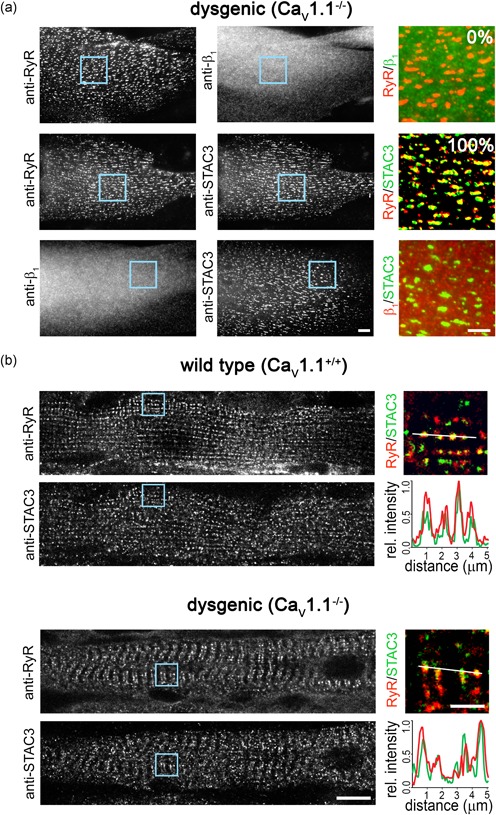
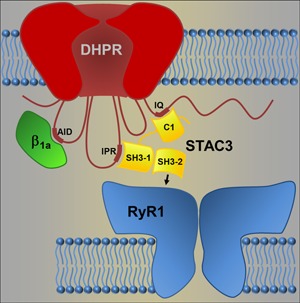
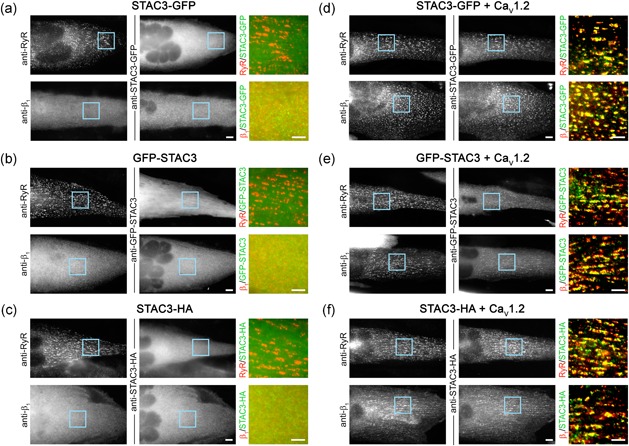
Excitation-contraction (EC) coupling in skeletal muscles operates through a physical interaction between the dihydropyridine receptor (DHPR), acting as a voltage sensor, and the ryanodine receptor (RyR1), acting as a calcium release channel. Recently, the adaptor protein SH3 and cysteine-rich containing protein 3 (STAC3) has been identified as a myopathy disease gene and as an additional essential EC coupling component. STAC3 interacts with DHPR sequences including the critical EC coupling domain and has been proposed to function in linking the DHPR and RyR1. However, we and others demonstrated that incorporation of recombinant STAC3 into skeletal muscle triads critically depends only on the DHPR but not the RyR1. On the contrary, here, we provide evidence that endogenous STAC3 incorporates into triads in the absence of the DHPR in myotubes and muscle fibers of dysgenic mice. This finding demonstrates that STAC3 interacts with additional triad proteins and is consistent with its proposed role in directly or indirectly linking the DHPR with the RyR1.
在骨骼肌中,兴奋-收缩(EC)偶联是通过电压传感器二氢吡啶受体(DHPR)与钙离子释放通道ryanodine 受体(RyR1)之间的物理相互作用来实现的。最近,衔接蛋白 SH3 和富含半胱氨酸的蛋白 3(STAC3)被确定为肌病疾病基因,并作为另一个重要的 EC 偶联组件。STAC3 与包括关键 EC 偶联结构域在内的 DHPR 序列相互作用,并被提议在连接 DHPR 和 RyR1 方面发挥作用。然而,我们和其他人的研究表明,重组 STAC3 掺入骨骼肌三联体仅取决于 DHPR,而不取决于 RyR1。相反,在这里,我们提供的证据表明,在肌营养不良小鼠的肌管和肌纤维中,内源性 STAC3 在没有 DHPR 的情况下也会掺入三联体。这一发现表明 STAC3 与其他三联体蛋白相互作用,这与其在直接或间接连接 DHPR 与 RyR1 方面的作用一致。