• 文献检索
  • 文档翻译
  • 深度研究
  • 学术资讯
  • Suppr Zotero 插件Zotero 插件
  • 邀请有礼
  • 套餐&价格
  • 历史记录
应用&插件
Suppr Zotero 插件Zotero 插件浏览器插件Mac 客户端Windows 客户端微信小程序
定价
高级版会员购买积分包购买API积分包
服务
文献检索文档翻译深度研究API 文档MCP 服务
关于我们
关于 Suppr公司介绍联系我们用户协议隐私条款
关注我们

Suppr 超能文献

核心技术专利:CN118964589B侵权必究
粤ICP备2023148730 号-1Suppr @ 2026

文献检索

告别复杂PubMed语法,用中文像聊天一样搜索,搜遍4000万医学文献。AI智能推荐,让科研检索更轻松。

立即免费搜索

文件翻译

保留排版,准确专业,支持PDF/Word/PPT等文件格式,支持 12+语言互译。

免费翻译文档

深度研究

AI帮你快速写综述,25分钟生成高质量综述,智能提取关键信息,辅助科研写作。

立即免费体验

在大黄石生态系统中,多种人为干预措施在狼恢复后推动美洲狮的生存。

Multiple anthropogenic interventions drive puma survival following wolf recovery in the Greater Yellowstone Ecosystem.

作者信息

Elbroch L Mark, Marescot Lucile, Quigley Howard, Craighead Derek, Wittmer Heiko U

机构信息

Panthera New York New York.

School of Biological Sciences Victoria University of Wellington Wellington New Zealand.

出版信息

Ecol Evol. 2018 Jun 25;8(14):7236-7245. doi: 10.1002/ece3.4264. eCollection 2018 Jul.

DOI:10.1002/ece3.4264
PMID:30073082
原文链接:https://pmc.ncbi.nlm.nih.gov/articles/PMC6065371/
Abstract

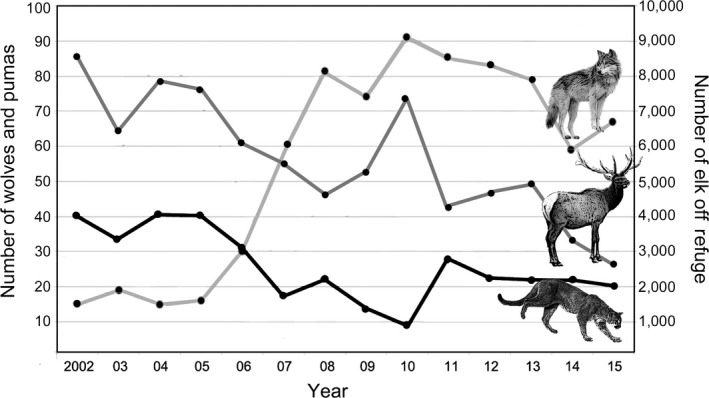
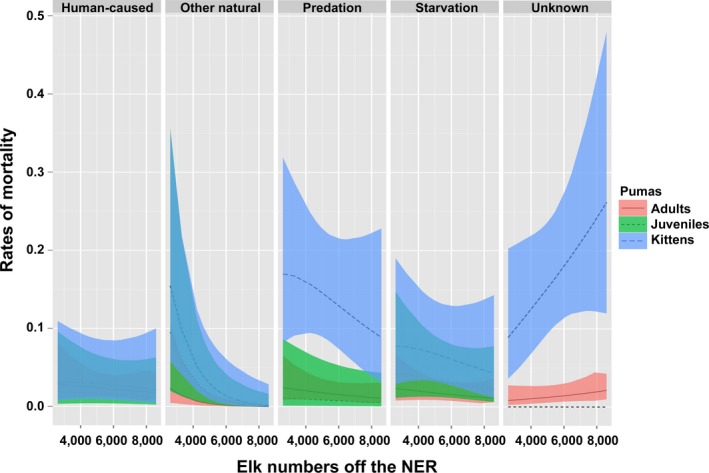
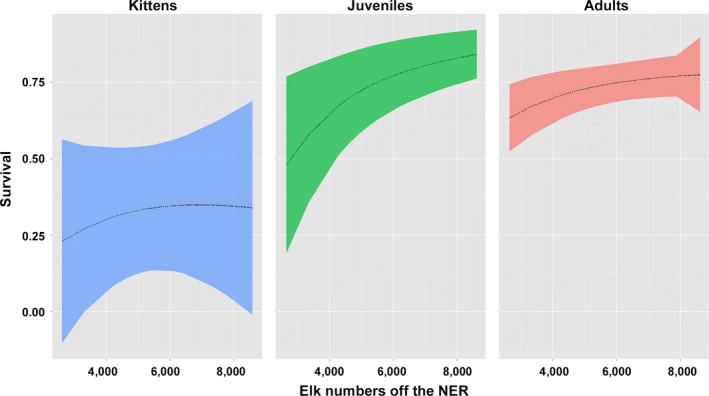
Humans are primary drivers of declining abundances and extirpation of large carnivores worldwide. Management interventions to restore biodiversity patterns, however, include carnivore reintroductions, despite the many unresolved ecological consequences associated with such efforts. Using multistate capture-mark-recapture models, we explored age-specific survival and cause-specific mortality rates for 134 pumas () monitored in the Greater Yellowstone Ecosystem during gray wolf () recovery. We identified two top models explaining differences in puma survivorship, and our results suggested three management interventions (unsustainable puma hunting, reduction in a primary prey, and reintroduction of a dominant competitor) have unintentionally impacted puma survival. Specifically, puma survival across age classes was lower in the 6-month hunting season than the 6-month nonhunting season; human-caused mortality rates for juveniles and adults, and predation rates on puma kittens, were higher in the hunting season. Predation on puma kittens, and starvation rates for all pumas, also increased as managers reduced elk () abundance in the system, highlighting direct and indirect effects of competition between recovering wolves and pumas over prey. Our results emphasize the importance of understanding the synergistic effects of existing management strategies and the recovery of large, dominant carnivores to effectively conserve subordinate, hunted carnivores in human-dominated landscapes.

摘要

人类是全球大型食肉动物数量减少和灭绝的主要驱动因素。然而,尽管与食肉动物重新引入相关的许多生态后果尚未得到解决,但恢复生物多样性模式的管理干预措施仍包括食肉动物的重新引入。我们使用多状态捕获-重捕模型,研究了在黄石国家公园生态系统灰狼恢复期间监测的134只美洲狮的年龄特异性存活率和死因特异性死亡率。我们确定了两个解释美洲狮存活率差异的顶级模型,我们的结果表明,三种管理干预措施(不可持续的美洲狮狩猎、主要猎物数量的减少以及优势竞争者的重新引入)无意中影响了美洲狮的生存。具体而言,在6个月的狩猎季节中,各年龄组的美洲狮存活率低于6个月的非狩猎季节;在狩猎季节,幼年和成年美洲狮的人为死亡率以及美洲狮幼崽的被捕食率更高。随着管理者减少系统中麋鹿的数量,美洲狮幼崽的被捕食率以及所有美洲狮的饥饿率也有所增加,这突出了正在恢复的狼和美洲狮在猎物竞争上的直接和间接影响。我们的结果强调了理解现有管理策略与大型优势食肉动物恢复之间的协同效应对于在人类主导的景观中有效保护从属的、被捕猎的食肉动物的重要性。
https://cdn.ncbi.nlm.nih.gov/pmc/blobs/237a/6065371/c5cd831084a1/ECE3-8-7236-g003.jpg
https://cdn.ncbi.nlm.nih.gov/pmc/blobs/237a/6065371/b83605278329/ECE3-8-7236-g001.jpg
https://cdn.ncbi.nlm.nih.gov/pmc/blobs/237a/6065371/477b533df8f2/ECE3-8-7236-g002.jpg
https://cdn.ncbi.nlm.nih.gov/pmc/blobs/237a/6065371/c5cd831084a1/ECE3-8-7236-g003.jpg
https://cdn.ncbi.nlm.nih.gov/pmc/blobs/237a/6065371/b83605278329/ECE3-8-7236-g001.jpg
https://cdn.ncbi.nlm.nih.gov/pmc/blobs/237a/6065371/477b533df8f2/ECE3-8-7236-g002.jpg
https://cdn.ncbi.nlm.nih.gov/pmc/blobs/237a/6065371/c5cd831084a1/ECE3-8-7236-g003.jpg

相似文献

1
Multiple anthropogenic interventions drive puma survival following wolf recovery in the Greater Yellowstone Ecosystem.在大黄石生态系统中,多种人为干预措施在狼恢复后推动美洲狮的生存。
Ecol Evol. 2018 Jun 25;8(14):7236-7245. doi: 10.1002/ece3.4264. eCollection 2018 Jul.
2
Are pumas subordinate carnivores, and does it matter?美洲狮是次级食肉动物吗?这重要吗?
PeerJ. 2018 Jan 24;6:e4293. doi: 10.7717/peerj.4293. eCollection 2018.
3
Reintroduced wolves and hunting limit the abundance of a subordinate apex predator in a multi-use landscape.重新引入的狼群和狩猎活动限制了多用途景观中一种从属顶级捕食者的数量。
Proc Biol Sci. 2020 Nov 11;287(1938):20202202. doi: 10.1098/rspb.2020.2202.
4
Cougars, wolves, and humans drive a dynamic landscape of fear for elk.美洲狮、狼和人类给麋鹿带来了充满恐惧的动态景观。
Ecology. 2024 Apr;105(4):e4255. doi: 10.1002/ecy.4255. Epub 2024 Feb 15.
5
Recolonizing wolves influence the realized niche of resident cougars.重新定居的狼会影响当地美洲狮的实际生态位。
Zool Stud. 2015 May 14;54:e41. doi: 10.1186/s40555-015-0122-y. eCollection 2015.
6
A global assessment of large terrestrial carnivore kill rates.大型陆生食肉动物捕杀率的全球评估。
Biol Rev Camb Philos Soc. 2025 Feb;100(1):327-350. doi: 10.1111/brv.13143. Epub 2024 Sep 11.
7
Do prey select for vacant hunting domains to minimize a multi-predator threat?被捕食者是否会选择空旷的狩猎领域,以最小化多种捕食者的威胁?
Ecol Lett. 2019 Nov;22(11):1724-1733. doi: 10.1111/ele.13319. Epub 2019 Aug 2.
8
Mesocarnivores vary in their spatiotemporal avoidance strategies at communications hubs of an apex carnivore.中肉食性动物在顶级肉食动物通讯枢纽处的时空回避策略存在差异。
Oecologia. 2024 Apr;204(4):805-813. doi: 10.1007/s00442-024-05541-y. Epub 2024 Apr 2.
9
Elk migration patterns and human activity influence wolf habitat use in the Greater Yellowstone Ecosystem.麋鹿的迁徙模式和人类活动影响大黄石生态系统中狼的栖息地利用。
Ecol Appl. 2012 Dec;22(8):2293-307. doi: 10.1890/11-1829.1.
10
Seasonal patterns of predation for gray wolves in the multi-prey system of Yellowstone National Park.黄石国家公园多猎物系统中灰狼的捕食季节性模式。
J Anim Ecol. 2012 May;81(3):553-63. doi: 10.1111/j.1365-2656.2011.01945.x. Epub 2012 Jan 19.

引用本文的文献

1
Newcastle disease virus transmission dynamics in wild peridomestic birds in the United Arab Emirates.阿联酋野生家禽中新城疫病毒传播动力学。
Sci Rep. 2021 Feb 10;11(1):3491. doi: 10.1038/s41598-020-79184-3.
2
Reintroduced wolves and hunting limit the abundance of a subordinate apex predator in a multi-use landscape.重新引入的狼群和狩猎活动限制了多用途景观中一种从属顶级捕食者的数量。
Proc Biol Sci. 2020 Nov 11;287(1938):20202202. doi: 10.1098/rspb.2020.2202.

本文引用的文献

1
Recolonizing wolves influence the realized niche of resident cougars.重新定居的狼会影响当地美洲狮的实际生态位。
Zool Stud. 2015 May 14;54:e41. doi: 10.1186/s40555-015-0122-y. eCollection 2015.
2
Why men trophy hunt.为什么男性进行战利品狩猎。
Biol Lett. 2017 Mar;13(3). doi: 10.1098/rsbl.2016.0909.
3
Study design and interpretation of mammalian carnivore density estimates.哺乳动物食肉动物密度估计的研究设计与解读。
Oecologia. 1998 Feb;113(4):474-491. doi: 10.1007/s004420050400.
4
Prey depletion as a threat to the world's large carnivores.猎物减少对全球大型食肉动物构成的威胁。
R Soc Open Sci. 2016 Aug 3;3(8):160252. doi: 10.1098/rsos.160252. eCollection 2016 Aug.
5
Managing more than the mean: using quantile regression to identify factors related to large elk groups.管理超过均值的情况:使用分位数回归来识别与大型麋鹿群体相关的因素。
J Appl Ecol. 2015 Dec;52(6):1656-1664. doi: 10.1111/1365-2664.12514. Epub 2015 Aug 27.
6
HUMAN IMPACTS. The unique ecology of human predators.人类的影响。人类捕食者的独特生态。
Science. 2015 Aug 21;349(6250):858-60. doi: 10.1126/science.aac4249.
7
The comparative effects of large carnivores on the acquisition of carrion by scavengers.大型食肉动物对食腐动物获取腐肉的比较影响。
Am Nat. 2015 Jun;185(6):822-33. doi: 10.1086/681004. Epub 2015 Mar 19.
8
Recovery of large carnivores in Europe's modern human-dominated landscapes.欧洲现代人类主导景观中大食肉动物的恢复。
Science. 2014 Dec 19;346(6216):1517-9. doi: 10.1126/science.1257553.
9
Reversing defaunation: restoring species in a changing world.反刍动物群灭绝:在不断变化的世界中恢复物种。
Science. 2014 Jul 25;345(6195):406-12. doi: 10.1126/science.1251818.
10
Ecosystem scale declines in elk recruitment and population growth with wolf colonization: a before-after-control-impact approach.狼的迁入导致生态系统尺度上麋鹿补充率和种群增长下降:一种前后对照影响研究方法
PLoS One. 2014 Jul 16;9(7):e102330. doi: 10.1371/journal.pone.0102330. eCollection 2014.