Gonçalves Lucas Braz, Miot Helio Amante, Domingues Maria Aparecida Custódio, Oliveira Cristiano Claudino
School of Medicine of Botucatu, São Paulo State University, FMB-UNESP, Botucatu, Brazil.
Department of Dermatology and Radiotherapy, School of Medicine of Botucatu, São Paulo State University, FMB-UNESP, Botucatu, Brazil.
Clin Med Insights Pathol. 2018 Jul 30;11:1179555718791575. doi: 10.1177/1179555718791575. eCollection 2018.
The objectives of this study were the evaluation of pathological characteristics of patients with obesity or metabolic syndrome (MS) as basic cause of death, associating the autopsy findings with some clinical aspects and the abdominal adipose panicle thickness.
A total of 88 autopsy cases were studied, divided into 2 groups based on the main cause of death: group 1 (n = 15) obesity and group 2 (n = 73) MS. Clinical summaries of autopsy requests, macroscopic findings, and histologic sections were reviewed.
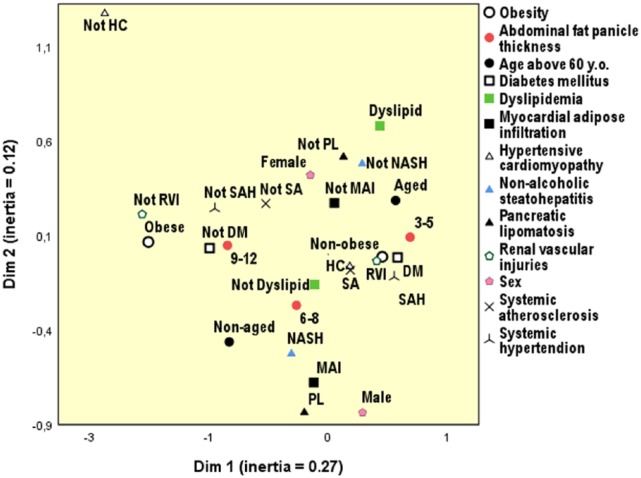
The definition of obesity as the basic cause of death is associated with larger thickness of the abdominal adipose panicle, being 8.5 cm ( = .001) the best measurement, according to the receiver operating characteristic curve. Hypertensive cardiopathy ( = .001), ischemic cardiopathy ( = .003), coronary ( = .008)/systemic ( = .005) atherosclerosis, and arterial ( = .014)/arteriolar ( = .027) nephrosclerosis are associated with the diagnosis of MS. Steatohepatitis is associated with the diagnosis of obesity ( = .030); however, its association with the thickness of the abdominal adipose panicle is not statistically significant ( = .211).
In the context of an obese patient in autopsy, pathologist may use the information about abdominal adipose panicle associated with heart, kidney, and liver findings, even macroscopic ones, to decide the basic cause death between obesity and MS.
本研究的目的是评估以肥胖或代谢综合征(MS)作为根本死因的患者的病理特征,将尸检结果与一些临床方面以及腹部脂肪层厚度相关联。
共研究了88例尸检病例,根据主要死因分为2组:第1组(n = 15)为肥胖组,第2组(n = 73)为MS组。回顾了尸检申请的临床总结、宏观检查结果和组织学切片。
根据受试者工作特征曲线,将肥胖定义为根本死因与腹部脂肪层厚度较大相关,8.5厘米(P = 0.001)是最佳测量值。高血压性心脏病(P = 0.001)、缺血性心脏病(P = 0.003)、冠状动脉(P = 0.008)/全身性(P = 0.005)动脉粥样硬化以及动脉性(P = 0.014)/小动脉性(P = 0.027)肾硬化与MS的诊断相关。脂肪性肝炎与肥胖的诊断相关(P = 0.030);然而,其与腹部脂肪层厚度的关联无统计学意义(P = 0.211)。
在肥胖患者尸检的情况下,病理学家可利用与心脏、肾脏和肝脏发现相关的腹部脂肪层信息,即使是宏观信息,来确定肥胖和MS之间的根本死因。