Bang Oh Young, Chung Jong-Won, Son Jeong Pyo, Ryu Wi-Sun, Kim Dong-Eog, Seo Woo-Keun, Kim Gyeong-Moon, Kim Yoon-Chul
Department of Neurology, Samsung Medical Center, Sungkyunkwan University School of Medicine, Seoul, South Korea.
Department of Health Sciences and Technology, Samsung Advanced Institute for Health Sciences and Technology, Sungkyunkwan University, Seoul, South Korea.
Front Neurol. 2018 Jul 24;9:586. doi: 10.3389/fneur.2018.00586. eCollection 2018.
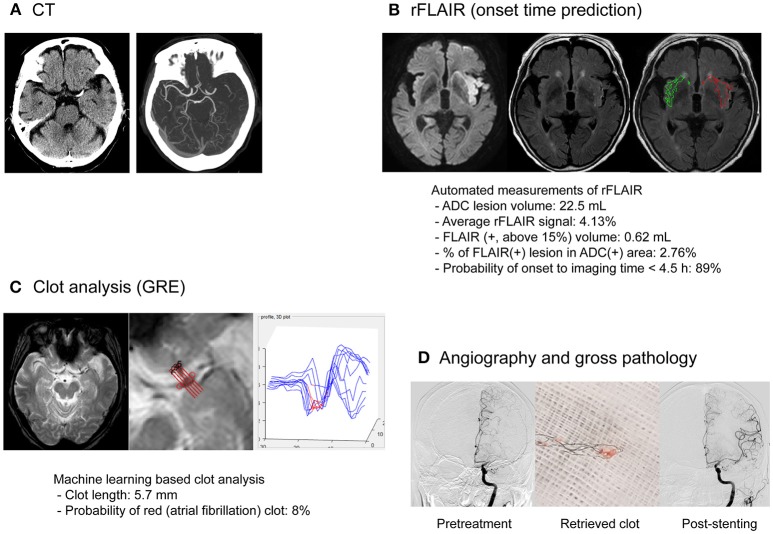
Revascularization therapies have been established as the treatment mainstay for acute ischemic stroke. However, a substantial number of patients are either ineligible for revascularization therapy, or the treatment fails or is futile. At present, non-contrast computed tomography is the first-line neuroimaging modality for patients with acute stroke. The use of magnetic resonance imaging (MRI) to predict the response to early revascularization therapy and to identify patients for delayed treatment is desirable. MRI could provide information on stroke pathophysiologies, including the ischemic core, perfusion, collaterals, clot, and blood-brain barrier status. During the past 20 years, there have been significant advances in neuroimaging as well as in revascularization strategies for treating patients with acute ischemic stroke. In this review, we discuss the role of MRI and post-processing, including machine-learning techniques, and recent advances in MRI-based triage for revascularization therapies in acute ischemic stroke.
血管再通治疗已成为急性缺血性卒中的主要治疗手段。然而,相当一部分患者要么不符合血管再通治疗的条件,要么治疗失败或无效。目前,非增强计算机断层扫描是急性卒中患者的一线神经影像学检查方法。使用磁共振成像(MRI)来预测早期血管再通治疗的反应并识别适合延迟治疗的患者是很有必要的。MRI可以提供有关卒中病理生理学的信息,包括缺血核心、灌注、侧支循环、血栓和血脑屏障状态。在过去20年中,神经影像学以及治疗急性缺血性卒中患者的血管再通策略都取得了重大进展。在本综述中,我们讨论了MRI及其后处理(包括机器学习技术)的作用,以及基于MRI的急性缺血性卒中血管再通治疗分诊的最新进展。