Maddox D A, Horn J F, Famiano F C, Gennari F J
J Clin Invest. 1986 May;77(5):1639-49. doi: 10.1172/JCI112481.
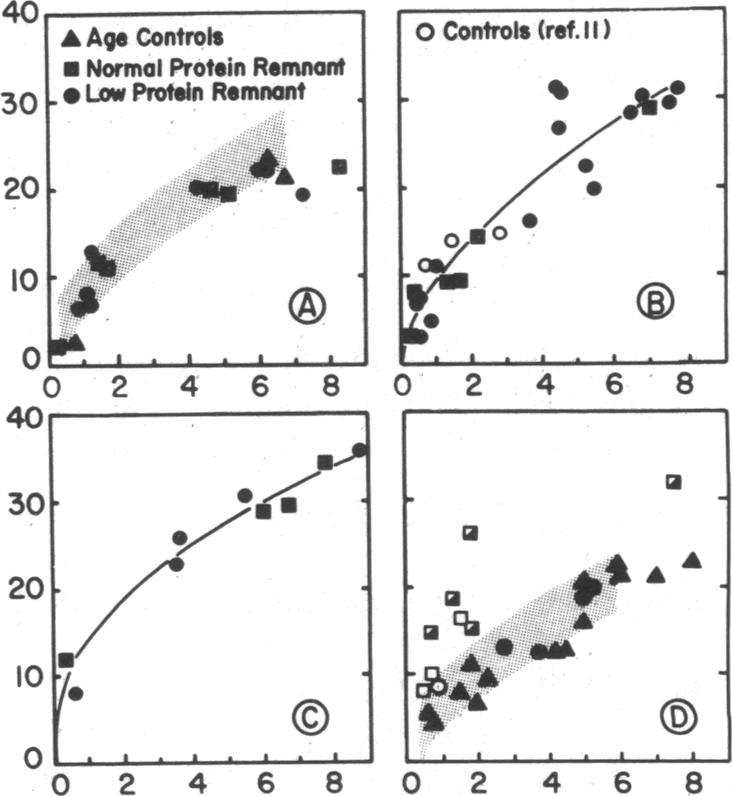
Studies were undertaken to characterize the pattern of proximal tubular fluid (APRH2O) and bicarbonate reabsorption (APRHCO3) in the remnant kidney of euvolemic Munich-Wistar rats. The remnant kidney rats were placed on a diet containing either low or normal protein. Collections were obtained in the early, mid-, and late proximal convoluted tubule. Single nephron glomerular filtration rate (SNGFR) increased from 40.2 nl/min in controls to 58.8 nl/min in low protein remnant kidney and 78.1 nl/min in normal protein remnant kidney rats. The filtered load of bicarbonate was 1,272, 1,641, and 2,013 pmol/min, in the three groups, respectively. APRH2O and APRHCO3 increased nearly in parallel. Most of the increase in reabsorption occurred in the early proximal tubule. Tubular hypertrophy could account for at least 20-40% of the increase in reabsorption, but the majority of the increase appeared to be a delivery-dependent response similar to that observed in normal rats after an acute increase in SNGFR.
开展了多项研究,以描述血容量正常的慕尼黑-威斯塔大鼠残余肾近端小管液(APRH2O)和碳酸氢盐重吸收(APRHCO3)的模式。将残余肾大鼠置于低蛋白或正常蛋白饮食中。在近端曲小管的早期、中期和晚期进行收集。单肾单位肾小球滤过率(SNGFR)从对照组的40.2 nl/min增加到低蛋白残余肾大鼠的58.8 nl/min和正常蛋白残余肾大鼠的78.1 nl/min。三组中碳酸氢盐的滤过量分别为1272、1641和2013 pmol/min。APRH2O和APRHCO3几乎平行增加。重吸收增加的大部分发生在近端小管早期。肾小管肥大至少可解释重吸收增加的20%-40%,但增加的大部分似乎是一种与正常大鼠SNGFR急性增加后观察到的类似的依赖于输送的反应。