Infectious Diseases Unit, Ospedale Policlinico San Martino - IRCCS per l'Oncologia and Department of Health Science (DISSAL), University of Genoa, Genoa, Italy.
Department of Sciences, Section Biomedical Sciences and Technology, Roma Tre University, Rome, Italy.
Sci Rep. 2018 Aug 10;8(1):11968. doi: 10.1038/s41598-018-30361-5.
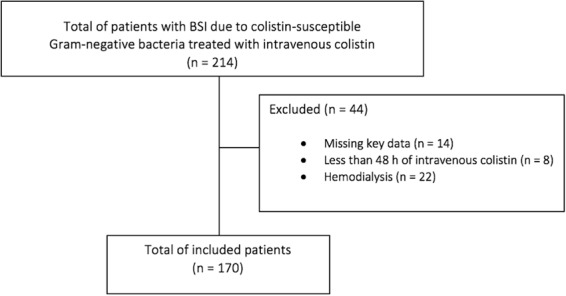
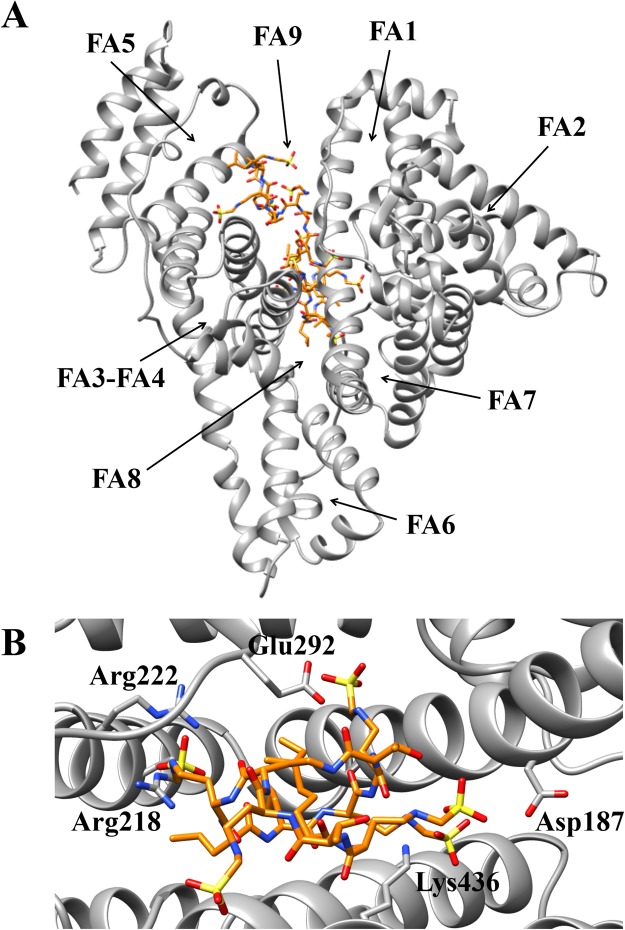
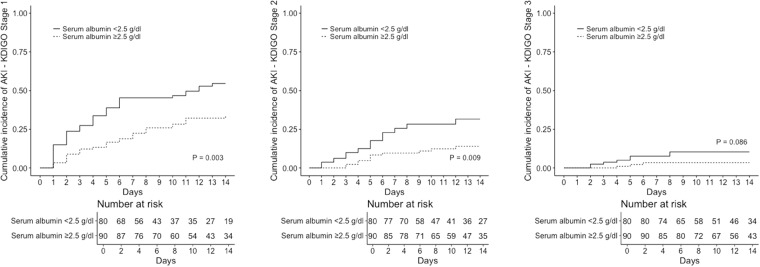
This study aimed to assess the predictors of acute kidney injury (AKI) during colistin therapy in a cohort of patients with bloodstream infections (BSI) due to colistin-susceptible Gram-negative bacteria, focusing on the role of serum albumin levels. The study consisted of two parts: (1) a multicentre retrospective clinical study to assess the predictors of AKI during colistin therapy, defined according to the Kidney Disease: Improving Global Outcomes (KDIGO) criteria; and (2) bioinformatic and biochemical characterization of the possible interaction between human serum albumin and colistin. Among the 170 patients included in the study, 71 (42%), 35 (21%), and 11 (6%) developed KDIGO stage 1 (K1-AKI), KDIGO stage 2 (K2-AKI), and KDIGO stage 3 (K3-AKI), respectively. In multivariable analyses, serum albumin <2.5 g/dL was independently associated with K1-AKI (subdistribution hazard ratio [sHR] 1.85, 95% confidence interval [CI] 1.17-2.93, p = 0.009) and K2-AKI (sHR 2.37, 95% CI 1.15-4.87, p = 0.019). Bioinformatic and biochemical analyses provided additional information nurturing the discussion on how hypoalbuminemia favors development of AKI during colistin therapy. In conclusion, severe hypoalbuminemia independently predicted AKI during colistin therapy in a large cohort of patients with BSI due to colistin-susceptible Gram-negative bacteria. Further study is needed to clarify the underlying causal pathways.
本研究旨在评估对因对多黏菌素敏感的革兰氏阴性菌引起血流感染(BSI)的患者进行多黏菌素治疗期间发生急性肾损伤(AKI)的预测因素,重点关注血清白蛋白水平的作用。该研究由两部分组成:(1)一项多中心回顾性临床研究,以评估根据肾脏疾病:改善全球预后(KDIGO)标准定义的多黏菌素治疗期间 AKI 的预测因素;(2)对人血清白蛋白和多黏菌素之间可能相互作用的生物信息学和生化特征的研究。在纳入的 170 名患者中,分别有 71 名(42%)、35 名(21%)和 11 名(6%)患者发展为 KDIGO 第 1 期(K1-AKI)、KDIGO 第 2 期(K2-AKI)和 KDIGO 第 3 期(K3-AKI)。在多变量分析中,血清白蛋白<2.5g/dL 与 K1-AKI(亚分布风险比[sHR] 1.85,95%置信区间[CI] 1.17-2.93,p=0.009)和 K2-AKI(sHR 2.37,95%CI 1.15-4.87,p=0.019)独立相关。生物信息学和生化分析提供了额外的信息,为讨论低白蛋白血症如何在多黏菌素治疗期间促进 AKI 的发生提供了依据。总之,严重的低白蛋白血症独立预测了因对多黏菌素敏感的革兰氏阴性菌引起的 BSI 患者进行多黏菌素治疗期间 AKI 的发生。需要进一步研究以阐明潜在的因果途径。