Hamdan Abdul-Latif, Rizk Marwan, Khalifee Elie, Ziade Georges, Kasti Maher
Department of Otolaryngology and Head & Neck Surgery, American University of Beirut-Medical Center, Lebanon.
Department of Anesthesiology, American University of Beirut-Medical Center, Lebanon.
World J Otorhinolaryngol Head Neck Surg. 2018 Jul 4;4(2):130-134. doi: 10.1016/j.wjorl.2018.04.005. eCollection 2018 Jun.
To report voice outcome measures after injection laryngoplasty using the transnasal or transoral flexible endoscopic technique.
A retrospective review of all patients who underwent flexible endoscopic injection laryngoplasty between June 2010 and August 2016 was carried out. Only those patients who had pre- and post-injection voice outcome measures recorded were included. Voice outcome measures recorded included perceptual voice evaluation using GRBAS, Voice Handicap Index-10 (VHI-10), maximum phonation time (MPT) and closed quotient (CQ) before and after treatment.
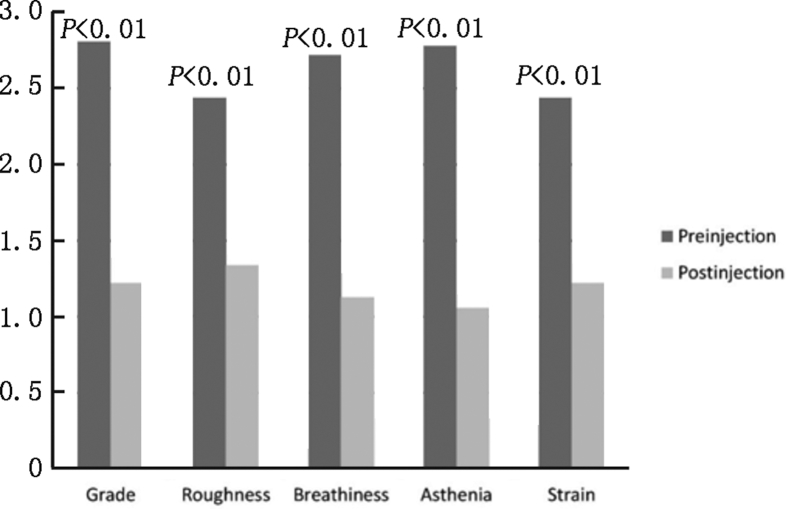
Forty-six patients were identified, of which 32 had pre- and post-injection voice outcome measures recorded. There were 19 males and 13 females. The mean age was 56.97 years (range 20-86 years) and the most common indication was unilateral vocal fold paralysis. Thirteen patients had a transnasal flexible endoscopic injection), while 19 patients were injected transorally. Following injection laryngoplasty, there was significant improvement in the mean grade of dysphonia (2.81 1.22, < 0.01, roughness (2.44 1.34, < 0.01), breathiness (2.72 1.13, < 0.01), asthenia (2.78 1.06, < 0.01), and strain (2.44 1.19, < 0.01), MPT (3.85 s 9.85 s, < 0.01) and mean CQ (0.19 0.46, < 0.01). There was also a decrease in the mean VHI-10 score (33.31 7.94, < 0.01).
s: Patients achieved significant improvement in both subjective and objective voice measures after flexible endoscopic injection laryngoplasty via the nasal or transoral route. Voice outcomes were comparable to those reported for other approaches. This technique provides an alternative approach for the management of patients with vocal fold paralysis or glottal insufficiency.
报告经鼻或经口柔性内镜技术进行注射喉成形术后的嗓音结果指标。
对2010年6月至2016年8月期间接受柔性内镜注射喉成形术的所有患者进行回顾性研究。仅纳入那些记录了注射前后嗓音结果指标的患者。记录的嗓音结果指标包括使用GRBAS进行的嗓音感知评估、嗓音障碍指数-10(VHI-10)、治疗前后的最长发声时间(MPT)和闭合商(CQ)。
共确定46例患者,其中32例记录了注射前后的嗓音结果指标。男性19例,女性13例。平均年龄56.97岁(范围20 - 86岁),最常见的适应证是单侧声带麻痹。13例患者接受经鼻柔性内镜注射,19例患者接受经口注射。注射喉成形术后,嗓音障碍平均分级(2.81±1.22,P<0.01)、粗糙(2.44±1.34,P<0.01)、气息声(2.72±1.13,P<0.01)、无力(2.78±1.06,P<0.01)和紧张(2.44±1.19,P<0.01)、MPT(3.85 s±9.85 s,P<0.01)及平均CQ(0.19±0.46,P<0.01)均有显著改善。平均VHI-10评分也有所降低(33.31±7.94,P<0.01)。
经鼻或经口柔性内镜注射喉成形术后,患者在主观和客观嗓音指标方面均取得了显著改善。嗓音结果与其他方法报告的结果相当。该技术为声带麻痹或声门闭合不全患者的治疗提供了一种替代方法。