Department of Neurology, The Fourth Affiliated Hospital of China Medical University, Shenyang, Liaoning, China (mainland).
Department of Neurology and Neuroscience, Shenyang First People's Hospital, Shenyang Brain Hospital, Shenyang Brain Institute, Shenyang, Liaoning, China (mainland).
Med Sci Monit. 2018 Aug 13;24:5635-5644. doi: 10.12659/MSM.908765.
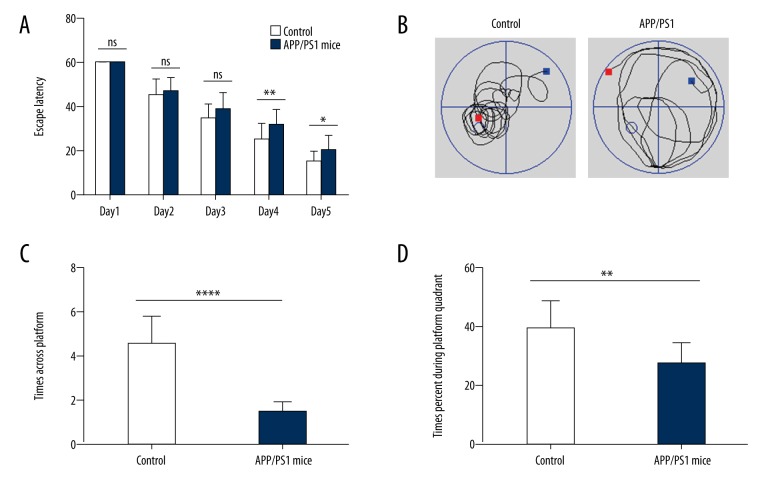
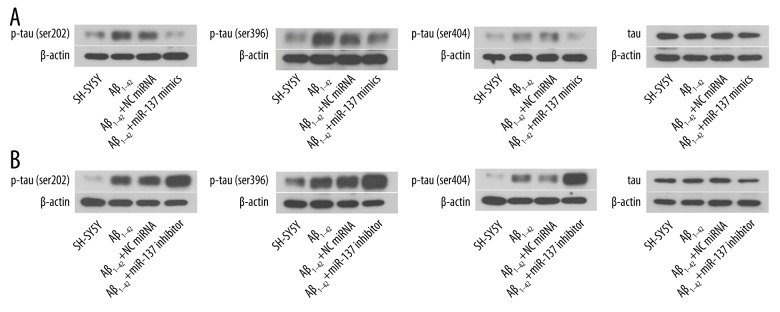
BACKGROUND Alzheimer's disease (AD) results in cognitive impairment. The calcium voltage-gated channel subunit alpha-1 C CACNA1C gene encodes an alpha-1 C subunit of L-type calcium channel (LTCC). The aim of this study was to investigate the role of micro-RNA-137 (miR-137) and the CACNA1C gene in APPswe/PS1ΔE9 (APP/PS1) double-transgenic AD mice and in human neuroblastoma SH-SY5Y cells. MATERIAL AND METHODS Six-month-old APP/PS1 double-transgenic AD mice (N=6) and age-matched normal C57BL/6 mice (N=6) underwent a Morris water maze (MWM) test, expression levels of amyloid-β (Aβ), LTCC, the CACNA1C gene, and miR-137 were measured in the rat hippocampus and cerebral cortex in both groups of mice. A luciferase assay was used to evaluate the effect of miR-137 on the expression of CACNA1C in SH-SY5Y human neuroblastoma SH-SY5Y cells. Western blotting was used to detect the CACNA1C, phosphorylated-tau (p-tau), and Aβ proteins. RESULTS In APP/PS1 transgenic AD mice, spatial learning and memory was significantly reduced, levels of Aβ1-40 and Aβ1-42 were increased in the serum, hippocampus, and cerebral cortex, expression levels of miR-137 were reduced, expression of CACNA1C protein was increased in the hippocampus and cerebral cortex, compared with normal control mice. miR-137 regulated the expression of the CACNA1C gene. Increased expression levels of p-tau (Ser202, Ser396, and Ser404) induced by Aβ1-42 were inhibited by miR-137 mimics in SH-SY5Y human neuroblastoma cells in vitro. CONCLUSIONS In a transgenic mouse model of AD, miR-137 and expression of the CACNA1C gene inhibited the hyperphosphorylation of tau protein.
阿尔茨海默病(AD)导致认知障碍。钙电压门控通道亚基 alpha-1 C CACNA1C 基因编码 L 型钙通道(LTCC)的 alpha-1 C 亚基。本研究旨在探讨 micro-RNA-137(miR-137)和 CACNA1C 基因在 APPswe/PS1ΔE9(APP/PS1)双转基因 AD 小鼠和人神经母细胞瘤 SH-SY5Y 细胞中的作用。
6 月龄 APP/PS1 双转基因 AD 小鼠(N=6)和年龄匹配的正常 C57BL/6 小鼠(N=6)进行 Morris 水迷宫(MWM)测试,测量两组小鼠海马和大脑皮质中淀粉样蛋白-β(Aβ)、LTCC、CACNA1C 基因和 miR-137 的表达水平。荧光素酶测定用于评估 miR-137 对 SH-SY5Y 人神经母细胞瘤 SH-SY5Y 细胞中 CACNA1C 表达的影响。Western blot 用于检测 CACNA1C、磷酸化-tau(p-tau)和 Aβ 蛋白。
在 APP/PS1 转基因 AD 小鼠中,空间学习和记忆能力明显下降,血清、海马和大脑皮质中 Aβ1-40 和 Aβ1-42 水平升高,miR-137 表达水平降低,海马和大脑皮质中 CACNA1C 蛋白表达增加,与正常对照组小鼠相比。miR-137 调节 CACNA1C 基因的表达。体外 Aβ1-42 诱导的 p-tau(Ser202、Ser396 和 Ser404)表达增加被 miR-137 模拟物抑制。
在 AD 的转基因小鼠模型中,miR-137 和 CACNA1C 基因的表达抑制了 tau 蛋白的过度磷酸化。