Department of Orthopedics, Baoshan Branch of Shanghai First People's Hospital, Shanghai 200940, P.R. China.
Department of Orthopaedics, Shanghai Ninth People's Hospital, Shanghai Jiao Tong University School of Medicine, Shanghai 201999, P.R. China.
Int J Mol Med. 2018 Nov;42(5):2604-2614. doi: 10.3892/ijmm.2018.3817. Epub 2018 Aug 9.
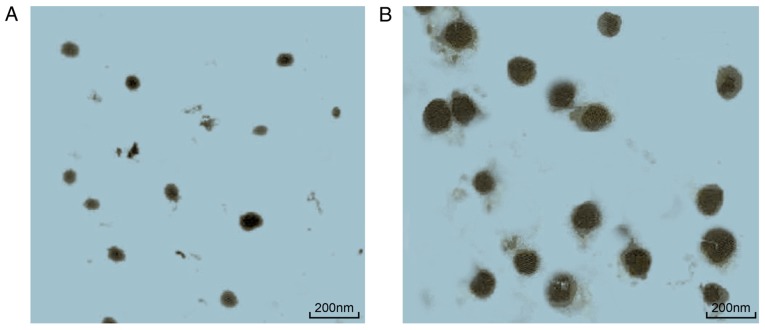
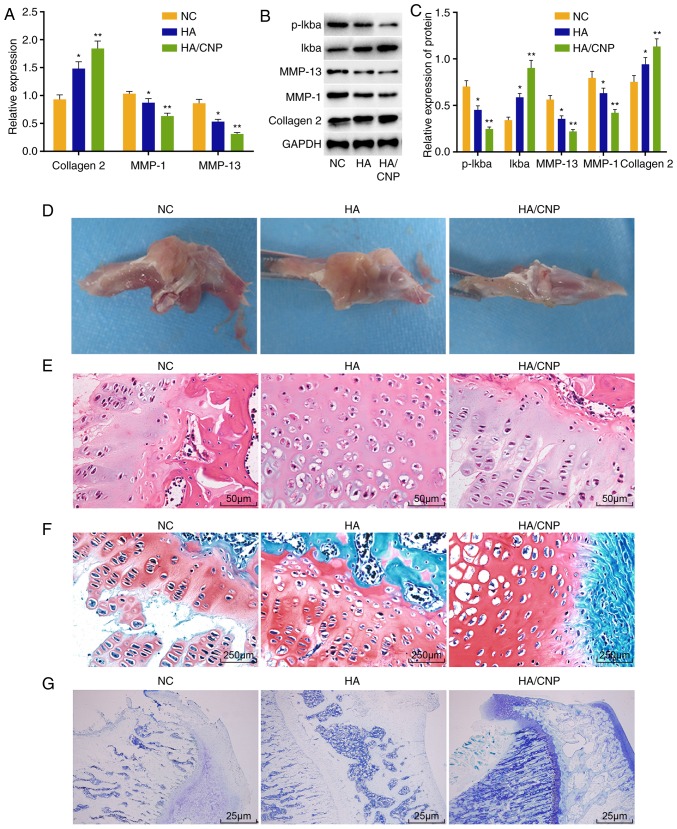
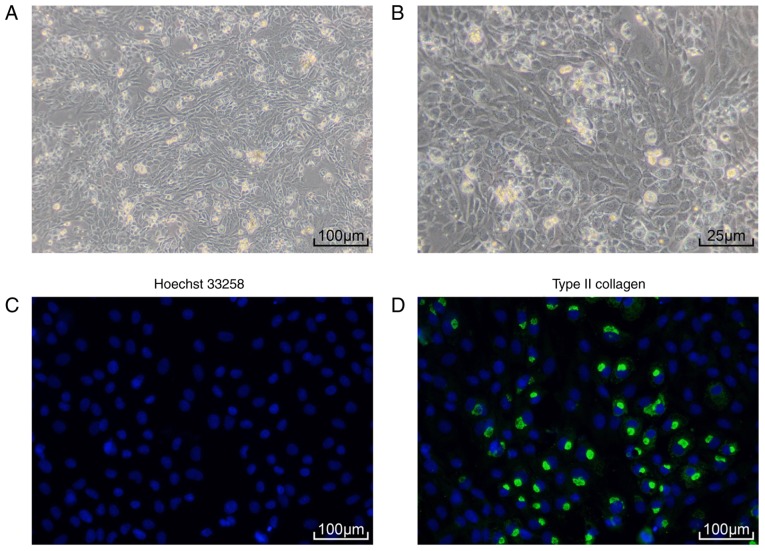
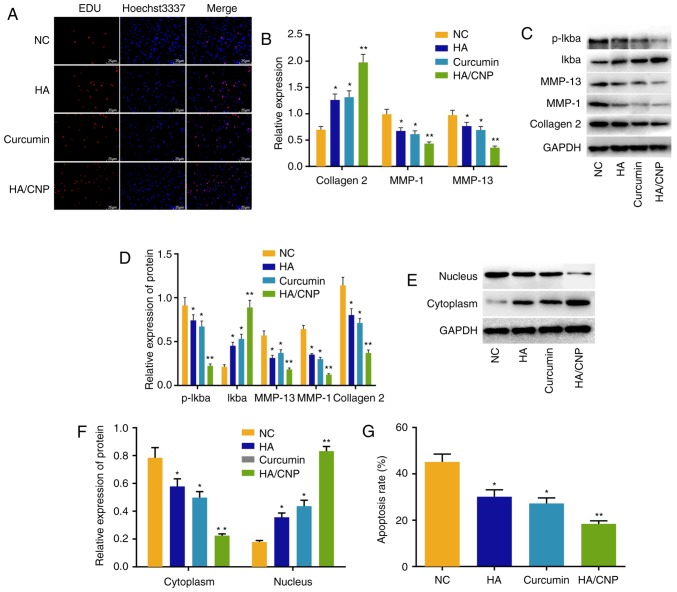
Knee osteoarthritis (OA) is the main cause of leg pain in middle‑aged and elderly individuals. Hyaluronic acid (HA), as well as curcuminoid, has been used in the treatment of knee OA. In the present study, HA/chitosan nanoparticles (CNPs) were prepared for the delivery of curcuminoid, in order to investigate whether HA and curcuminoid can act synergistically as a better treatment option. The knee OA model was established by the Hulth method, and a knee OA chondrocyte model was constructed by the co‑induction of interleukin‑1β and tumor necrosis factor (TNF)‑α. The drug loading capacity of HA/CNP for the delivery of curcuminoid was measured by an ultraviolet assay, and the cytotoxicity to chondrocytes was measured by an MTT assay. Collagen II was detected by immunofluorescence, and the expression levels of nuclear factor (NF)‑κB and inflammation‑related genes in cartilage tissue and chondrocytes were detected. Chondrocyte proliferation was determined by an EdU assay, and chondrocyte apoptosis was determined by flow cytometry. The Mankin pathological score of the Outerbridge classification was obtained. The results demonstrated that the optimum drug loading capacity of HA/CNP for the delivery of curcuminoid was 38.44%, with a good sustained release function. HA/CNP treatment resulted in inhibition of the NF‑κB pathway, as well as the expression of matrix metalloproteinase (MMP)‑1 and MMP‑13, but it increased collagen II expression. HA/CNP for the delivery of curcuminoid significantly decreased the Outerbridge classification and Mankin pathological scores to close to normal until the 4th week. Furthermore, it was also observed that all the effects of HA/CNP on the delivery of curcuminoid were more prominent compared with the effects of HA or curcuminoid treatment individually. Taken together, these findings demonstrated that HA/CNP for the delivery of curcuminoid may suppress inflammation and chondrocyte apoptosis in knee OA via repression of the NF‑κB pathway.
膝骨关节炎(OA)是中老年人腿部疼痛的主要原因。透明质酸(HA)和姜黄素已被用于治疗膝 OA。本研究制备了 HA/壳聚糖纳米粒子(CNP)以递送姜黄素,以研究 HA 和姜黄素是否可以协同作用作为更好的治疗选择。通过 Hulth 方法建立膝 OA 模型,并通过白细胞介素-1β和肿瘤坏死因子(TNF)-α的共诱导构建膝 OA 软骨细胞模型。通过紫外分光光度法测量 HA/CNP 递送姜黄素的载药量,通过 MTT 法测量对软骨细胞的细胞毒性。通过免疫荧光检测胶原 II 的表达,检测软骨组织和软骨细胞中核因子(NF)-κB 和炎症相关基因的表达水平。通过 EdU 测定法测定软骨细胞增殖,通过流式细胞术测定软骨细胞凋亡。获得 Outerbridge 分类的 Mankin 病理评分。结果表明,HA/CNP 递送姜黄素的最佳载药量为 38.44%,具有良好的持续释放功能。HA/CNP 治疗抑制 NF-κB 通路以及基质金属蛋白酶(MMP)-1 和 MMP-13 的表达,但增加胶原 II 的表达。HA/CNP 递送姜黄素可显著降低 Outerbridge 分类和 Mankin 病理评分,接近正常,直至第 4 周。此外,还观察到 HA/CNP 递送姜黄素的所有作用均比 HA 或姜黄素单独治疗的作用更为明显。综上所述,这些发现表明,HA/CNP 递送姜黄素可能通过抑制 NF-κB 通路抑制膝骨关节炎中的炎症和软骨细胞凋亡。