Division of Basic Biomedical Sciences, Sanford School of Medicine, The University of South Dakota, Vermillion, SD, USA.
Department of Chemistry, Center for Diagnostics & Therapeutics, Georgia State University, Atlanta, GA, USA.
Mol Oncol. 2018 Oct;12(10):1753-1777. doi: 10.1002/1878-0261.12372. Epub 2018 Sep 3.
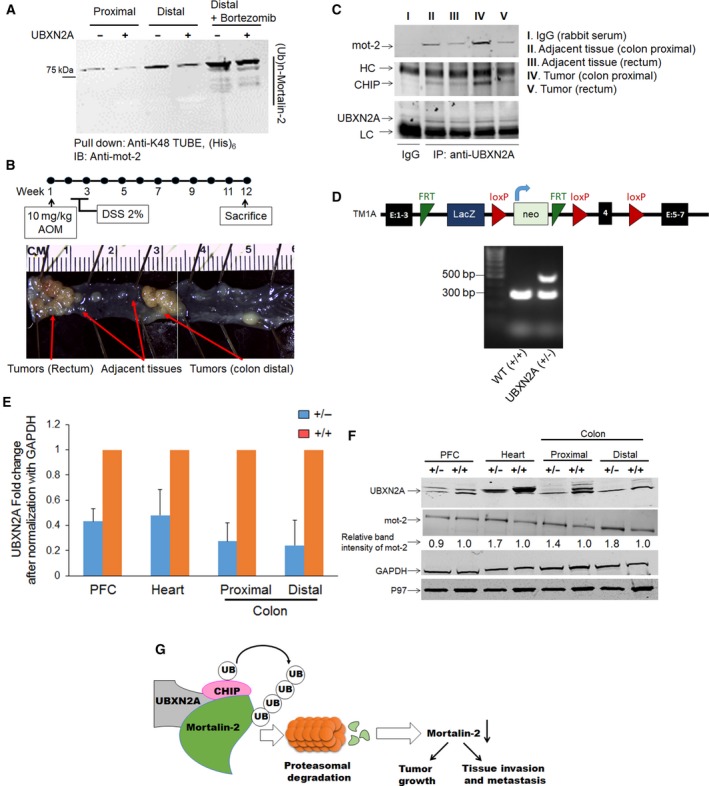
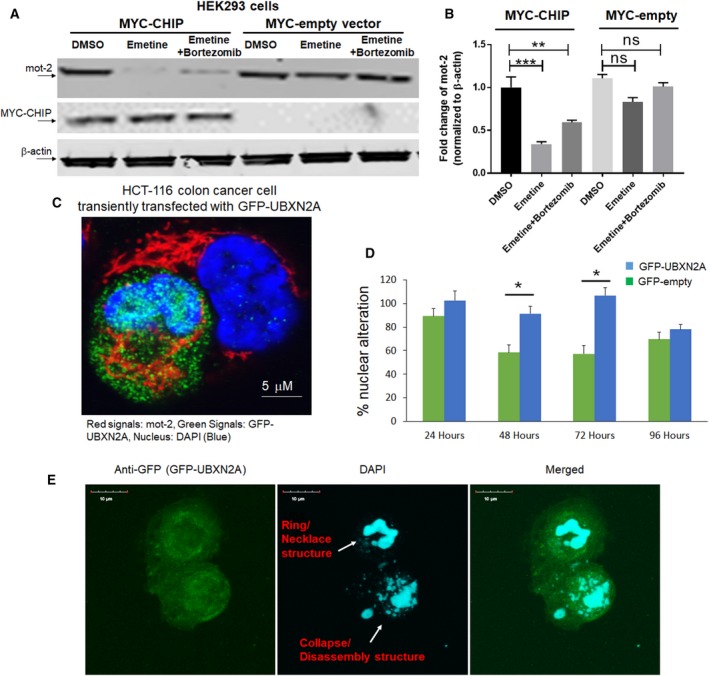
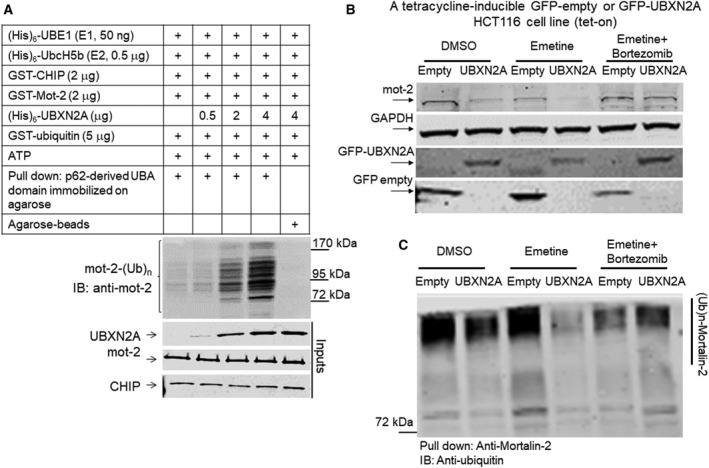
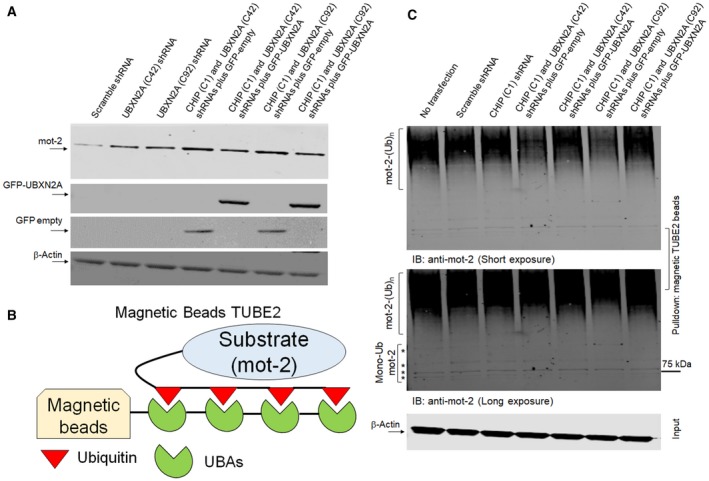
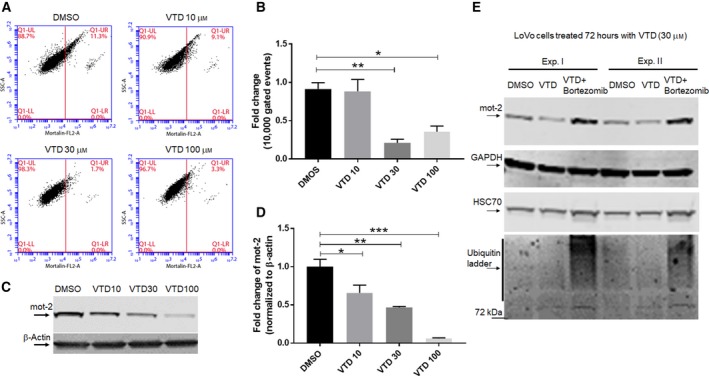
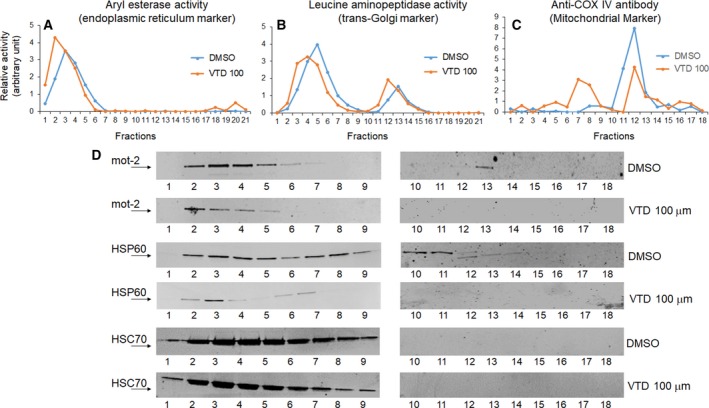
Overexpression of oncoproteins is a major cause of treatment failure using current chemotherapeutic drugs. Drug-induced degradation of oncoproteins is feasible and can improve clinical outcomes in diverse types of cancers. Mortalin-2 (mot-2) is a dominant oncoprotein in several tumors, including colorectal cancer (CRC). In addition to inactivating the p53 tumor suppressor protein, mot-2 enhances tumor cell invasion and migration. Thus, mot-2 is considered a potential therapeutic target in several cancer types. The current study investigated the biological role of a ubiquitin-like protein called UBXN2A in the regulation of mot-2 turnover. An orthogonal ubiquitin transfer technology followed by immunoprecipitation, in vitro ubiquitination, and Magnetic Beads TUBE2 pull-down experiments revealed that UBXN2A promotes carboxyl terminus of the HSP70-interacting protein (CHIP)-dependent ubiquitination of mot-2. We subsequently showed that UBXN2A increases proteasomal degradation of mot-2. A subcellular compartmentalization experiment revealed that induced UBXN2A decreases the level of mot-2 and its chaperone partner, HSP60. Pharmacological upregulation of UBXN2A using a small molecule, veratridine (VTD), decreases the level of mot-2 in cancer cells. Consistent with the in vitro results, UBXN2A mice exhibited selective elevation of mot-2 in colon tissues. An in vitro Anti-K48 TUBE isolation approach showed that recombinant UBXN2A enhances proteasomal degradation of mot-2 in mouse colon tissues. Finally, we observed enhanced association of CHIP with the UBXN2A-mot-2 complex in tumors in an azoxymethane/dextran sulfate sodium-induced mouse CRC model. The existence of a multiprotein complex containing UBXN2A, CHIP, and mot-2 suggests a synergistic tumor suppressor activity of UBXN2A and CHIP in mot-2-enriched tumors. This finding validates the UBXN2A-CHIP axis as a novel and potential therapeutic target in CRC.
癌蛋白的过表达是当前化疗药物治疗失败的主要原因。癌蛋白的药物诱导降解是可行的,并可以改善多种类型癌症的临床结果。线粒体 2(mot-2)是包括结直肠癌(CRC)在内的几种肿瘤中的主要癌蛋白。除了使抑癌蛋白 p53 失活外,mot-2 还增强了肿瘤细胞的侵袭和迁移。因此,mot-2 被认为是几种癌症类型的潜在治疗靶点。本研究探讨了一种称为 UBXN2A 的泛素样蛋白在调节 mot-2 周转中的生物学作用。正交泛素转移技术,随后进行免疫沉淀、体外泛素化和磁珠 TUBE2 下拉实验表明,UBXN2A 促进 HSP70 相互作用蛋白(CHIP)依赖性 mot-2 的羧基末端泛素化。随后我们表明,UBXN2A 增加了 mot-2 的蛋白酶体降解。亚细胞区室化实验表明,诱导的 UBXN2A 降低了 mot-2 及其伴侣 HSP60 的水平。使用小分子维拉帕米(VTD)上调 UBXN2A,可降低癌细胞中 mot-2 的水平。与体外结果一致,UBXN2A 小鼠在结肠组织中选择性地升高了 mot-2 的水平。体外 Anti-K48 TUBE 分离方法表明,重组 UBXN2A 增强了小鼠结肠组织中 mot-2 的蛋白酶体降解。最后,我们在氧化偶氮甲烷/葡聚糖硫酸钠诱导的小鼠 CRC 模型中观察到 CHIP 与 UBXN2A-mot-2 复合物的结合增强。含有 UBXN2A、CHIP 和 mot-2 的多蛋白复合物的存在表明 UBXN2A 和 CHIP 在 mot-2 富集的肿瘤中具有协同的肿瘤抑制活性。这一发现验证了 UBXN2A-CHIP 轴作为 CRC 中的一个新的潜在治疗靶点。