From the Departments of Nutrition (Y.H., G.Z., G.L., W.C.W., F.B.H., Q.S.), Epidemiology (Y.H., M.W., W.C.W., J.E.M., F.B.H.), and Biostatistics (M.W., B.R.), Harvard T.H. Chan School of Public Health, and the Channing Division of Network Medicine (M.W., W.C.W., J.E.M., F.B.H., Q.S.) and the Division of Preventive Medicine (J.E.M.), Department of Medicine, Brigham and Women's Hospital and Harvard Medical School - all in Boston; and the Key Laboratory of Nutrition, Metabolism, and Food Safety, Institute of Nutrition and Health, Shanghai Institutes for Biological Sciences, University of Chinese Academy of Sciences, Chinese Academy of Sciences, Shanghai (G.Z.), and the Department of Epidemiology and Biostatistics, Ministry of Education Key Laboratory of Environment and Health and State Key Laboratory of Environmental Health (Incubating), School of Public Health, Tongji Medical College, Huazhong University of Science and Technology, Wuhan (A.P.) - both in China.
N Engl J Med. 2018 Aug 16;379(7):623-632. doi: 10.1056/NEJMoa1803626.
Whether weight gain after smoking cessation attenuates the health benefits of quitting is unclear.
In three cohort studies involving men and women in the United States, we identified those who had reported quitting smoking and we prospectively assessed changes in smoking status and body weight. We estimated risks of type 2 diabetes, death from cardiovascular disease, and death from any cause among those who had reported quitting smoking, according to weight changes after smoking cessation.
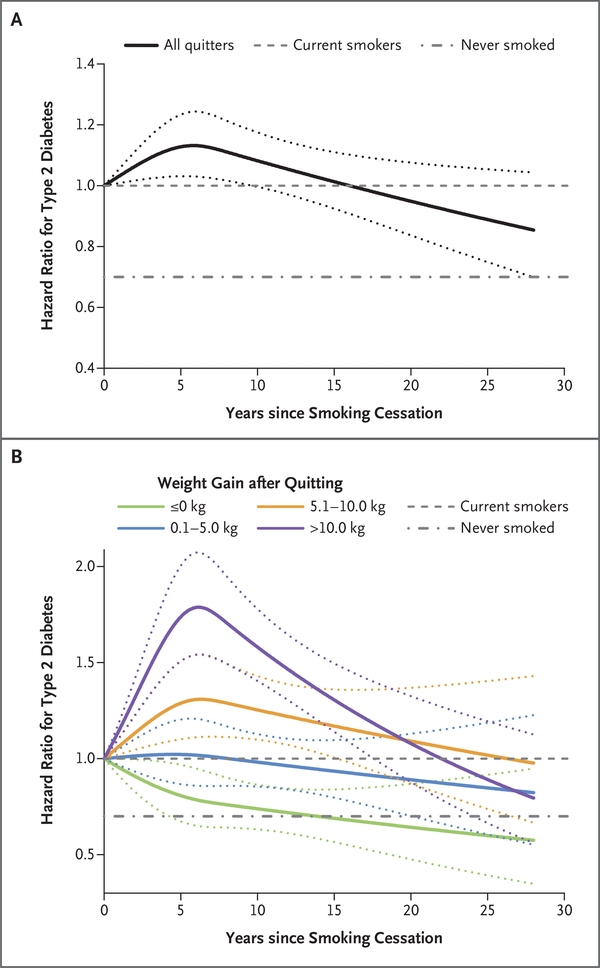
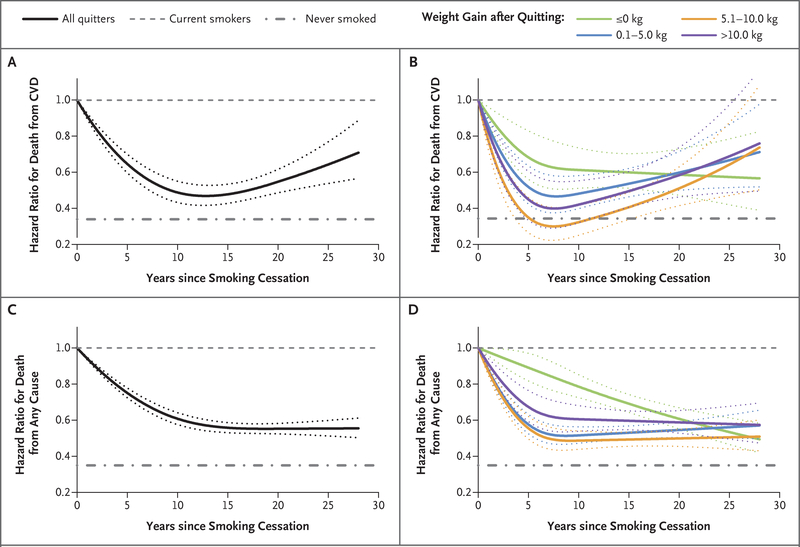
The risk of type 2 diabetes was higher among recent quitters (2 to 6 years since smoking cessation) than among current smokers (hazard ratio, 1.22; 95% confidence interval [CI], 1.12 to 1.32). The risk peaked 5 to 7 years after quitting and then gradually decreased. The temporary increase in the risk of type 2 diabetes was directly proportional to weight gain, and the risk was not increased among quitters without weight gain (P<0.001 for interaction). In contrast, quitters did not have a temporary increase in mortality, regardless of weight change after quitting. As compared with current smokers, the hazard ratios for death from cardiovascular disease were 0.69 (95% CI, 0.54 to 0.88) among recent quitters without weight gain, 0.47 (95% CI, 0.35 to 0.63) among those with weight gain of 0.1 to 5.0 kg, 0.25 (95% CI, 0.15 to 0.42) among those with weight gain of 5.1 to 10.0 kg, 0.33 (95% CI, 0.18 to 0.60) among those with weight gain of more than 10.0 kg, and 0.50 (95% CI, 0.46 to 0.55) among longer-term quitters (>6 years since smoking cessation). Similar associations were observed for death from any cause.
Smoking cessation that was accompanied by substantial weight gain was associated with an increased short-term risk of type 2 diabetes but did not mitigate the benefits of quitting smoking on reducing cardiovascular and all-cause mortality. (Funded by the National Institutes of Health.).
戒烟后体重增加是否会减弱戒烟带来的健康益处尚不清楚。
我们在美国的三项队列研究中纳入了男性和女性,在这些研究中,我们识别出那些报告已经戒烟的人,并前瞻性评估了他们的吸烟状况和体重变化。我们根据戒烟后体重的变化,评估了报告已经戒烟的人患 2 型糖尿病、心血管疾病死亡和任何原因死亡的风险。
与当前吸烟者相比,最近戒烟者(戒烟后 2 至 6 年)患 2 型糖尿病的风险更高(危险比为 1.22;95%置信区间[CI]为 1.12 至 1.32)。风险在戒烟后 5 至 7 年达到峰值,然后逐渐下降。2 型糖尿病风险的暂时增加与体重增加成正比,而且在没有体重增加的戒烟者中,风险并未增加(交互作用 P<0.001)。相比之下,无论戒烟后体重如何变化,戒烟者的死亡率均未增加。与当前吸烟者相比,体重无增加的最近戒烟者患心血管疾病的死亡风险比为 0.69(95%CI 为 0.54 至 0.88),体重增加 0.1 至 5.0 公斤者的死亡风险比为 0.47(95%CI 为 0.35 至 0.63),体重增加 5.1 至 10.0 公斤者的死亡风险比为 0.25(95%CI 为 0.15 至 0.42),体重增加超过 10.0 公斤者的死亡风险比为 0.33(95%CI 为 0.18 至 0.60),长期戒烟者(戒烟后>6 年)的死亡风险比为 0.50(95%CI 为 0.46 至 0.55)。对于任何原因导致的死亡,也观察到了类似的关联。
与大量体重增加相关的戒烟与短期 2 型糖尿病风险增加有关,但并没有减轻戒烟对降低心血管疾病和全因死亡率的益处。(由美国国立卫生研究院资助)。