Misión Biológica de Galicia, Spanish National Research Council (CSIC), Apartado 28, 36080, Pontevedra, Spain.
National Institute of Forestry, Agriculture and Livestock Research (INIFAP), Ave. Hidalgo 1213, Cd., 31500, Cuauhtémoc, Chihuahua, Mexico.
BMC Plant Biol. 2018 Aug 15;18(1):169. doi: 10.1186/s12870-018-1385-3.
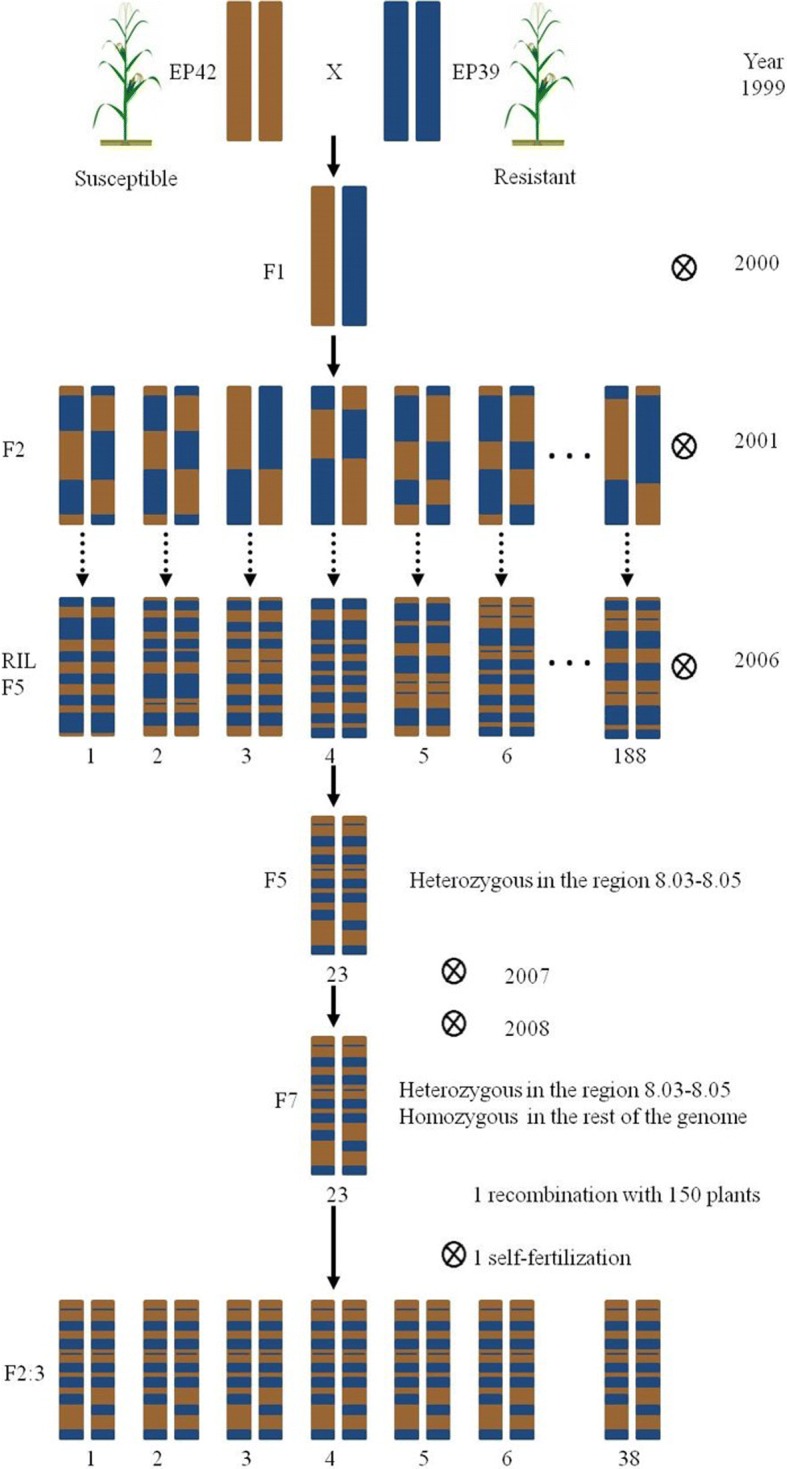
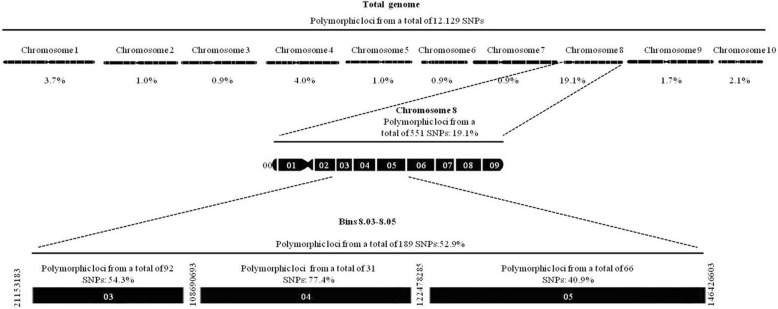
Sesamia nonagrioides Lefebvere (Mediterranean corn borer, MCB) is the main pest of maize in the Mediterranean area. QTL for MCB stalk tunneling and grain yield under high MCB infestation had been located at bin 8.03-8.05 (4-21 cM and 10-30 cM respectively) in a previous analysis of the EP42 x EP39 RILs mapping population. The objective of the present work was to study with higher resolution those QTL, and validating and estimating with higher precision their locations and effects. To achieve this objective, we developed a set of 38 heterogeneous inbred families (HIFs) which were near-homozygous in the genome, except in the region under study. The HIFs were evaluated in multiple environments under artificial infestation with MCB and genotyped with SNPs.
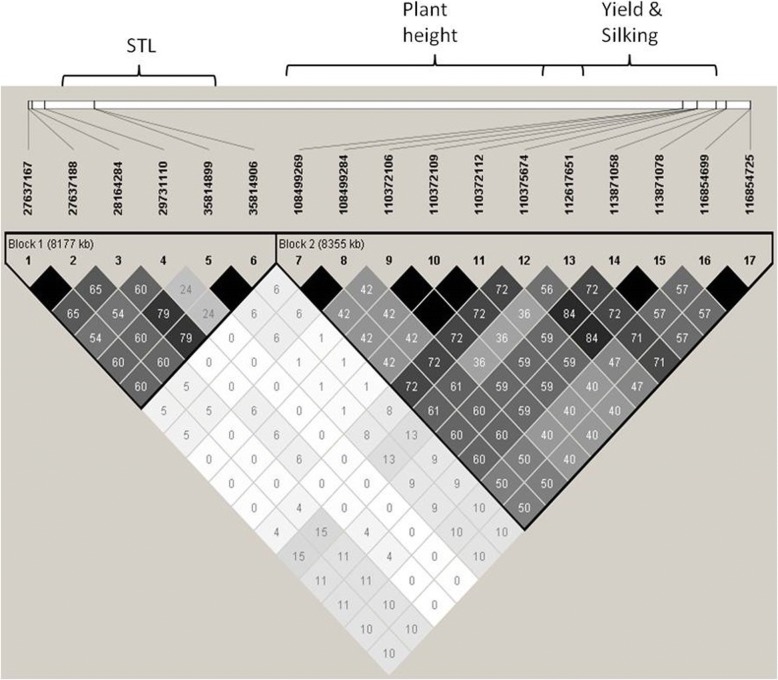
The QTL for grain yield under high infestation was confirmed with higher precision and improved reliability at 112.6-116.9 Mb. On the contrary, the location of the QTL for stalk tunneling was not validated probably due to the fixation of some genomic regions during the development of the HIFs. Our study confirmed that the co-localization of the QTL for stalk tunneling and grain yield in the previous study was due to linked genes, not to pleiotropic effects. So, the QTL for grain yield can be used for improving grain yield without undesirable effect on stalk tunneling.
The HIF analysis is useful for validating QTL and for conducting deeper studies in traits related to corn borer resistance.
Sesamia nonagrioides Lefebvre(地中海玉米螟,MCB)是地中海地区玉米的主要害虫。在之前对 EP42 x EP39 RILs 作图群体的分析中,已经定位到了 MCB 茎隧道和高 MCB 侵染下粒产量的 QTL 位于 bin 8.03-8.05(分别为 4-21 cM 和 10-30 cM)。本工作的目的是用更高的分辨率研究这些 QTL,并更精确地验证和估计它们的位置和效应。为了实现这一目标,我们开发了一组 38 个异质近交系(HIFs),这些 HIFs在基因组中除了研究区域外都是近纯合的。在人工感染 MCB 的多个环境中评估了 HIFs,并通过 SNPs 进行了基因型分析。
高侵染下粒产量的 QTL 得到了更高的精度和更高的可靠性确认,位置在 112.6-116.9 Mb。相反,茎隧道的 QTL 位置没有得到验证,可能是由于 HIFs 发育过程中一些基因组区域的固定。我们的研究证实,之前研究中茎隧道和粒产量的 QTL 共定位是由于连锁基因,而不是多效性效应。因此,粒产量的 QTL 可用于提高粒产量,而不会对茎隧道产生不良影响。
HIF 分析对于验证 QTL 和进行与玉米螟抗性相关性状的深入研究是有用的。