ICIQ, Institute of Chemical Research of Catalonia - the Barcelona Institute of Science and Technology, Avinguda Països Catalans 16, 43007, Tarragona, Spain.
ICREA, Catalan Institution for Research and Advanced Studies, Passeig Lluís Companys 23, 08010, Barcelona, Spain.
Nat Commun. 2018 Aug 16;9(1):3274. doi: 10.1038/s41467-018-05375-2.
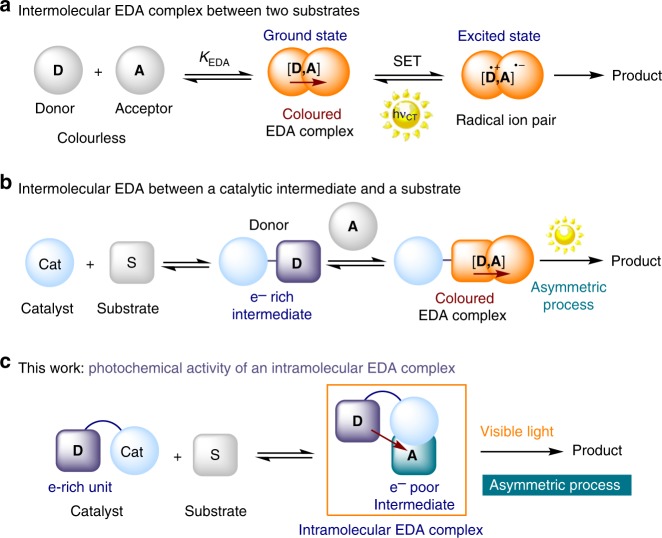
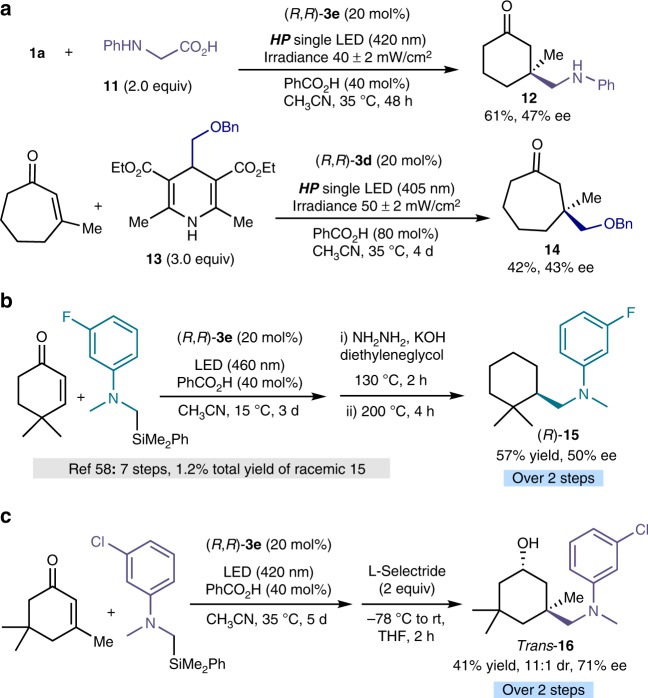
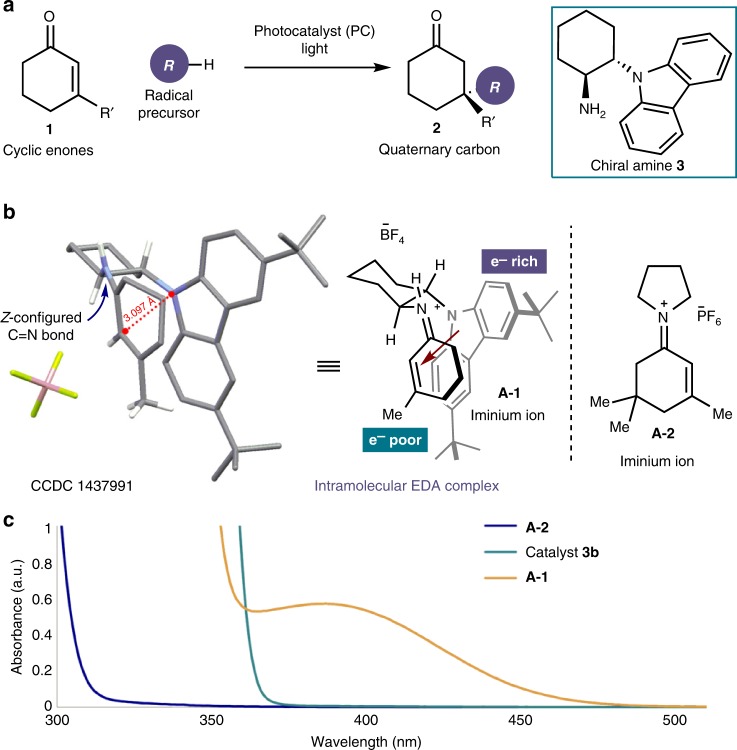
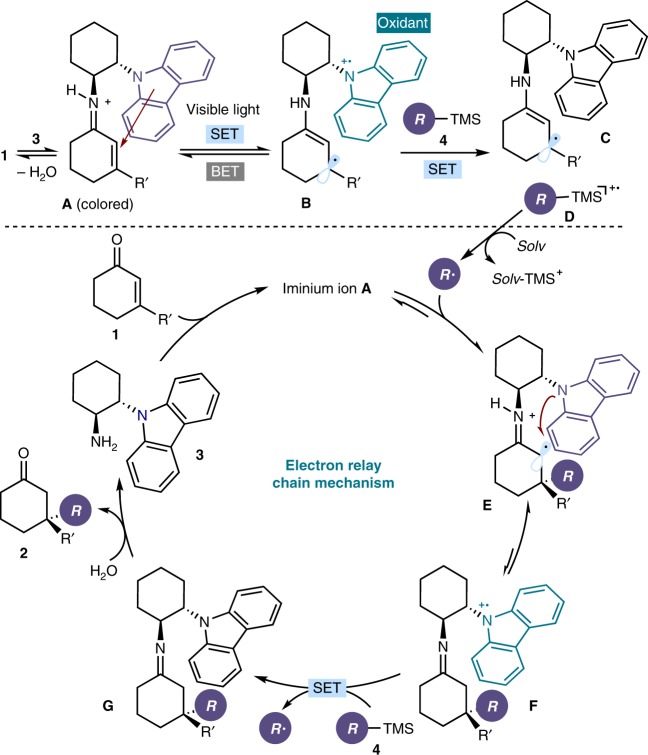
The photochemical activity of electron donor-acceptor (EDA) complexes provides a way to generate radicals under mild conditions. This strategy has found application in chemical synthesis and recently in enantioselective catalysis. Reported methods classically relied on the formation of intermolecular EDA complexes, generated upon aggregation of two suitable reagents. Herein, we further expand the synthetic utility of this strategy demonstrating that an intramolecular EDA complex can trigger a photochemical catalytic enantioselective radical process. This approach enables radical conjugate additions to β-substituted cyclic enones to form quaternary carbon stereocenters with high stereocontrol using visible light irradiation. Crucial for success is the use of an amine catalyst, adorned with a carbazole moiety, which generates, upon condensation with enones, chiral iminium ions that show a broad absorption band in the visible region. This optical property originates from an intramolecular charge transfer π-π interaction between the electron-rich carbazole nucleus and the electron-deficient iminium double bond.
供体-受体(EDA)复合物的光化学活性为在温和条件下生成自由基提供了一种方法。该策略已在化学合成中得到应用,最近在对映选择性催化中也得到了应用。报道的方法通常依赖于两个合适的试剂聚合后形成的分子间 EDA 复合物。在此,我们进一步扩展了该策略的合成实用性,证明了分子内 EDA 复合物可以引发光化学反应的对映选择性自由基过程。该方法可以使用可见光照射,通过β-取代环状烯酮的自由基共轭加成来形成具有高立体选择性的季碳立体中心。成功的关键是使用带有咔唑部分的胺催化剂,它与烯酮缩合后生成的手性亚胺离子在可见光区域具有宽吸收带。这种光学性质源于富电子咔唑核和缺电子亚胺双键之间的分子内电荷转移π-π相互作用。