Leere Julius Simoni, Kruse Christian, Robaczyk Maciej, Karmisholt Jesper, Vestergaard Peter
Department of Clinical Medicine, Aalborg University, Denmark.
Steno Diabetes Center North Jutland, Denmark.
Bone Rep. 2018 Aug 9;9:101-109. doi: 10.1016/j.bonr.2018.08.001. eCollection 2018 Dec.
Trabecular Bone Score (TBS) is a software-based method for indirect assessment of trabecular bone structure of the spine, based on analysis of pixels in dual energy x-ray absorptiometry (DXA) images. Few studies describe the use of TBS in patients with primary hyperparathyroidism (PHPT). This study aimed at further describing this relationship, investigating possible correlations between biochemistry, body mass index (BMI), fracture incidence and TBS.
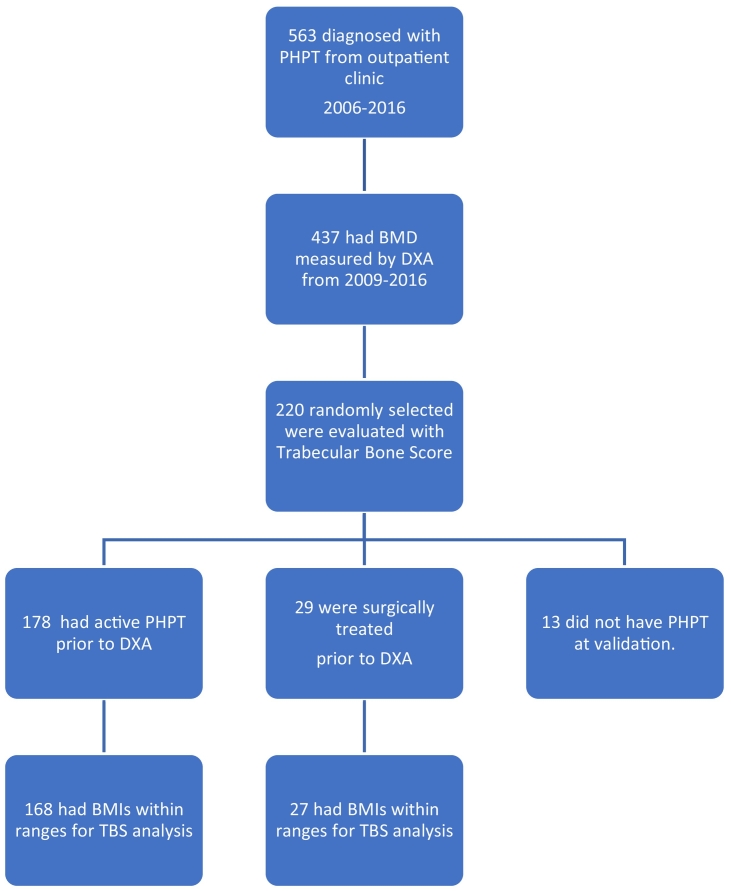
Cross-sectional study of 195 patients with verified PHPT, surgically (27) or conservatively (168) treated at the Department of Endocrinology, Aalborg University Hospital. TBS was acquired by reanalyzing DXA-images of the included subjects from the outpatient clinic. Biochemical variables were obtained from clinical routine blood samples taken in relation to the DXA-scans. History of fractures and medical history was obtained from radiology reports and medical charts.
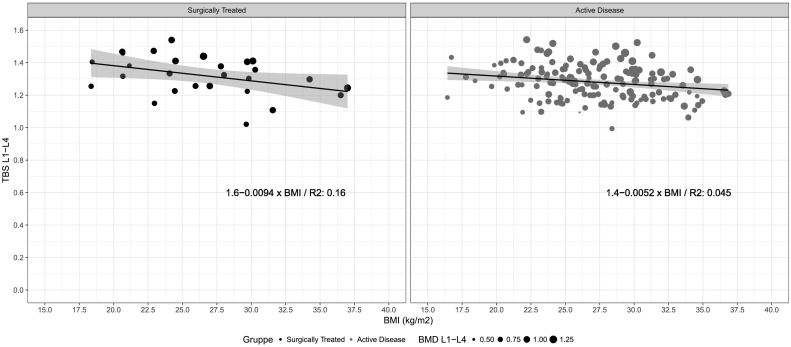
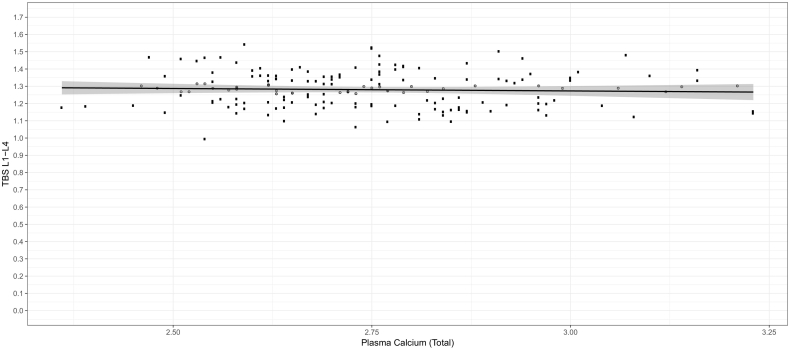
Patients with active PHPT had a TBS-score signifying a partly degraded bone structure, whereas surgically treated patients had a normal bone structure as judged by TBS, though the difference in TBS-score was not statistically significant. Use of antiresorptive treatment was negatively associated with BMD but not TBS. No correlations between the biochemical variables and TBS were found. A negative correlation between TBS and BMI in patients with PHPT was present. Patients experiencing a fragility fracture had a significantly lowered TBS, BMD and T-Score.
Biochemistry does not seem to predict bone status in terms of TBS in patients with PHPT. TBS is negatively correlated to BMI, which is also seen in patients not suffering from PHPT. The lack of a predictive value for antiresorptive treatment for TBS may raise concern. TBS appears to have a predictive value when assessing risk of fracture in patients with PHPT.
This cross-sectional study investigates possible correlations between biochemical variables, body mass index (BMI) and trabecular bone score (TBS) in 195 patients with primary hyperparathyroidism. It finds no correlation between biochemical variables and TBS, but finds a negative correlation between TBS and BMI and a clear association between fracture incidence and low TBS-score.
小梁骨评分(TBS)是一种基于软件的方法,通过分析双能X线吸收测定法(DXA)图像中的像素来间接评估脊柱小梁骨结构。很少有研究描述TBS在原发性甲状旁腺功能亢进症(PHPT)患者中的应用。本研究旨在进一步描述这种关系,探讨生化指标、体重指数(BMI)、骨折发生率与TBS之间可能存在的相关性。
对奥尔堡大学医院内分泌科195例确诊为PHPT的患者进行横断面研究,其中27例接受手术治疗,168例接受保守治疗。通过重新分析门诊患者的DXA图像来获取TBS。生化指标来自与DXA扫描相关的临床常规血液样本。骨折病史和病史来自放射学报告和病历。
活动性PHPT患者的TBS评分表明骨结构部分退化,而手术治疗患者经TBS判断骨结构正常,尽管TBS评分差异无统计学意义。使用抗吸收治疗与骨密度呈负相关,但与TBS无关。未发现生化指标与TBS之间存在相关性。PHPT患者的TBS与BMI呈负相关。发生脆性骨折的患者TBS、骨密度和T值显著降低。
就PHPT患者的TBS而言,生化指标似乎无法预测骨状态。TBS与BMI呈负相关,这在非PHPT患者中也有体现。抗吸收治疗对TBS缺乏预测价值可能令人担忧。在评估PHPT患者的骨折风险时,TBS似乎具有预测价值。
本横断面研究调查了195例原发性甲状旁腺功能亢进症患者的生化指标、体重指数(BMI)与小梁骨评分(TBS)之间可能存在的相关性。研究发现生化指标与TBS之间无相关性,但TBS与BMI呈负相关,且骨折发生率与低TBS评分之间存在明显关联。