School of Physiology, Pharmacology and Neuroscience, University of Bristol, Bristol, BS8 1TD, UK.
Neurochem Res. 2019 Mar;44(3):627-635. doi: 10.1007/s11064-018-2613-9. Epub 2018 Aug 16.
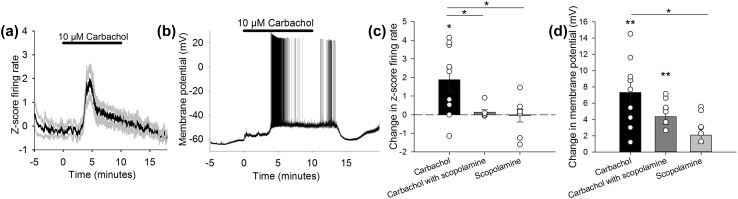
How the cerebellum carries out its functions is not clear, even for its established roles in motor control. In particular, little is known about how the cerebellar nuclei (CN) integrate their synaptic and neuromodulatory inputs to generate cerebellar output. CN neurons receive inhibitory inputs from Purkinje cells, excitatory inputs from mossy fibre and climbing fibre collaterals, as well as a variety of neuromodulatory inputs, including cholinergic inputs. In this study we tested how activation of acetylcholine receptors modulated firing rate, intrinsic properties and synaptic transmission in the CN. Using in vitro whole-cell patch clamp recordings from neurons in the interpositus nucleus, the acetylcholine receptor agonist carbachol was shown to induce a short-term increase in firing rate, increase holding current and decrease input resistance of interpositus CN neurons. Carbachol also induced long-term depression of evoked inhibitory postsynaptic currents and a short-term depression of evoked excitatory postsynaptic currents. All effects were shown to be dependent upon muscarinic acetylcholine receptor activation. Overall, the present study has identified muscarinic receptor activation as a modulator of CN activity.
小脑如何执行其功能尚不清楚,即使对于其在运动控制中的既定作用也是如此。特别是,小脑核(CN)如何整合其突触和神经调质输入以产生小脑输出知之甚少。CN 神经元接收来自浦肯野细胞的抑制性输入,来自苔藓纤维和 climbing 纤维分支的兴奋性输入,以及各种神经调质输入,包括胆碱能输入。在这项研究中,我们测试了乙酰胆碱受体的激活如何调节 CN 中的放电率、固有特性和突触传递。使用来自中间核神经元的体外全细胞膜片钳记录,显示乙酰胆碱受体激动剂 carbachol 可诱导放电率短期增加、保持电流增加和中间核神经元输入电阻降低。Carbachol 还诱导了抑制性突触后电流的长时程抑制和兴奋性突触后电流的短时间抑制。所有效应均显示依赖于毒蕈碱乙酰胆碱受体的激活。总的来说,本研究表明毒蕈碱受体的激活是 CN 活性的调节剂。