Muessig Kathryn E, Knudtson Kelly A, Soni Karina, Larsen Margo Adams, Traum David, Dong Willa, Conserve Donaldson F, Leuski Anton, Artstein Ron, Hightow-Weidman Lisa B
Department of Health Behavior, CB #7440, Gillings School of Global Public Health, The University of North Carolina at Chapel Hill, Chapel Hill, NC 27599-7440.
Institute for Global Health and Infectious Diseases, The University of North Carolina at Chapel Hill, Chapel Hill, NC 27599.
Digit Cult Educ. 2018;10:22-48. Epub 2018 Jul 13.
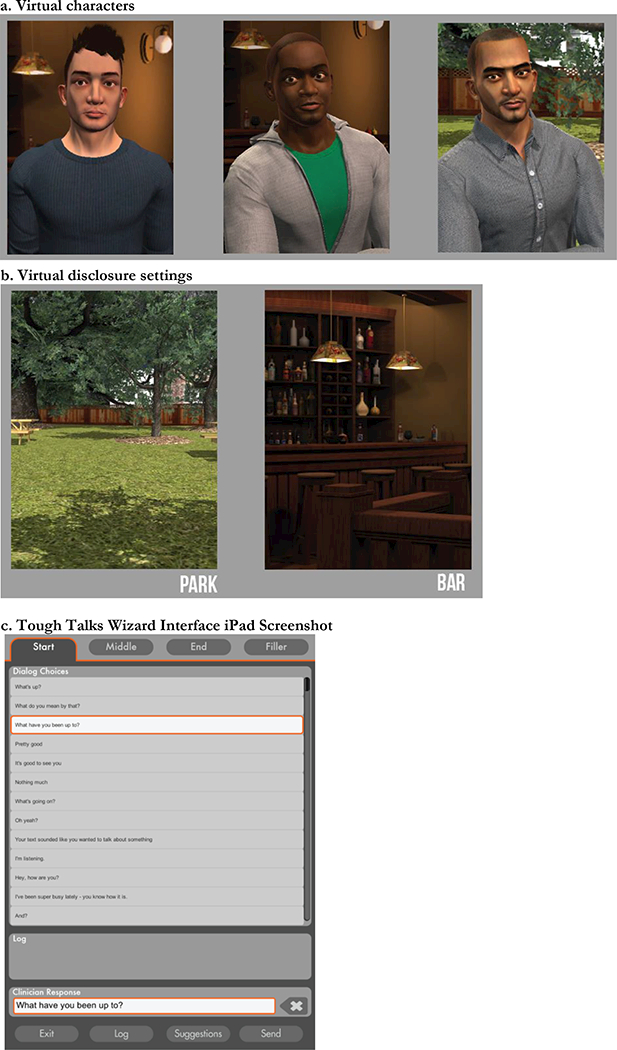
HIV status disclosure is associated with increased sorcial support and protective behaviors against HIV transmission. Yet disclosure poses significant challenges in the face of persistent societal stigma. Few interventions focus on decision-making self-efficacy, and communication skills to support disclosing HIV status to an intimate partner. Virtual reality (VR) and artifcial intelligence (AI) technologies offer poweful tools to address this gap. Informed by Social Cognitive Theory, we created the Tough Talks VR program for HIV-positive young men who have sex with men (YMSM) to practice status disclosure safely and confidentially. Fifty-eight YMSM (ages 18 - 30, 88% HIV-positive) contributed 132 disclosure dialogues to develop the prototype through focus groups, usability testing, and a technical pilot. The prototype includes three disclosure scenarios (neutral, sympathetic, and negative response) and a database of 125 virtual character utterances. Participants select a VR scenario and realistic virtual character with whom to practice. In a pilot test of the fully automated neutral response scenario, the AI system responded appropriately to 71% of participant utterances. Most pilot study participants agreed Tough Talks was easy to use (9/11) and that they would like to use the system frequently (9/11). Tough Talks demonstrates that VR can be used to practice HIV status disclosure and lessons learned from program development offer insights for the use of AI systems for other areas of health and education.
披露艾滋病毒感染状况与社会支持的增加以及预防艾滋病毒传播的保护行为相关。然而,面对持续存在的社会耻辱感,披露行为带来了重大挑战。很少有干预措施关注决策自我效能以及向亲密伴侣披露艾滋病毒感染状况所需的沟通技巧。虚拟现实(VR)和人工智能(AI)技术提供了强大的工具来填补这一空白。基于社会认知理论,我们为与男性发生性关系的艾滋病毒阳性年轻男性(YMSM)创建了“艰难对话VR”项目,以便他们安全、保密地练习披露感染状况。58名YMSM(年龄在18 - 30岁之间,88%为艾滋病毒阳性)通过焦点小组、可用性测试和技术试点贡献了132次披露对话,用于开发原型。该原型包括三种披露场景(中性、同情和负面反应)以及一个包含125条虚拟角色话语的数据库。参与者选择一个VR场景和一个逼真的虚拟角色进行练习。在全自动中性反应场景的试点测试中,人工智能系统对71%的参与者话语做出了适当回应。大多数试点研究参与者认为“艰难对话”易于使用(9/11),并且他们愿意经常使用该系统(9/11)。“艰难对话”表明VR可用于练习艾滋病毒感染状况的披露,并且从项目开发中学到的经验教训为将人工智能系统用于其他健康和教育领域提供了见解。