Loh Ping Yeap, Yeoh Wen Liang, Nakashima Hiroki, Muraki Satoshi
Department of Human Science, Faculty of Design, Kyushu University, Fukuoka, Japan.
Department of Human Science, Graduate School of Design, Kyushu University, Fukuoka, Japan.
PeerJ. 2018 Aug 9;6:e5406. doi: 10.7717/peerj.5406. eCollection 2018.
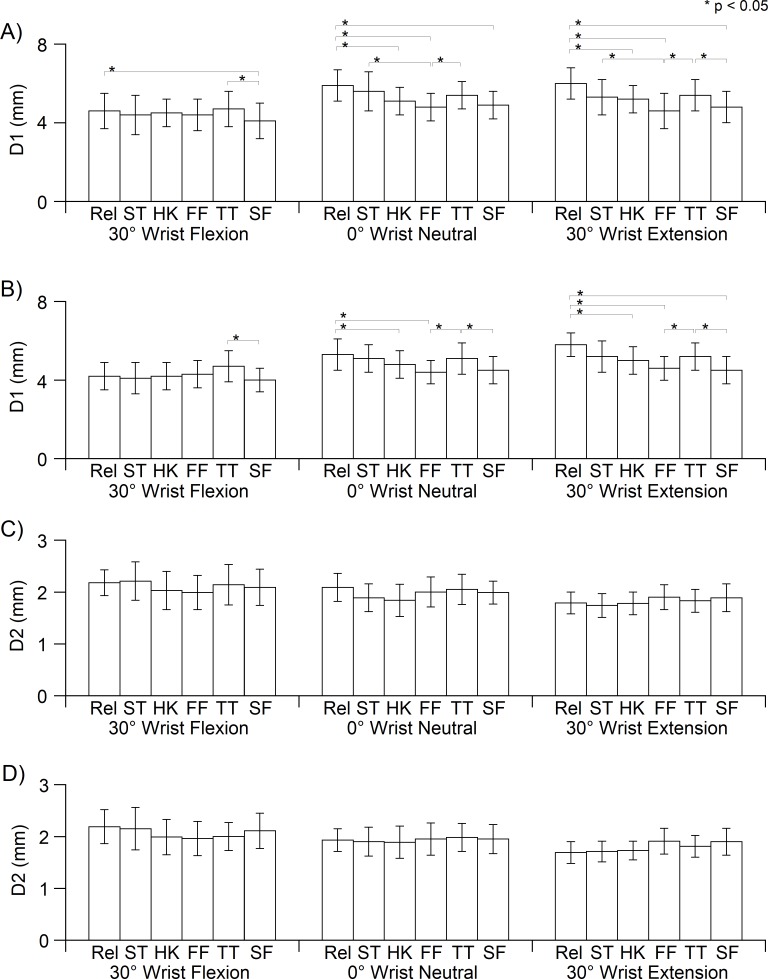
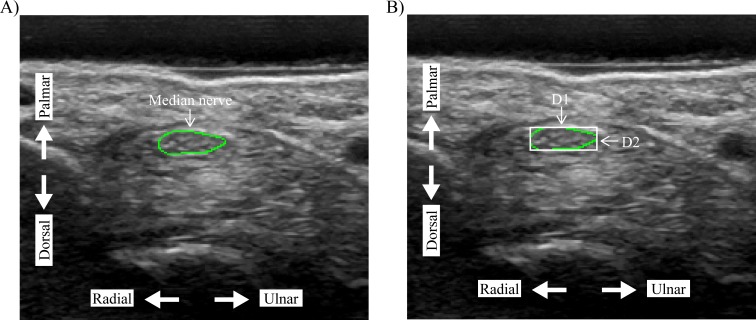
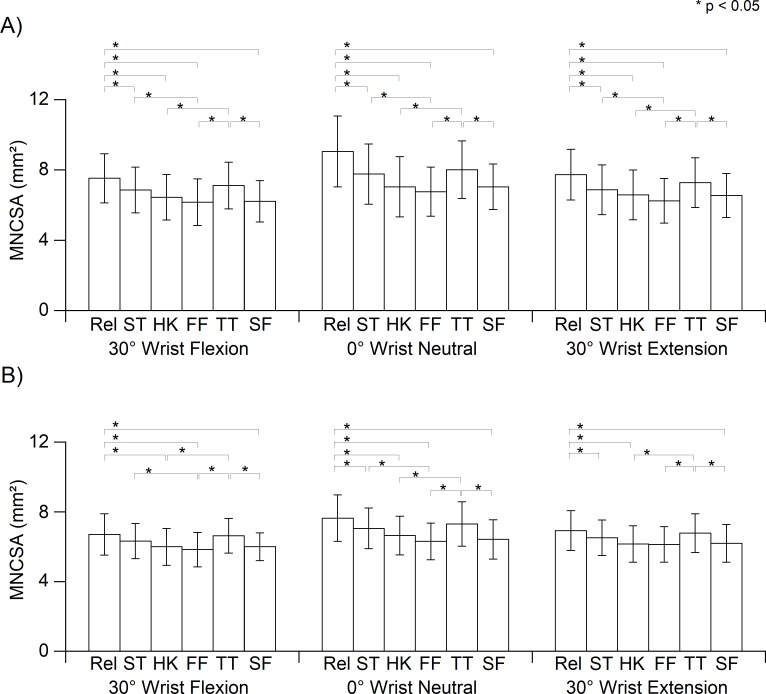
The objective of this study was to evaluate the changes of the median nerve cross-sectional area (MNCSA) and diameters of the median nerve at different finger postures and wrist angles.
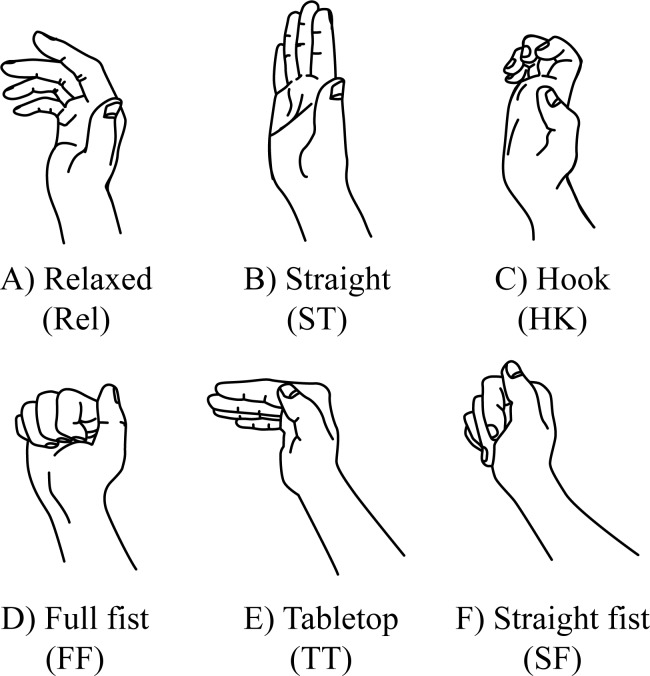
Twenty-five healthy male participants were recruited in this study. The median nerve at wrist crease was examined at six finger postures, and repeated with the wrist in 30° flexion, neutral (0°), and 30° extension. The six finger postures are relaxed, straight finger, hook, full fist, tabletop, and straight fist.
The main effects of both finger postures and wrist angles are significant ( < 0.05) on changes of the MNCSA. Different finger tendon gliding postures cause a change in the MNCSA. Furthermore, wrist flexion and extension cause higher deformation of the MNCSA at different finger postures.
The median nerve parameters such as MNCSA and diameter were altered by a change in wrist angle and finger posture. The results may help to understand the direct biomechanical stresses on the median nerve by different wrist-finger activities.
本研究的目的是评估在不同手指姿势和腕关节角度下正中神经横截面积(MNCSA)和直径的变化。
本研究招募了25名健康男性参与者。在六种手指姿势下检查腕横纹处的正中神经,并在腕关节屈曲30°、中立位(0°)和伸展30°时重复检查。六种手指姿势分别为放松、直指、钩指、全握拳、桌面位和直拳。
手指姿势和腕关节角度对MNCSA变化的主效应均具有显著性(P<0.05)。不同的手指肌腱滑动姿势会导致MNCSA发生变化。此外,在不同手指姿势下,腕关节的屈曲和伸展导致MNCSA的变形更大。
MNCSA和直径等正中神经参数会因腕关节角度和手指姿势的改变而改变。这些结果可能有助于理解不同腕指活动对正中神经的直接生物力学应力。