Department of Psychiatry and Behavioral Sciences, Emory University School of Medicine.
Department of Psychology and the Neuroscience Institute, Georgia State University.
Emotion. 2019 Aug;19(5):863-875. doi: 10.1037/emo0000466. Epub 2018 Aug 20.
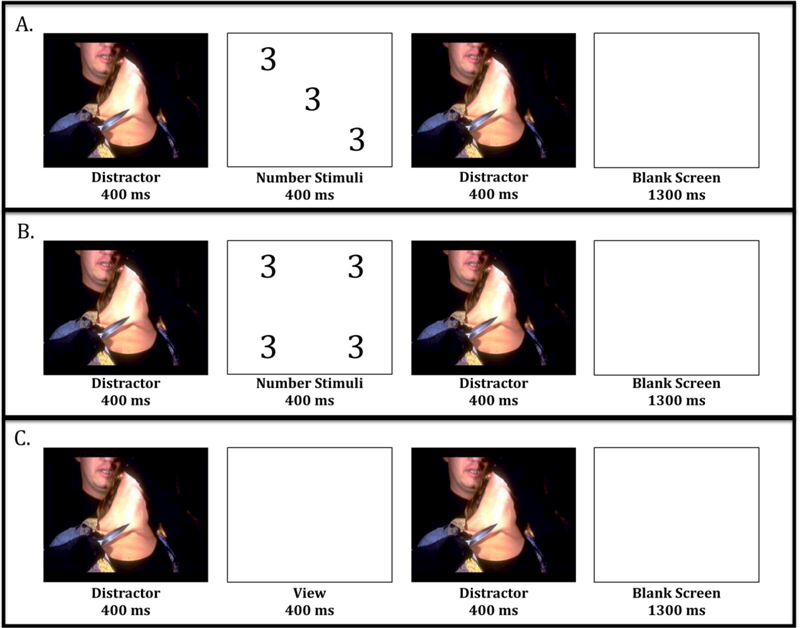
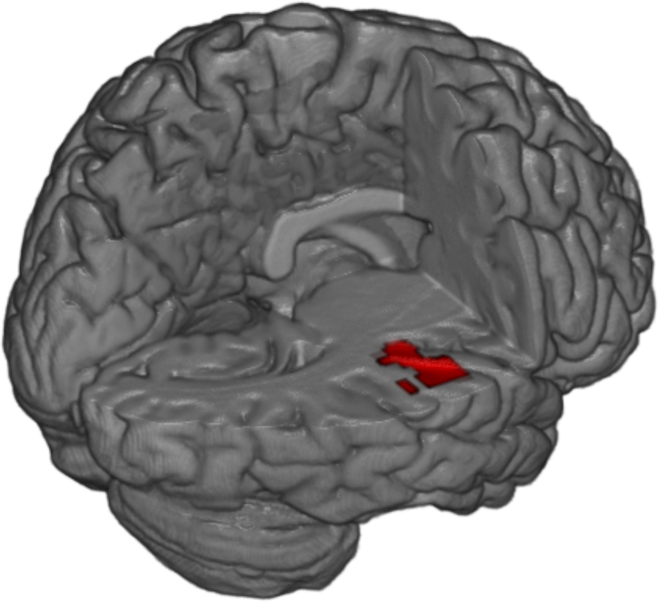
Dissociative phenomena are frequently experienced by psychologically traumatized people. However, little is known about the cognitive profiles of highly dissociative traumatized individuals, and corresponding patterns of neural connectivity when attentional networks are engaged in the context of emotion. One hundred seventeen traumatized women completed the multiscale dissociation inventory (MDI) and neuropsychological testing; MDI scores were used to classify high- and low-dissociative participants. Forty-six participants also underwent fMRI during performance of an attentional control task that incorporates emotionally distracting images (Affective Number Stroop; ANS). Compared to low-dissociative participants, high-dissociative participants demonstrated better performance on an executive functioning task (F1,111 = 4.64, p = .03), worse performance on a task of visual memory (F1,111 = 9.52, p = .003), and similar performance on all other neuropsychological measures. In addition, dissociative symptoms were negatively correlated with functional connectivity between the amygdala and right anterior insula in response to trauma-related ANS trials. These findings indicate that highly dissociative traumatized people experience difficulties with attentional control in the context of emotionally evocative stimuli, but in a neutral context, their overall cognitive profiles are similar to low-dissociative people. Highly dissociative participants also demonstrated weaker connectivity between the amygdala and insula in response to trauma-relevant images. Evocative, trauma-relevant stimuli appear to disrupt neutral networks involved with attention to salient cues and interoception in highly dissociative traumatized individuals. (PsycINFO Database Record (c) 2019 APA, all rights reserved).
分离现象经常发生在心理受创的人群中。然而,对于高度分离的创伤人群的认知特征,以及在情绪背景下注意力网络参与时相应的神经连接模式,人们知之甚少。117 名创伤女性完成了多尺度分离量表(MDI)和神经心理学测试;MDI 分数用于将高分离组和低分离组参与者进行分类。46 名参与者还在执行注意力控制任务时接受了 fMRI 检查,该任务结合了情感分散图像(情感数字斯特鲁普;ANS)。与低分离组参与者相比,高分离组参与者在执行功能任务(F1,111 = 4.64,p =.03)上表现更好,在视觉记忆任务(F1,111 = 9.52,p =.003)上表现更差,而在所有其他神经心理学测试上的表现则相似。此外,分离症状与杏仁核和右侧前岛叶之间的功能连接呈负相关,而这种功能连接与创伤相关的 ANS 试验有关。这些发现表明,高度分离的创伤人群在情感唤起的刺激背景下注意力控制方面存在困难,但在中性背景下,他们的整体认知特征与低分离人群相似。高分离组参与者在对创伤相关图像的反应中,杏仁核和岛叶之间的连接也较弱。唤起性、与创伤相关的刺激似乎会破坏高度分离的创伤人群中与注意力和内感受相关的中性网络。(PsycINFO 数据库记录(c)2019 APA,保留所有权利)。