Anderson Emily E, Wilson Cara, Knap Anthony H, Villareal Tracy A
Department of Marine Science and Marine Science Institute, The University of Texas at Austin, Port Aransas, TX, USA.
National Marine Fisheries, National Oceanic and Atmospheric Administration, Monterey, CA, USA.
PeerJ. 2018 Aug 15;6:e5387. doi: 10.7717/peerj.5387. eCollection 2018.
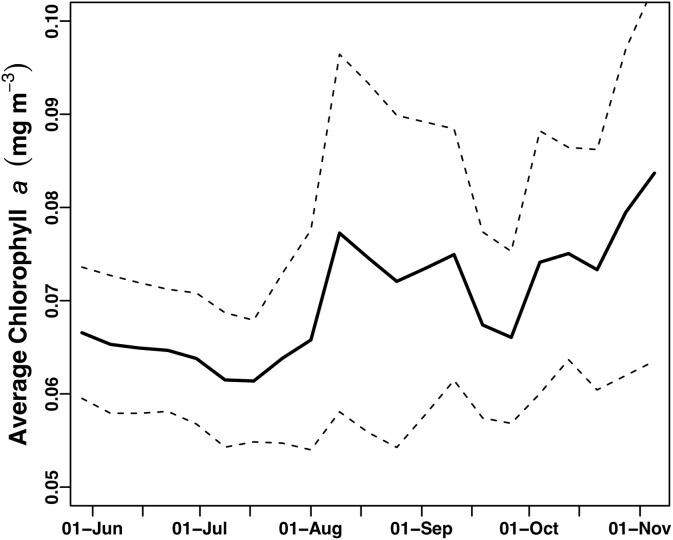
Satellite chlorophyll (chl ) observations have repeatedly noted summertime phytoplankton blooms in the North Pacific subtropical gyre (NPSG), a region of open ocean that is far removed from any land-derived or Ekman upwelling nutrient sources. These blooms are dominated by N-fixing diatom-cyanobacteria associations of the diatom genera Brightwell and Ehrenberg. Their nitrogen fixing endosymbiont, J.A. Schmidt, is hypothesized to be critical to the development of blooms in this nitrogen limited region. However, due to the remote location and unpredictable duration of the summer blooms, prolonged in situ observations are rare outside of the Station ALOHA time-series off of Hawai'i. In summer, 2015, a proof-of-concept mission using the autonomous vehicle, (Wave Glider SV2; Liquid Robotics, a Boeing company, Sunnyvale, CA, USA), collected near-surface (<20 m) observations in the NPSG using hydrographic, meteorological, optical, and imaging sensors designed to focus on phytoplankton abundance, distribution, and physiology of this bloom-forming region. and cell abundance was determined using digital holography for the entire June-November mission. was not able to reach the 30°N subtropical front region where most of the satellite chl blooms have been observed, but near-real time navigational control allowed it to transect two blooms near 25°N. The two taxa did not co-occur in large numbers, rather the blooms were dominated by either or . The August 2-4, 2015 bloom was comprised of 96% and the second bloom, August 15-17, 2015, was dominated by (75%). The holograms also imaged undisturbed, fragile aggregates throughout the sampled area at ∼10 L. Aggregated represented the entire observed population at times and had a widespread distribution independent of the summer export pulse, a dominant annual event suggested to be mediated by aggregate fluxes. Aggregate occurrence was not consistent with a density dependent formation mechanism and may represent a natural growth form in undisturbed conditions. The photosynthetic potential index (F:F) increased from ∼0.4 to ∼0.6 during both blooms indicating a robust, active phytoplankton community in the blooms. The diel pattern of F:F (nocturnal maximum; diurnal minimum) was consistent with macronutrient limitation throughout the mission with no evidence of Fe-limitation despite the presence of nitrogen fixing diatom-diazotroph assemblages. During the 5-month mission, covered ∼5,690 km (3,070 nautical miles), acquired 9,336 holograms, and reliably transmitted data onshore in near real-time. Software issues developed with the active fluorescence sensor that terminated measurements in early September. Although images were still useful at the end of the mission, fouling of the LISST-Holo optics was considerable, and appeared to be the most significant issue facing deployments of this duration.

卫星叶绿素(chl)观测多次记录到北太平洋亚热带环流(NPSG)夏季出现浮游植物水华,该开阔海域远离任何陆地来源或埃克曼上升流营养源。这些水华主要由硅藻属Brightwell和Ehrenberg的固氮硅藻 - 蓝细菌组合主导。它们的固氮内共生体J.A. Schmidt被认为对这个氮限制区域水华的发展至关重要。然而,由于夏季水华位置偏远且持续时间不可预测,除了夏威夷附近的ALOHA站时间序列外,很少有长时间的原位观测。2015年夏季,一项使用自主航行器(Wave Glider SV2;Liquid Robotics,波音公司,美国加利福尼亚州桑尼维尔)的概念验证任务,利用水文、气象、光学和成像传感器在NPSG收集了近表层(<20米)观测数据,这些传感器旨在聚焦于这个形成水华区域的浮游植物丰度、分布和生理状况。在整个6月至11月的任务期间,使用数字全息术确定了细胞丰度。该航行器未能到达观测到大部分卫星chl水华的北纬30°亚热带锋区,但近实时导航控制使其能够在北纬25°附近穿过两次水华。这两个分类群并未大量同时出现,相反,水华主要由其中一种或另一种主导。2015年8月2 - 4日的水华由96%的[具体物种1]组成,第二次水华,即2015年8月15 - 17日,主要由[具体物种2](75%)主导。全息图还在整个采样区域以约10升的规模成像了未受干扰的、脆弱的[具体物种]聚集体。有时聚集体中的[具体物种]代表了整个观测群体,并且具有广泛分布,与夏季输出脉冲无关,夏季输出脉冲是一个主要的年度事件,据认为是由聚集体通量介导的。聚集体的出现与密度依赖性形成机制不一致,可能代表了未受干扰条件下的一种自然生长形式。在两次水华期间,光合潜力指数(F:F)从约0.4增加到约0.6,表明水华中浮游植物群落活跃且强健。F:F的日变化模式(夜间最大值;白天最小值)在整个任务期间与大量营养素限制一致,尽管存在固氮硅藻 - 固氮菌组合,但没有铁限制的证据。在为期5个月的任务中,该航行器覆盖了约5690公里(3070海里),获取了9336张全息图,并将近实时数据可靠地传输到岸上。有源荧光传感器出现软件问题,于9月初终止了测量。尽管在任务结束时图像仍然有用,但LISST - Holo光学器件的污染相当严重,这似乎是这种持续时间部署面临的最重大问题。