Department of Neurology, Linkou Chang Gung Memorial Hospital, Taoyuan, Taiwan; College of Medicine, Chang Gung University, Taiwan.
Department of Neurology, Linkou Chang Gung Memorial Hospital, Taoyuan, Taiwan; College of Medicine, Chang Gung University, Taiwan.
Neuroimage Clin. 2018 Aug 9;20:476-484. doi: 10.1016/j.nicl.2018.08.011. eCollection 2018.
Neural disruption and cognitive impairment have been reported in patients with carotid stenosis (CS), but carotid artery stenting (CAS) may not contribute to the cognitive recovery. Although functional hyper-connectivity is one of the physiological over-compensation phenomena in neurological diseases, the literature on the cognitive influence of functional hyper-connectivity in CS patients is limited. We aimed to investigate the longitudinal changes of hyper-connectivity after CAS and its association with cognition in CS patients.
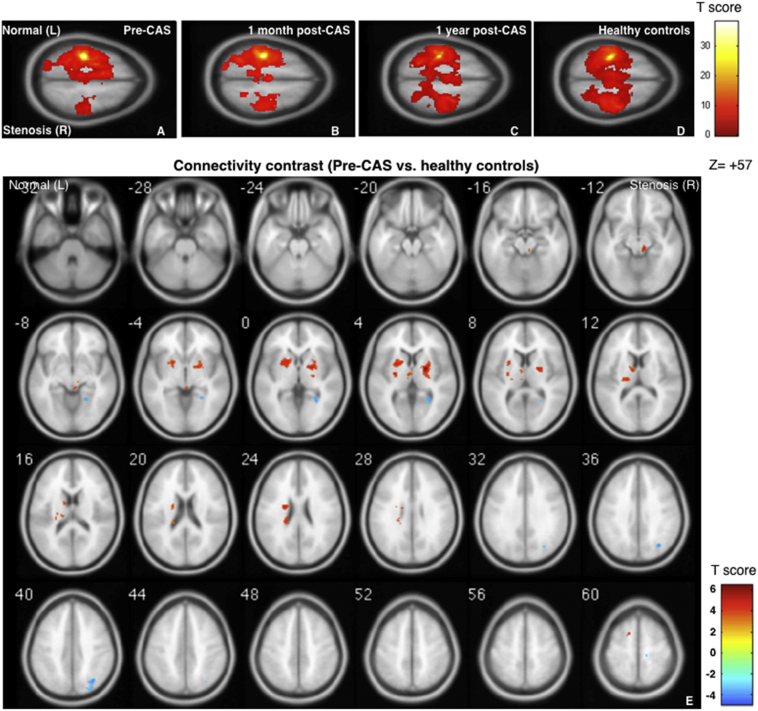
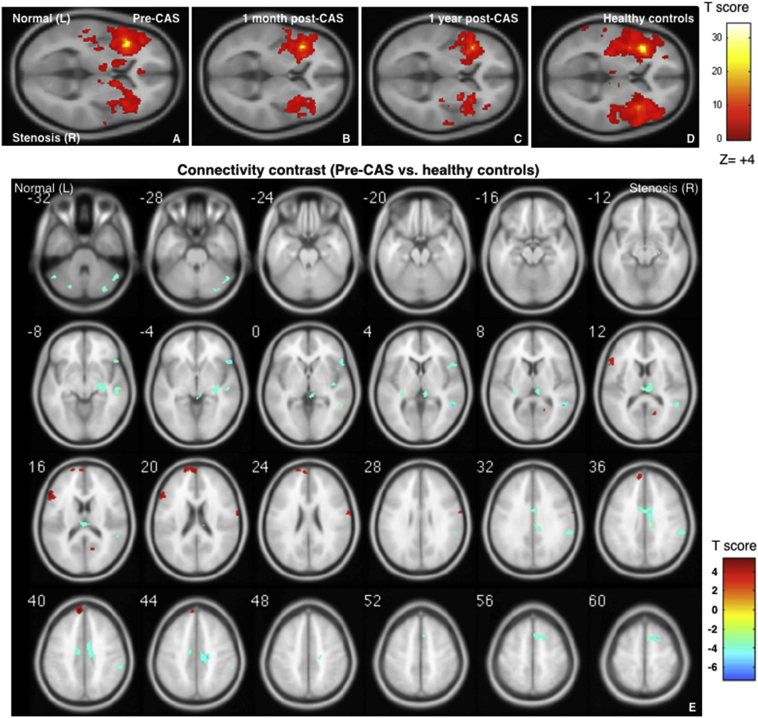
Thirteen patients with unilateral CS and 17 controls without CS were included. Cognitive function was evaluated at baseline, and resting-state functional MRI was performed 1 week before and 1 month and 1 year after CAS. Comparisons of functional connectivity (FC) between CS patients and controls in multiple brain networks were performed.
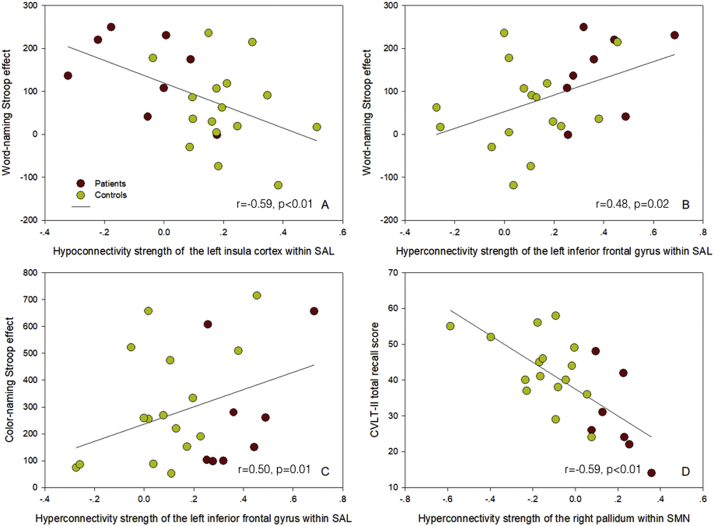
In patients before CAS, FC in the cerebral hemispheres ipsilateral and contralateral to CS was mainly decreased and increased, respectively, compared with normal controls. Part of the FC alterations gradually recovered to the normal condition after CAS. The stronger FC abnormality (both hypo- and hyper-connectivity compared with normal controls) was associated with poorer cognitive performances, especially in memory and executive functions.
The study demonstrated the lateralization of hyper-connectivity and hypo-connectivity in patients with unilateral CS in contrast to the FC in normal controls. These FC alterations were associated with poor cognitive performances and tended to recover after CAS, implying that hyper-connectivity is served as a compensation for neural challenge.
已有研究报道颈动脉狭窄(CS)患者存在神经功能障碍和认知损伤,但颈动脉支架置入术(CAS)可能不会影响认知恢复。虽然功能过度连接是神经科疾病的一种生理代偿现象,但关于 CS 患者功能过度连接对认知影响的文献有限。我们旨在研究 CAS 后过度连接的纵向变化及其与 CS 患者认知的关系。
纳入 13 例单侧 CS 患者和 17 例无 CS 的对照者。在基线时评估认知功能,并在 CAS 前 1 周、CAS 后 1 个月和 1 年进行静息态功能磁共振成像。比较 CS 患者与对照组在多个脑网络中的功能连接(FC)。
在 CAS 前的患者中,与正常对照组相比,CS 同侧和对侧大脑半球的 FC 主要降低和增加。部分 FC 改变在 CAS 后逐渐恢复到正常状态。与正常对照组相比,FC 异常(包括过度连接和连接不足)越强,认知表现越差,尤其是记忆和执行功能。
本研究表明,与正常对照组相比,单侧 CS 患者存在功能过度连接和连接不足的偏侧化。这些 FC 改变与认知表现较差有关,且在 CAS 后趋于恢复,提示过度连接可能是神经挑战的代偿。