School of Earth and Environmental Sciences, The University of Manchester, Oxford Road, Manchester, M13 9PT, United Kingdom.
NERC Centre for Ecology & Hydrology, Wallingford, OX10 8BB, United Kingdom.
Ecology. 2018 Oct;99(10):2260-2271. doi: 10.1002/ecy.2437. Epub 2018 Aug 20.
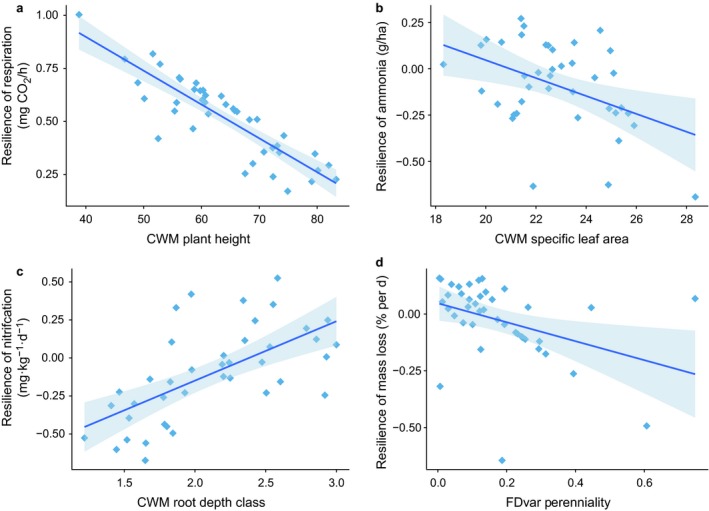
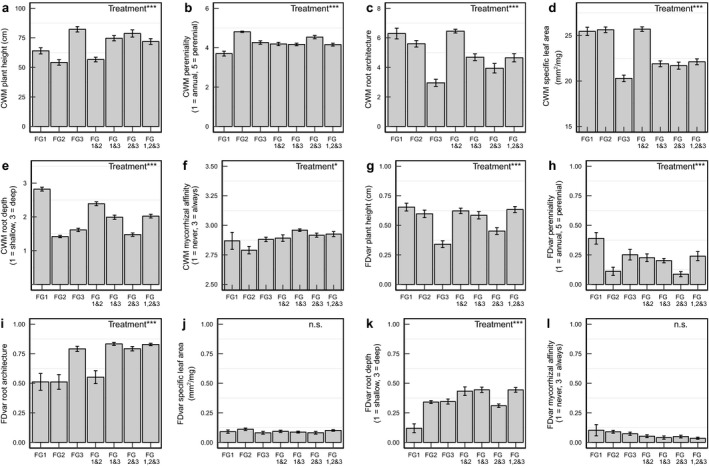
It is increasingly recognized that belowground responses to vegetation change are closely linked to plant functional traits. However, our understanding is limited concerning the relative importance of different plant traits for soil functions and of the mechanisms by which traits influence soil properties in the real world. Here we test the hypothesis that taller species, or those with complex rooting structures, are associated with high rates of nutrient and carbon (C) cycling in grassland. We further hypothesized that communities dominated by species with deeper roots may be more resilient to drought. These hypotheses were tested in a 3-yr grassland restoration experiment on degraded ex-arable land in southern England. We sowed three trait-based plant functional groups, assembled using database derived values of plant traits, and their combinations into bare soil. This formed a range of plant trait syndromes onto which we superimposed a simulated drought 2 yr after initial establishment. We found strong evidence that community weighted mean (CWM) of plant height is negatively associated with soil nitrogen cycling and availability and soil multifunctionality. We propose that this was due to an exploitative resource capture strategy that was inappropriate in shallow chalk soils. Further, complexity of root architecture was positively related to soil multifunctionality throughout the season, with fine fibrous roots being associated with greater rates of nutrient cycling. Drought resistance of soil functions including ecosystem respiration, mineralization, and nitrification were positively related to functional divergence of rooting depth, indicating that, in shallow chalk soils, a range of water capture strategies is necessary to maintain functions. Finally, after 3 yr of the experiment, we did not detect any links between the plant traits and microbial communities, supporting the finding that traits based on plant structure and resource foraging capacity are the main variables driving soil function in the early years of grassland conversion. We suggest that screening recently restored grassland communities for potential soil multifunctionality and drought resilience may be possible based on rooting architecture and plant height. These results indicate that informed assembly of plant communities based on plant traits could aid in the restoration of functioning in degraded soil.
人们越来越认识到,植被变化对地下的反应与植物功能特征密切相关。然而,我们对于不同植物特征对土壤功能的相对重要性以及这些特征在现实世界中影响土壤特性的机制的了解是有限的。在这里,我们检验了这样一个假设,即较高的物种,或具有复杂根系结构的物种,与草原中养分和碳(C)循环的高速度有关。我们进一步假设,以具有更深根系的物种为主的群落可能对干旱更具弹性。这些假设在英格兰南部退化耕地的 3 年草地恢复实验中得到了检验。我们播种了三个基于特征的植物功能群,这些功能群是使用数据库中推导的植物特征值组装而成的,然后将它们及其组合播种到裸露的土壤中。这形成了一系列植物特征综合征,我们在初始建立后 2 年模拟了干旱,并将其叠加在这些综合征上。我们有强有力的证据表明,植物高度的群落加权平均值(CWM)与土壤氮循环和有效性以及土壤多功能性呈负相关。我们认为这是由于在浅层白垩土中,一种掠夺性的资源获取策略是不合适的。此外,根系结构的复杂性与整个季节的土壤多功能性呈正相关,细纤维根与养分循环的速度较快有关。包括生态系统呼吸、矿化和硝化作用在内的土壤功能的抗旱能力与根系深度功能的差异呈正相关,表明在浅层白垩土中,需要一系列的水分获取策略来维持功能。最后,在实验进行 3 年后,我们没有发现植物特征与微生物群落之间存在任何联系,这支持了这样一种发现,即基于植物结构和资源觅食能力的特征是草原转化早期驱动土壤功能的主要变量。我们建议,基于根系结构和植物高度,对最近恢复的草地群落进行土壤多功能性和抗旱性的筛选,可能是可行的。这些结果表明,基于植物特征对植物群落进行明智的组合,可以有助于恢复退化土壤的功能。