Department of Psychology, University of Utah, Salt Lake City, UT
Psychological Sciences and Health Sciences Research Institute, University of California, Merced, Merced, CA.
Diabetes Care. 2018 Nov;41(11):2281-2288. doi: 10.2337/dc18-0351. Epub 2018 Aug 21.
The objective of this study was to examine ) whether teens' glycemic control and adherence to type 1 diabetes treatment regimen worsen during the transition from late adolescence to emerging adulthood, and ) whether teens' executive function (EF), as measured by performance and self-reported problems with EF, is predictive of these changes (after controlling for general intelligence).
High school seniors with type 1 diabetes ( = 236; mean age 17.74 years) were assessed at three yearly time points. At baseline, during the senior year of high school, participants completed a self-report measure of problems with EF and performance-based measures of EF and general intelligence (IQ). Glycemic control was determined on the basis of results collected from HbA assay kits, and teens reported their adherence at all three time points.
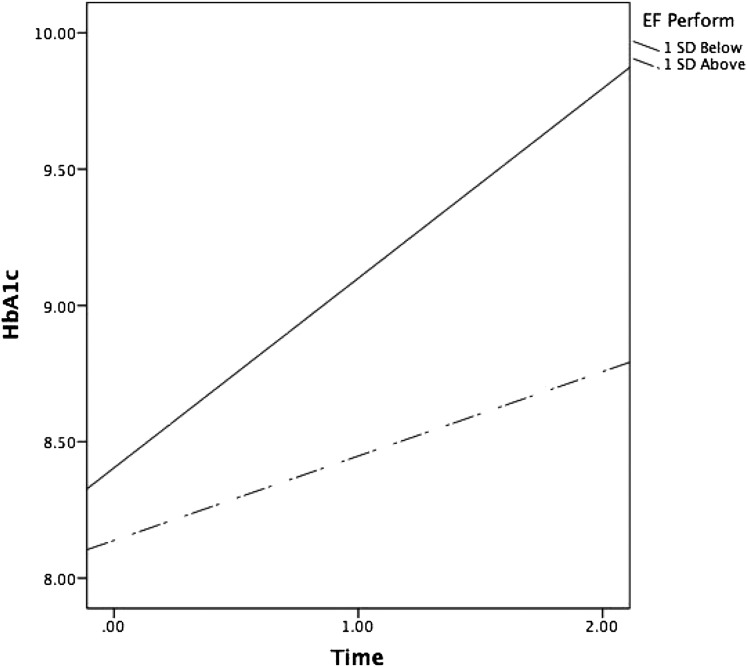
HbA increased significantly across the three time points and adherence declined. EF performance was not associated with adherence or HbA at baseline, nor with changes in adherence over time. However, better EF performance predicted slower increases in HbA over time (i.e., slope) while controlling for IQ. Teens' self-reported problems with EF were associated with worse glycemic control and poorer adherence at baseline (i.e., intercept), but they did not predict changes in either HbA or adherence over time (i.e., slope).
Abilities involved in performance on EF tests may be one resource for maintaining better glycemic control during the transition to emerging adulthood. Assessment of such EF abilities may allow for the identification of individuals who are most at risk for deterioration of glycemic control during this transition.
本研究旨在考察 1) 青少年的血糖控制和 1 型糖尿病治疗方案的依从性是否在从青少年晚期向成年早期过渡期间恶化,以及 2) 青少年的执行功能(EF),通过执行功能的表现和自我报告的问题来衡量,是否可以预测这些变化(在控制一般智力的情况下)。
有 1 型糖尿病的高中生(=236;平均年龄 17.74 岁)在三个年度时间点进行评估。在基线时,即高中高年级,参与者完成了执行功能自我报告问题量表和基于表现的执行功能和一般智力(智商)量表。血糖控制是根据 HbA 检测试剂盒的结果确定的,青少年在所有三个时间点都报告了他们的依从性。
HbA 在三个时间点都显著升高,而依从性下降。EF 表现与依从性或基线时的 HbA 无关,也与随时间变化的依从性无关。然而,更好的 EF 表现预测了 HbA 随时间的较慢增加(即斜率),同时控制了智商。青少年自我报告的执行功能问题与基线时较差的血糖控制和较差的依从性相关(即截距),但它们不能预测 HbA 或依从性随时间的变化(即斜率)。
在向成年早期过渡期间,执行功能测试中的表现所涉及的能力可能是维持更好血糖控制的一种资源。评估这种 EF 能力可能有助于确定在这个过渡期间血糖控制恶化风险最高的个体。