Mizerska-Wasiak Małgorzata, Gajewski Łukasz, Cichoń-Kawa Karolina, Małdyk Jadwiga, Dziedzic-Jankowska Katarzyna, Leszczyńska Beata, Rybi-Szumińska Agnieszka, Wasilewska Anna, Pukajło-Marczyk Agnieszka, Zwolińska Danuta, Bieniaś Beata, Sikora Przemysław, Szczepańska Maria, Stelmaszczyk-Emmel Anna, Górska Elżbieta, Pańczyk-Tomaszewska Małgorzata
Department of Paediatrics and Nephrology, Medical University of Warsaw, Warsaw, Poland.
Student's Scientific Group at the Department of Paediatrics and Nephrology, Medical University of Warsaw, Warsaw, Poland.
Cent Eur J Immunol. 2018;43(2):162-167. doi: 10.5114/ceji.2018.77386. Epub 2018 Jun 30.
GDIgA1 (galactose deficient IgA1) plays a significant role in the pathogenesis of IgA nephropathy (IgAN) and Henoch-Schönlein nephritis (HSN).
The aim of this study was to assess the relevance of serum GDIgA1 level as a prognostic marker in children with IgAN and HSN.
41 children were included to the study group (15 IgAN, 26 HSN) and 22 to the control group. The following parameters were evaluated at baseline and endpoint: proteinuria, erythrocyturia, serum creatinine, serum IgA, GFR. A kidney biopsy was performed in all patients and evaluated according to the Oxford Classification (1 - present, 0 - absent: M - mesangial hypercellularity; E- endocapillary hypercellularity; S - segmental sclerosis/adhesion; T - tubular atrophy/interstitial fibrosis), and was calculated as the total score (sum of M, E, S, T). At the end of follow-up, the serum GDIgA1 concentration was measured.
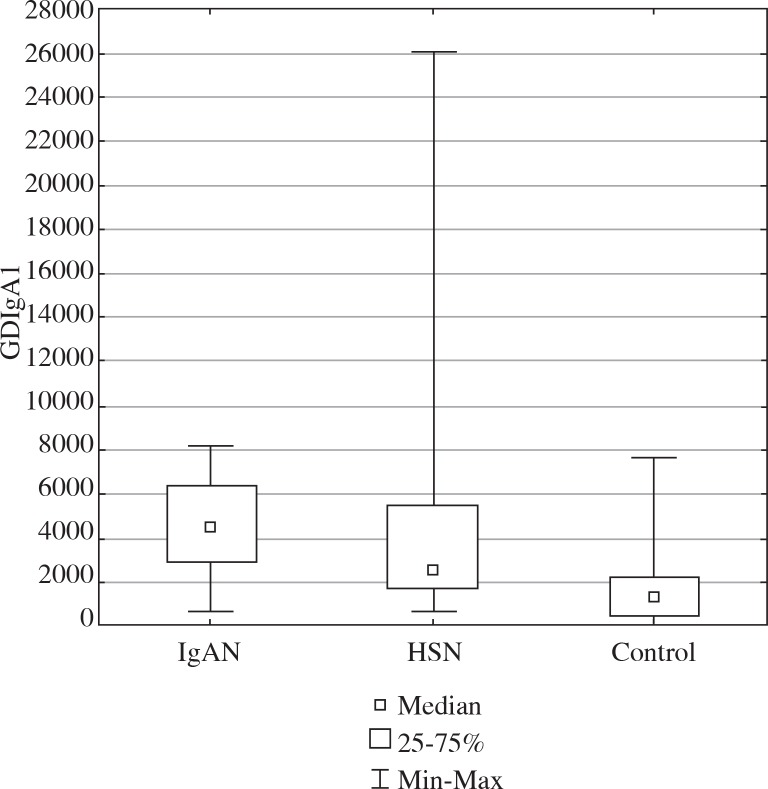
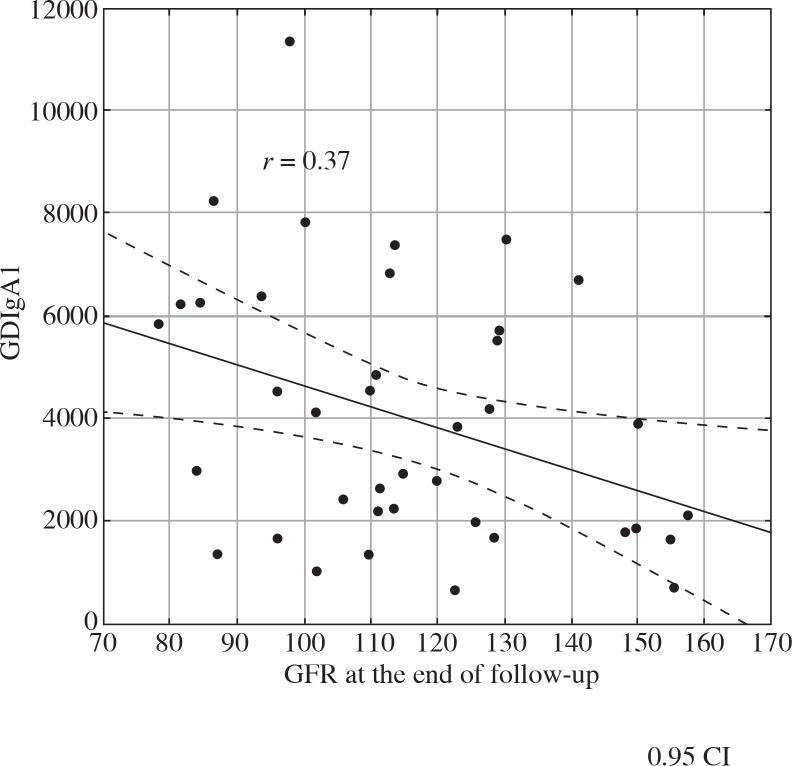
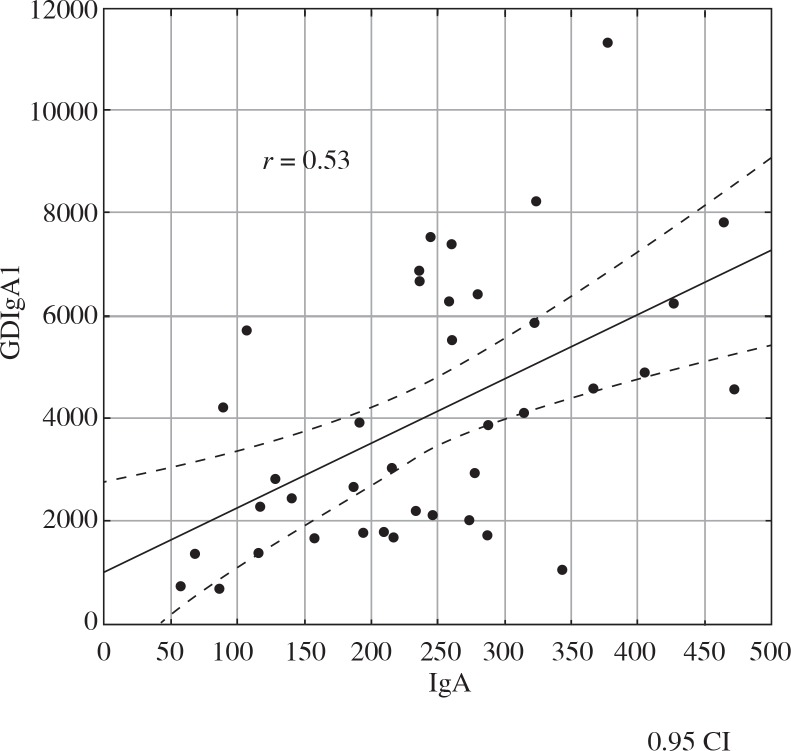
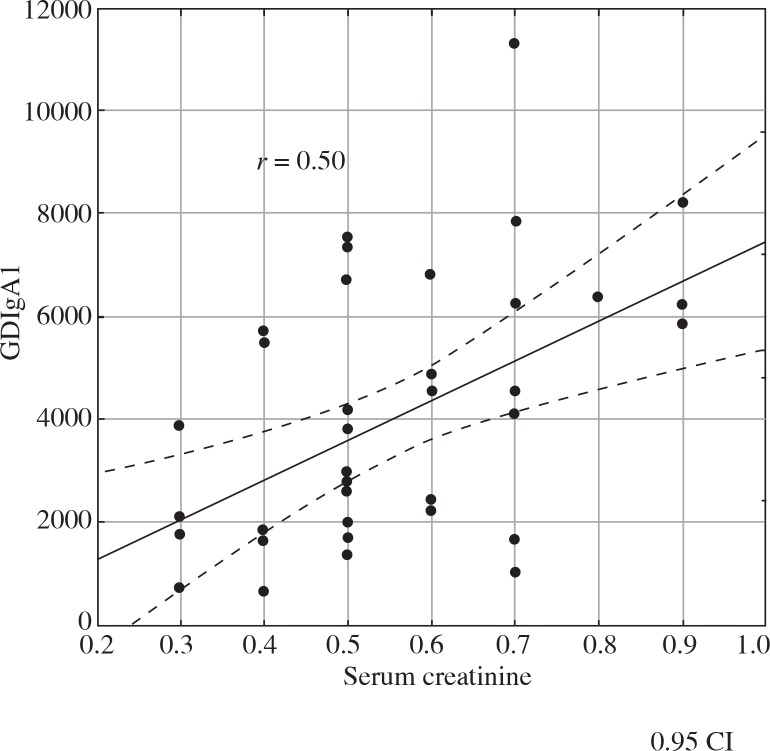
The serum GDIgA1 concentration in patients with IgAN and HSN was significantly higher than in the control group. No significant differences in mean proteinuria, erythrocyturia, GFR, MEST score, or GDIgA1 in serum, as well as the duration of follow-up between IgAN and HSN were observed. Baseline serum IgA concentration and time to kidney biopsy were significantly higher in children with IgAN than in children with HSN. We observed a positive correlation between GDIgA1 and IgA levels (r = 0.53), and GDIgA1 and serum creatinine levels (r = 0.5), as well as negative correlation between GDIgA1 and GFR (r = -0.37).
Serum GDIgA1 level may have a prognostic value in children with IgAN and HSN; however, to fully elucidate its clinical potential further studies performed in larger patient cohorts are required.
半乳糖缺陷型IgA1(GDIgA1)在IgA肾病(IgAN)和过敏性紫癜性肾炎(HSN)的发病机制中起重要作用。
本研究旨在评估血清GDIgA1水平作为IgAN和HSN患儿预后标志物的相关性。
41名儿童被纳入研究组(15例IgAN,26例HSN),22名儿童被纳入对照组。在基线和终点评估以下参数:蛋白尿、红细胞尿、血清肌酐、血清IgA、肾小球滤过率(GFR)。所有患者均进行肾活检,并根据牛津分类法进行评估(1-存在,0-不存在:M-系膜细胞增生;E-毛细血管内细胞增生;S-节段性硬化/粘连;T-肾小管萎缩/间质纤维化),并计算总分(M、E、S、T之和)。随访结束时,测量血清GDIgA1浓度。
IgAN和HSN患者的血清GDIgA1浓度显著高于对照组。未观察到IgAN和HSN之间在平均蛋白尿、红细胞尿、GFR、MEST评分或血清GDIgA1以及随访时间方面存在显著差异。IgAN患儿的基线血清IgA浓度和肾活检时间显著高于HSN患儿。我们观察到GDIgA1与IgA水平之间呈正相关(r = 0.53),GDIgA1与血清肌酐水平之间呈正相关(r = 0.5),以及GDIgA1与GFR之间呈负相关(r = -0.37)。
血清GDIgA1水平可能对IgAN和HSN患儿具有预后价值;然而,要充分阐明其临床潜力,需要在更大的患者队列中进行进一步研究。