Ma Yingxu, Li Dongping, Bai Fan, Qin Fen, Li Jiayi, Li Yixi, Liu Na, Xie Hui, Zhou Shenghua, Liu Qiming
Department of Cardiology Department of Cardiothoracic Surgery, The Second Xiangya Hospital, Central South University, Changsha, Hunan, China.
Medicine (Baltimore). 2018 Aug;97(34):e11965. doi: 10.1097/MD.0000000000011965.
It was under debate whether cryptogenic stroke patients benefited from patent foramen ovale (PFO) closure. We sought to determine secondary prevention strategy in these patients.
Scientific databases were searched for randomized controlled trials enrolling cryptogenic stroke patients with PFO who underwent PFO closure or medical therapy. The random-effect model was used to analyze the outcomes.
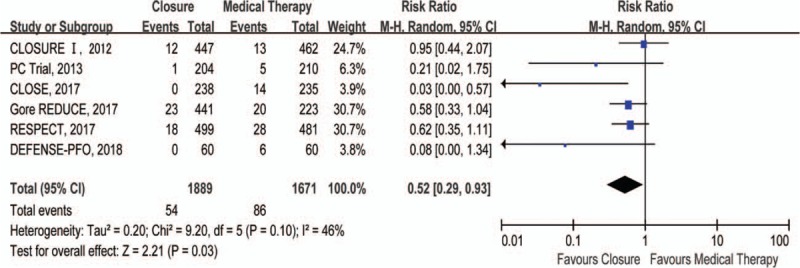
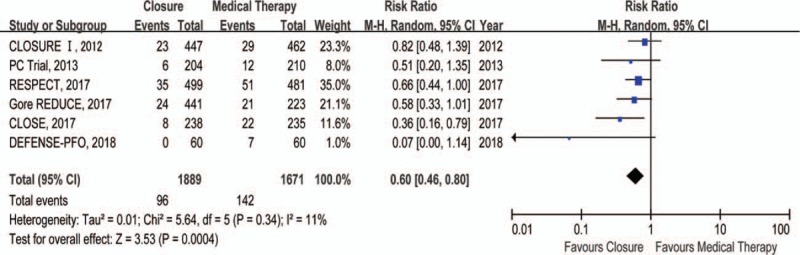
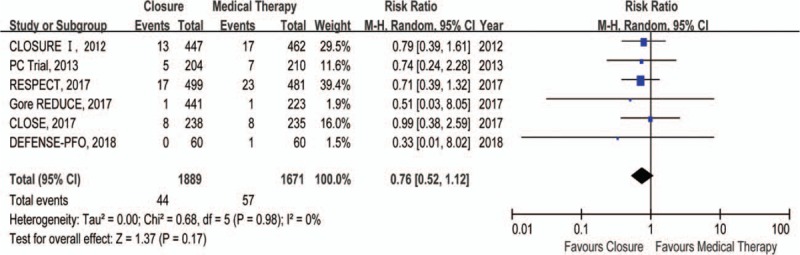
We identified 6 trials enrolling 3630 participants in this meta-analysis. When compared with medical therapy, PFO closure reduced risks of recurrent stroke (risk ratio [RR] 0.52, 95% confidence interval [CI] 0.29-0.93) and composite of stroke and transient ischemic attack (TIA) (RR 0.60, 95% CI 0.46-0.80). And no differences in all-cause death (RR 0.80, 95% CI 0.37-1.72) and cardiovascular death (RR 1.47, 95% CI 0.36-5.94) between 2 groups were observed. The risks of major bleeding (RR 0.96, 95% CI 0.47-1.96) and any serious adverse event (RR 1.03, 95% CI 0.92-1.16) did not differ between 2 groups. Yet, PFO closure increased risk of atrial fibrillation (RR 4.25, 95% CI 2.10-8.60).
PFO closure, as compared with medical therapy, was associated with decreased risk of recurrent stroke and increased risk of atrial fibrillation in cryptogenic stroke patients with PFO.
隐源性卒中患者是否能从卵圆孔未闭(PFO)封堵术中获益仍存在争议。我们试图确定这些患者的二级预防策略。
检索科学数据库,查找纳入接受PFO封堵术或药物治疗的隐源性卒中合并PFO患者的随机对照试验。采用随机效应模型分析结果。
在这项荟萃分析中,我们确定了6项试验,共纳入3630名参与者。与药物治疗相比,PFO封堵术降低了复发性卒中风险(风险比[RR]0.52,95%置信区间[CI]0.29 - 0.93)以及卒中与短暂性脑缺血发作(TIA)的复合风险(RR 0.60,95% CI 0.46 - 0.80)。两组间全因死亡(RR 0.80,95% CI 0.37 - 1.72)和心血管死亡(RR 1.47,95% CI 0.36 - 5.94)无差异。两组间大出血风险(RR 0.96,95% CI 0.47 - 1.96)和任何严重不良事件风险(RR 1.03,95% CI 0.92 - 1.16)无差异。然而,PFO封堵术增加了房颤风险(RR 4.25,95% CI 2.10 - 8.60)。
与药物治疗相比,PFO封堵术可降低合并PFO的隐源性卒中患者的复发性卒中风险,但会增加房颤风险。